Hotel
CastleBaden-Baden
Bühlerhöhe Castle
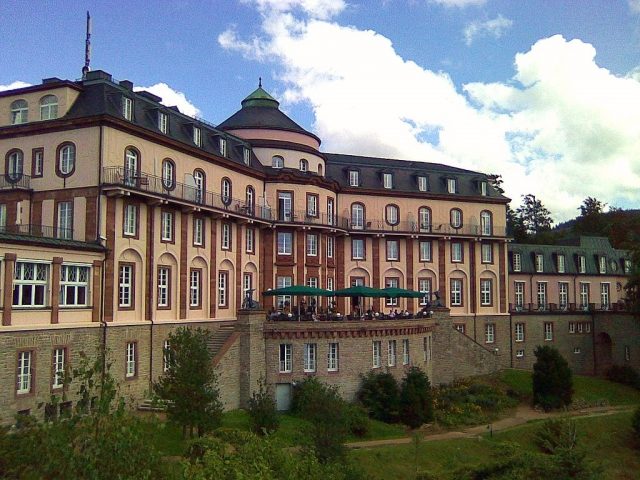
Bühlerhöhe was built starting in 1912 as an officer's convalescent home according to plans by architect Wilhelm Kreis on the Kohlbergfelsen at an altitude of 770 meters above the town of Bühl in the Northern Black Forest. Bühlerhöhe was never used for its original purpose, but served as a hotel from 1920 to 2010.
The client for the officer's convalescent home was Hertha Isenbart (1871–1918), the daughter of the Jewish merchant Julius Schottländer. She was married to the much older banker Pringsheim and met Major General Wilhelm Isenbart, who was also married, around the turn of the century. Both divorced their first spouses and married. Marriage to a divorced partner was a scandal at the time. Hertha's family disinherited their daughter and settled her with a substantial compulsory portion of more than twelve million gold marks; her husband soon had to resign from service.
The sudden death of her husband on November 30, 1908, in Egypt was the turning point in Hertha Isenbart's life. The widow henceforth lived only for the goal of erecting a monument to her husband in the form of an officer's convalescent home. This was to be gifted to German Emperor Wilhelm II. She acquired 18 hectares of forest in the Kohlbergfelsen area from the city of Bühl.
Construction began in 1912 and was largely completed at the beginning of the First World War. Due to financing problems, the original concept was reduced by Curt Karl Rüschhoff (1887–1969) and Hans Woltmann, two employees of Wilhelm Kreis. The final completion of the house was delayed due to the war. Bühlerhöhe never fulfilled its purpose as an officer's convalescent home. Herta Isenbart committed suicide in 1918.
In 1920, the building was sold to private investors and from 1921 was converted into a spa house by architect Wilhelm Rutsch from Freiburg.
A frequent guest in the house was Konrad Adenauer, in whose honor a memorial plaque is placed in the hotel park and after whom a suite of the hotel was named.
1986 to 2010
In 1986, industrialist Max Grundig acquired the spa house, which had fallen into economic difficulties, and had it expanded into a luxury hotel for 150 million D-Mark by 1988 according to plans by architect Henner Hoos and interior designer Jan Wichers.
After being briefly owned by the Rafael Group, Dietmar Hopp acquired the hotel in 1999. From 2002 to 2010, the Spanish hotel chain NH operated the hotel. During the 2006 FIFA World Cup, the English national team used the castle hotel as their team hotel.
Since 2010
In July 2010, Hopp sold the hotel to Anna Maria Vermögensverwaltung GmbH, founded specifically for this purchase, behind which stands a Ukrainian investor. The company planned to extensively renovate the hotel after its closure at the end of August 2010 and reopen it in 2013 with a new concept.
However, the investors did not begin with the renovation. In early June 2013, it became known that unpaid operating cost bills amounting to several tens of thousands of euros had accumulated, and electricity and telephone connections had been cut off. In the same month, two companies co-owned by Dietmar Hopp filed for insolvency against the new owners; part of the purchase price had not yet been settled.
On August 23, hotel operations resumed until early November. At the end of August, the Ukrainian investor let the payment deadline pass. This opened the insolvency proceedings.
Building Description+
Bühlerhöhe is located at an altitude of 770 meters below the Schwarzwaldhochstraße, built only in 1930, on a mountain spur with a view of the Rhine Valley. Wilhelm Kreis adapted the building to the topography and let it culminate with a free-standing observation tower on the tip of the mountain spur. The main building is a three-story solid construction with a mansard hip roof. Its two wings, each 27 meters long, which are arranged at an obtuse angle to each other, are connected by a four-story circular building crowned with a conical roof. Each of these sections has five axes on the valley side, framed by pilasters.
The valley side is the actual main facade of the castle. The first and second floors are combined in a colossal order by a ashlar structure of pilasters framing the window axes, with a crowning floor cornice. Between the pilasters, stucco elements define the appearance; the rectangular wooden sash windows of the ground floor have framing blind arches, the second floor has lower wooden sash windows with frames, the third floor is designed with a relief-like, geometric stucco structure with oval windows. The round tower protrudes from the facade on the valley side like a risalit; its ground floor contains three doors, otherwise the structure corresponds to that of the side wings.
In contrast to the neo-baroque castle architecture of the valley side is the inner courtyard area, which Kreis designed with motifs from fortress and castle construction. The courtyard side of the main building is asymmetrically structured. The axis of symmetry of the castle facade on the valley side does not continue here, but bends to the right, i.e., in a southeast direction, for topographical reasons. This results in a two-part courtyard of honor on the mountain side. This courtyard of honor, framed by lower wings, consists of two approximately square courtyards on different levels. Each section of the main building is thus assigned a courtyard. In front of the central circular building in the center of the two-winged main building, a mighty neoclassical main portal, typical of fortresses, protrudes in the axis of the access road.
On the Architecture+
Bühlerhöhe is a late work of Historicism. In its artistic expressiveness and dimensions, the castle is a remarkable representative of its time, symbolizing societal demands like hardly any other building in the state of Baden. The model is Stupinigi Palace near Turin, which Filippo Juvarra built starting in 1729 on behalf of King Victor Amadeus II of Sardinia-Piedmont.
Take Mobile History with you
You are reading this text for free. Premium adds what matters on the road: descriptions read aloud, sites found through your camera, whole regions taken offline.
- Every description, including the ~17,700 Premium sites
- Audio guide: have descriptions read to you on location
- AR finder: see sites through your camera, with distance and bearing
- Unlimited saved sites
14 days free, then from €2.99 a month. Cancel anytime.
Source: Wikipedia · Licence: CC BY-SA 4.0 · Image: http://de.wikipedia.org/wiki/Datei:B%C3%BChlerh%C3%B6he.jpg
This description draws on the facts documented in the linked Wikipedia article; Wikipedia content is licensed under CC BY-SA 4.0. Wording and editing: Mobile History.
Location: 48.6717, 8.2315