The Castle can be visited
Museum
CastleBüdingen
Büdingen Castle
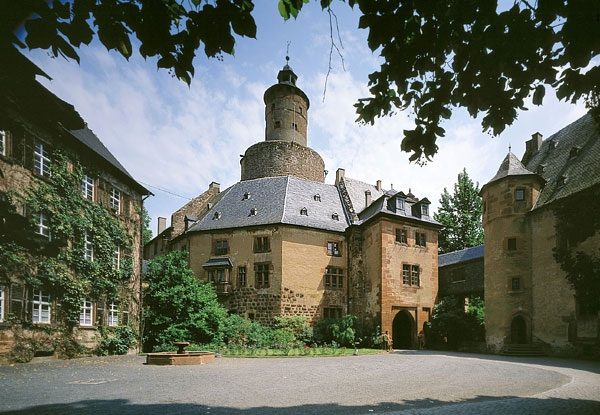
Büdingen Castle dates back to a Staufer water castle from the 12th century, which was expanded over the years into a fortified castle and the residence of the County of Isenburg. It is located in the old town of Büdingen in Hesse, Germany.
Inside the thirteen-sided, almost round ashlar masonry ring from the Staufer period are the main castle, the keep, a Gothic chapel with carved choir stalls, and other buildings. The complex was rebuilt and extended several times over the centuries. The originally existing moat has since silted up. Only a watercourse and an artificial lake behind the castle still hint at its former presence. Directly behind the castle is the large castle park.
The actual core castle is fronted by the outer castle courtyard with the chancellery building and servants' quarters from the 18th century. Access to the actual castle is through the inner gatehouse, also known as the Ludwigsbau.
The mighty two-part keep dates from the second half of the 13th century. This castle tower contains five superimposed vaults, the floor levels thus formed could only be reached from above by means of ladders or a winch. In a document from 1519, the tower is referred to as "Fry Thurn". It is built in the style of a butter-churn tower and is therefore divided into a wider lower tower and a narrower upper tower.
The lower tower has a height of 25.80 m and a diameter of 16.60 m. The height of the upper tower is 9.00 m, the diameter 5.50 m. Both tower parts have a circular floor plan. The inscription on the tower, dated to 1610, reads: "Turris Fortissima Nomen Domini" (The name of the Lord is the strongest tower).
The water castle was built on an island between the arms of the Seemenbach stream to protect the royal hunting ground between Kinzig and Nidder, the Roman Limes, and the high Vogelsberg. The castle was first mentioned in a document in 1219.
The owners of the castle were the Lords of Büdingen, who were first mentioned in a document in 1131. They were also the burgraves of Gelnhausen. The lineage of the Lords of Büdingen died out in the male line with Gerlach II, the first Landvogt in the Wetterau, after 1240 but no later than 1247, and the possessions largely fell to his four sons-in-law from the houses of Breuberg, Hohenlohe, Kempenich, and Trimberg. A part also fell to the rightful heir house of Isenburg with its ancestral seat in "Sayntal" near Koblenz.
Already in the 12th century, the Ysenburgs had possessions in the Wetterau, which they were able to further expand over time through purchase, exchange, and inheritance. They succeeded in acquiring all rights over the Büdingen Forest and the neighboring courts. With the regency of the Lords of Büdingen, a distinct prosperity of the citizens developed. This was particularly promoted by the imperial privilege of Louis the Bavarian, issued on July 26, 1330, to Luther von Ysenburg, allowing a weekly market to be held in Büdingen every Monday and an annual fair once a year.
As a sign of the founding of a new line, however, they wrote their name with "Y" here. The later Counts or Princes of Ysenburg have resided in the castle from the 13th century to the present day.
Legends+
The castle was given to the Lords of Büdingen directly by the Emperor as a fief. According to legend, Emperor Barbarossa gave the land to a charcoal burner in gratitude for saving him. For it happened that the Emperor was on a winter hunt in the Büdingen forests and was separated from his company and got lost. There he met a charcoal burner in the forest, whom he asked for directions. However, the charcoal burner did not dare to address the high lord and instead drew the way in the snow with two of his soot-blackened fingers. The coat of arms of the Büdingen noble family is also derived from this story: a silver (snow-white) shield divided horizontally by two black stripes.
A small legend is told about the gate leading from the outer to the inner castle courtyard. To the left and right, it is guarded by two stone figures with clubs. It is said that they switch sides every night at midnight. However, the phenomenon can only be observed by people who have never lied in their lives.
Current Use+
Büdingen Castle, like many similar buildings, is now used as a museum and accommodation/catering establishment: Guided tours in the castle museum take place daily (except Mondays) at 2:00 PM and 5:00 PM from March to mid-December. The castle hotel offers 26 individually furnished rooms. Reservations are possible online. The castle café and restaurant are open all year round from Wednesday to Sunday.
Albert Einstein visited the museum incognito in 1952 and described Büdingen as an idyll in a letter: "A piece of the Middle Ages shown from its most attractive side."
Take Mobile History with you
You are reading this text for free. Premium adds what matters on the road: descriptions read aloud, sites found through your camera, whole regions taken offline.
- Every description, including the ~17,700 Premium sites
- Audio guide: have descriptions read to you on location
- AR finder: see sites through your camera, with distance and bearing
- Unlimited saved sites
14 days free, then from €2.99 a month. Cancel anytime.
Source: Wikipedia · Licence: CC BY-SA 4.0
This description draws on the facts documented in the linked Wikipedia article; Wikipedia content is licensed under CC BY-SA 4.0. Wording and editing: Mobile History.
Location: 50.2926, 9.1198