Youth welfare office
CastleBuckenhof
Buckenhof Castle
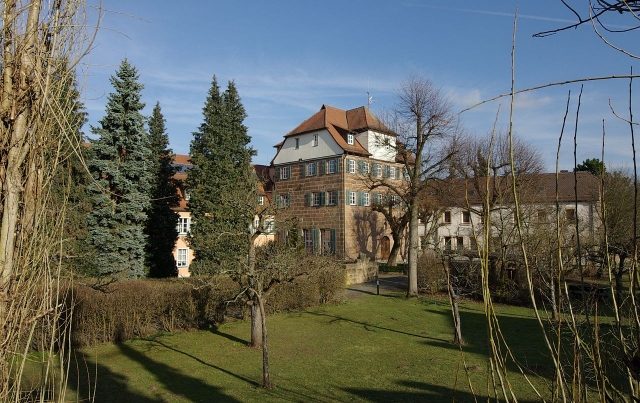
The Buckenhof manor house emerged from an inherited forest holding of the Sebalder Reichswald. Its owner, as a so-called hereditary forester, was enfeoffed with an imperial fief. He enjoyed the rights associated with the property but also had to fulfill the duties of forest service, with the practical forest service being carried out by appointed, so-called "Stockförster" (local foresters). The inherited forest holding appears in documents for the first time in 1372. The hereditary forester and feudal lord was the Nuremberg citizen Hermann Remar/Raymar, who already called himself "von Buckenhof" in 1359. In 1390, Heinrich Remar was the owner. In 1417, Hans Starz acquired the estate from Hans Remar. Due to financial claims against Georg Starz, the inherited forest holding first fell to Irmel Wagner, who sold the estate to Ludwig Haller in 1462. In 1473, it passed to Peter Haller, who was already residing at Buckenhof in 1480.
When the forest estate was sold to Christoph Rothan in 1487, a "stone house" at Buckenhof is mentioned for the first time. In 1501, the seat was documented with walls, a moat, and towers. By this time, it had already been exchanged by Christoph Rothan, also owner of the Reckersdorf estate and the Neumühle near Bruckberg, for the Bruckberg knight's estate. The exchange partner in 1501 was Georg Haller, who repossessed the Buckenhof seat for his family and transferred it to the Georg Haller Foundation in 1505.
The "Haller Seat" at Buckenhof was burned down by margravial troops on May 29, 1552, during the Second Margrave War. Sebald Haller had the manor house restored from 1564 to 1567, with little change to the appearance of the manor house, a residential tower secured with a Zwinger (outer ward) and a moat. It is reported that in connection with the reconstruction planning, two architectural models were made – one for a half-timbered construction and one for the solid construction that was then executed. Integrated into the defensive wall were a defensive tower and the so-called "Kemnath," a habitable tower, which was probably only restored in its lower floors after the fire damage in 1552 and was used on the ground floor as a horse stable and wood storage. In 1615, by which time Tobias Haller had been appointed as administrator of the foundation, a supervisor was to be accommodated here. The manor house had been broken into several times, and the Buckenhofer Voithaus (bailiff's house) was relatively far away in the village. During attacks by imperial troops who ravaged the Nuremberg region from 1631 to 1634, considerable damage was probably suffered. Especially the two wall towers seem to have been damaged on one occasion. A thorough repair of the towers only took place in 1661/62.
In 1737, an old forge was converted into a summer arbor. From 1747 to 1750, a long, two-story residential building, later called the "small castle," was built in the forecourt directly next to the gate by extending the summer arbor from 1737. Probably shortly after 1763, under administrator Christoph Joachim Haller, the manor house was rebuilt. An extension for a new staircase was added to the eastern enclosure, and a kind of garden hall with representative Rococo stucco work was installed in the old ground-floor hall. Also noteworthy is the conversion of a wall tower into a laundry room with a fruit dryer and oven in 1801.
Already in the 1830s, the family foundations having long been legally abolished, a sale of the castle was imminent. An auction to the highest bidder failed in 1842. It was not until 1848 that Sigmund Freiherr Haller von Hallerstein succeeded in selling it to Daniel Beck. Soon after the purchase, the Beck family entered into purchase negotiations with the Erlangen city vicar Julius Schunck and the other initiators of the "Rescue Home for Poor Boys and Girls" of the Inner Mission. Since 1850, the manor house has served as a youth home. The adaptation of the historic building stock to the new use and the renovations carried out repeatedly in the following decades led to the demolition of outbuildings and the two towers, as well as corresponding changes in the manor house. However, a tower stump with the Haller coat of arms remained. In 1922, Friedrich Freiherr von Haller, through a donation, prevented the destruction of the stucco work in the Rococo hall. Several extension buildings for the Protestant youth home were built in the castle courtyard, especially after the Second World War. The hall in the manor house was restored in 1999 under the supervision of monument preservationists.
Take Mobile History with you
You are reading this text for free. Premium adds what matters on the road: descriptions read aloud, sites found through your camera, whole regions taken offline.
- Every description, including the ~17,700 Premium sites
- Audio guide: have descriptions read to you on location
- AR finder: see sites through your camera, with distance and bearing
- Unlimited saved sites
14 days free, then from €2.99 a month. Cancel anytime.
Source: Wikipedia · Licence: CC BY-SA 4.0 · Image: http://commons.wikimedia.org/wiki/File:Buckenhof_Schloss_Puckenhof_001.JPG
This description draws on the facts documented in the linked Wikipedia article; Wikipedia content is licensed under CC BY-SA 4.0. Wording and editing: Mobile History.
Location: 49.5946, 11.0519