Municipal offices
CastleLörrach - Brombach
Brombach Castle
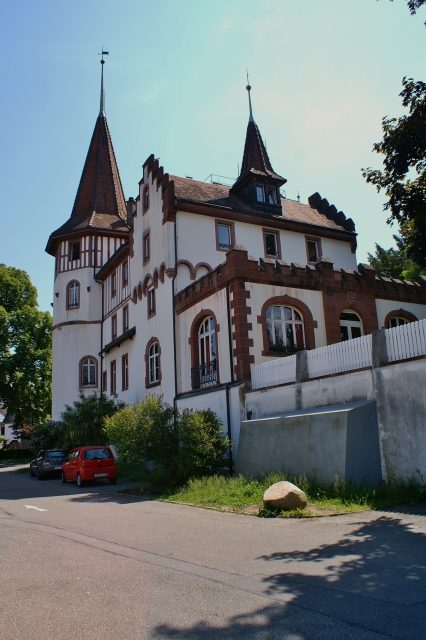
Brombach Castle is a new building, reconstructed in a historicizing style from 1880 to 1885, of an originally medieval castle complex in the Brombach district of Lörrach. A first description of Brombach Castle dates from a deed of ownership from 1294. In 1678, the castle was destroyed by French troops. The small castle, now a protected monument, has been owned by the municipality since 1962 and, after extensive renovation, is used as the town hall.
The Old Water Castle
A description of the old water castle exists, which the local pastor Johann Mulsow created in 1905 based on the ruins recognizable at the time. According to this, it was a rectangular building with a side length of 42 meters and a width of 35 meters. In each corner stood a round tower with a clear span of 5 meters. The towers protruded about 2 to 3 meters beyond the connecting building walls. The complex was surrounded by a moat, which had a side length of approx. 65 meters. It was 15 to 20 meters wide and about 2 meters deep. It is assumed that there was an inner courtyard of about 200 square meters in the middle of the complex. Due to the size of the complex, it is believed to have been used not only as a defensive structure but also contained stables and farm buildings.
The New Building of 1885
The small castle stands centrally and slightly elevated at an altitude of around 310 meters in the center of Brombach. The building is surrounded by a small park, which is bordered by a circular road, though interrupted in the west by development. The difference in level between the small castle and the terrain sloping towards the road can be seen from the location of the former castle moat. The moat served as protection for the lowland castle and was fed by the nearby village stream (Tannengraben).
Brombach Castle features a round tower facing north, which functions as a building corner. The tower, covered with a pointed pyramidal roof, has a diameter of 7 meters and a wall thickness of 1.70 meters in its substructure. At the foot of the round tower are the relics of the old surrounding wall. The still visible remains are 15 meters long and 5 meters high. Since precise reports on the structural changes are missing, the age of the wall cannot be precisely determined. The wall presumably dates from the 17th century. The four-winged building occupies a floor area of 23 by 17 meters.
Above the entrance portal, a coat of arms stone with the coat of arms of Abbot Caspar II of St. Blasien is embedded. However, the coat of arms has no connection to the original water castle but comes from the former monastery mill of Weitenau Abbey. The coat of arms stone was bought in 1900 from the then miller by Moritz Grossmann and installed in his manor house - the sandstone frame was newly made at that time.
Origins and Middle Ages
In 1113, Walcho von Waldeck handed over his possessions in Brombach to St. Blasien Abbey. In the 13th century, a castle foundation by the Lords Reich von Reichenstein is documented. For over 500 years, Brombach belonged to this noble family, who had their manor in the village center of Brombach. In 1294, Mathias Reich sold the water castle and the village to his brother, the Prince-Bishop of Basel, Peter I. Matthias subsequently received the village back from his brother as a fief. The year of construction and the builder of the castle complex are not documented in records. Likewise, an illustration of the castle is missing. A description by a pastor named Deisler from 1294 states that it was supposed to have had round towers at its four corners, as well as two-meter-thick foundation walls and catacomb-like cellar passages. It is said to have measured 45 by 35 meters in a square and had a 5-meter-wide tower at each corner. The location was on the site of today's Brombach Castle in the village center. Werner, Vogt of Brombach, was Schultheiß of Kleinbasel around 1290. He is the progenitor of the Lords of Bärenfels. Rudolf von Berne (or: Derne) was Vogt of Brombach in 1336. At the end of the 13th or beginning of the 14th century, the Lords of Rötteln seem to have come into possession of the village, possibly again in the form of a Basel fief. After the Röttlers died out with Lüthold II in 1316, their heirs, the Lords of Krenkingen and the Margraves of Hachberg-Sausenberg, came into possession of Brombach and concluded a castle peace in 1326. However, this led to inheritance disputes. After an arbitration award by Count Konrad von Freiburg from 1341, the Margraves were allowed to keep Brombach, while the also disputed Niedereggenen went to the Krenkingens. Finally, the estates and the castle were again granted to the Lords Reichenstein. Like many castles, palaces, and houses, the castle in Brombach also suffered damage from the Basel earthquake of 1356.
Since the 16th Century
In 1549, inheritance disputes arose over the Brombach estate. Claims were made by the widow Clara-Else Kapplerin of the castle lord Hans Heinrich Reich von Reichenstein, who died in 1544, her second husband Hans Heinreich von Landeck, and Jakob Reich von Reichenstein, the brother of the deceased castle lord. Jakob allowed Clara-Else and her mother to live in the castle "out of friendship" until Lent Sunday 1547. The dispute arose because the second husband, Hans Heinrich, had also lived in the castle since the wedding, but without Jakob's express consent. Hans Heinrich was asked to leave the castle but refused. He claimed feudal services like a castle lord, without having received the necessary authorizations from the margrave. The disputes were also fought in court, which decided on January 22, 1547, that Hans Heinreich had to leave the castle but was allowed to take everything that was not "nut and nail".
During the Thirty Years' War, Brombach Castle was occupied several times. In 1636, it was the headquarters of Duke Bernhard von Weimar, who, as commander-in-chief, prepared the siege and storming of Rötteln Castle, which had fallen into the hands of the Habsburgs three years earlier. In 1642, Brombach Castle was in the possession of the Habsburgs. The castle lords Reich von Reichenstein stayed in Basel during this time, where they owned a house. In 1651, Max Jacob Reich von Reichenstein is mentioned as a resident in a church book. In 1676, the castle became a strategically important siege object in the Dutch War for Lorraine troops. Due to the resistance of the castle residents, Brombach was set on fire by French troops on October 23, 1676. The damage to the castle itself is not documented. The castle was then destroyed by French troops on the night of June 29-30, 1678.
As a result of the wars, the Reich von Reichenstein family increasingly fell into financial difficulties. Due to debts, the Reichensteins had to sell more and more houses and estates. The now dilapidated Brombach Castle was also sold. In a feudal letter dated June 22, 1845, Grand Duke Leopold of Baden confirmed the remaining tithe rights in Inzlingen and Brombach. In 1848, the property then passed to the Basel merchant Isaak Dreyfus, who sold it to the farmer Johann Jakob Dietz. In 1879, he failed in his plan to convert the castle into an inn due to the high costs.
On April 9, 1880, the textile entrepreneur Moritz Grossmann from the Canton Aargau/Switzerland took over the unfinished and under-construction building and had a ready-to-occupy and completely renovated building erected for his family five years later. Descendants of the Grossmann family lived in the house until 1960.
Current Use
In 1962, ownership passed to the then still independent municipality of Brombach, which has used it as its town hall since October 31, 1966. Since 1972, the Brombach Castle Moat Festival has taken place annually in September around Brombach Castle. Since the municipality of Brombach became a district of Lörrach on January 1, 1975, the building has been the seat of the district administration. Since January 1, 2005, the Lörrach registry office has been located in Brombach Town Hall.
Take Mobile History with you
You are reading this text for free. Premium adds what matters on the road: descriptions read aloud, sites found through your camera, whole regions taken offline.
- Every description, including the ~17,700 Premium sites
- Audio guide: have descriptions read to you on location
- AR finder: see sites through your camera, with distance and bearing
- Unlimited saved sites
14 days free, then from €2.99 a month. Cancel anytime.
Source: Wikipedia · Licence: CC BY-SA 4.0 · Image: Peter van der Wielen
This description draws on the facts documented in the linked Wikipedia article; Wikipedia content is licensed under CC BY-SA 4.0. Wording and editing: Mobile History.
Location: 47.6345, 7.6936