The Castle can be visited
CastleWeiterstadt-Braunshardt
Braunshardt Castle
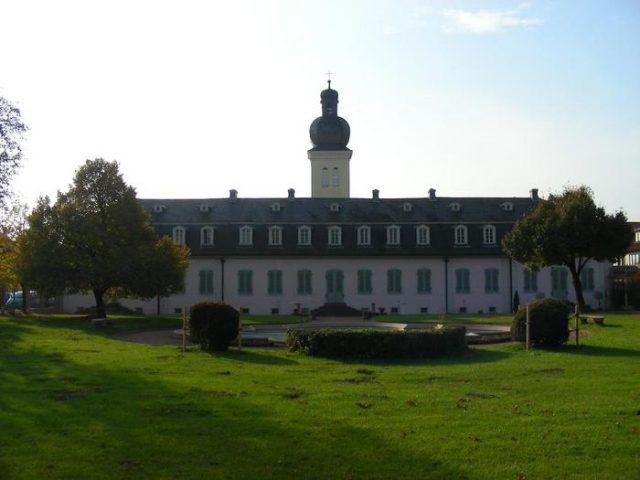
Rococo Palace Schloss Braunshardt is located in the Braunshardt district of the South Hessian city of Weiterstadt.
In 1760, Landgrave Ludwig VIII gifted the Braunshardt estate to his son, Prince Georg Wilhelm of Hessen-Darmstadt. There, he commissioned architect Johann Jakob Hill to build the palace in the French style. His wife, Countess Maria Luise Albertine zu Leiningen-Dagsburg-Falkenburg, provided financial support.
A special feature of the palace is that each room is decorated in a different color. In 1885, British Queen Victoria visited the palace. She later referred to it in her diary as a "colorful box of chocolates."
After approximately 250 years of eventful history, the city of Weiterstadt purchased the palace in 2006.
Schloss Braunshardt was built in 1760 by Prince Georg Wilhelm. He received the Braunshardt estate as a gift from his father, Landgrave Ludwig VIII of Hessen-Darmstadt. With the financial support of his wife, he commissioned engineer lieutenant Johann Jakob Hill to build the palace, consisting of a ground floor with a Dutch mansard roof. A garden in the style of the Petit Trianon of Versailles Palace was laid out at the palace. The Cavalier's building and the kitchen building adjoined at right angles on the south side.
In 1772, Prince Georg Wilhelm had a distillery established. He received a perpetual permit for this. Sixteen years later, he died, and his son Prince Georg Karl inherited his estate. He worked as a physicist and technician, conducting experiments with steam power. In 1786, he built an oil mill, for which he specifically brought in an expert. This was the experienced miller Johann Georg Bernhard from Nieder-Modau, who took charge of the mill. A few years later, gardener Schneeberger from Braunshardt took over supervision of the oil mill.
A very special guest of the palace was Luise von Mecklenburg-Strelitz, later Queen of Prussia. She was a granddaughter of the palace's builder. In 1793, she stayed at the palace with her fiancé, the Crown Prince of Prussia.
Change of Ownership
When Prince Georg Karl lost all his assets in 1819, creditors took over the estate in Braunshardt. Three years later, after some negotiations, court lawyer Karl Weidenbusch bought the palace. When he died two years later, the property passed to the Darmstadt merchant Johann Heinrich Fuhr. When he died unmarried in 1840, his nephew, the farmer Georg Ludwig Heinrich Fuhr, inherited it. He sold it in 1865 for 60,000 guilders to the Frankfurt banker Achilles Andreae. However, Andreae had only bought it on behalf of Grand Duke Ludwig III, to whom it eventually went. A large part of the meadows and fields was sold to farmers from Braunshardt in the same year. The Grand Duke renovated the palace, and it was re-inaugurated on May 30, 1867. During this time, Princess Alix, later the Tsarina, often stayed at Schloss Braunshardt as a child. However, the palace remained in the Grand Ducal family for only a few decades.
Ernst von Hohmeyer acquired the palace in June 1898, and he rented it out several times. On May 15, 1904, Grand Duke Ernst Ludwig visited the palace. He established the Marienhof girls' home on a plot of land next to the park. Between 1907 and 1911, the widowed Princess Karl von Hanau rented the palace. In April 1912, the new tenant, a Miss Lemp, moved into the palace. With this tenant, the palace flourished once again. She moved the German Women's School, which she directed, to the palace. However, after two years, the school was moved near Kassel. From that point on, the owner used the palace only as a summer residence. In 1915, Dr. Eduard von Bamberg bought the palace, where he housed his collections and library. He had the current dining salon laid out. He was also the builder of the garden pavilion, which is now used as a chapel dedicated to the Virgin Mary. After the armistice in 1918, French troops destroyed almost the entire library and collections.
The Caritas Association of the Diocese of Mainz acquired the palace in 1926 and carried out a renovation. The appearance of the palace was not changed, but the outbuildings were brought to the same height and design and connected to the palace. A year later, the complex was expanded threefold to the west. In the center of the palace, the St. Ludwig Chapel with its church tower was built. It was consecrated by the Bishop of Mainz, Dr. Ludwig Maria Hugo, in 1929. The garden was temporarily transformed into a large vegetable patch. Only the lime avenues have been preserved. Since the renovation work, Benedictine nuns managed the girls' home and cultivated the land themselves. Shortly thereafter, the English Ladies worked at the same location. They offered their students a wonderful country boarding school stay in Braunshardt. They also supervised the Voluntary Labor Service.
Since 1936, the Johannesbund Leutesdorf has managed the property. They dedicated the entire home to retreats and the care of the elderly. However, this was not easy during the Third Reich, and already in 1941, the National Socialists dissolved the home. In 1950, the Johannesbund regained possession.
The magnificent inventory of the palace that remained after this period is now located in the Prinz-Georg-Palais and the Schlossmuseum Darmstadt. In the palace itself, only the marble fireplaces and stucco work have been preserved. Since the 1970s, a small part of the palace park has been developed with residential houses. This part was sold to use the proceeds to renovate and restore the palace. However, the proceeds were not used for the palace, but the Johannesbund decided in 1984 to build a new retirement home in the southwestern part. A part of the palace was demolished, but not the historical part. The retirement home has been in operation since 1985. The palace itself was sold to a private individual, renovated, and restored.
In 2006, the city of Weiterstadt bought the palace to make it accessible to the public. The reason given at the time for buying the palace was never implemented. To this day, the palace is only open to the public upon special request. The initiative not to make the palace accessible to the public as planned goes back to the work of the former local mayor Peter Rohrbach. Today, the different colored rooms can be viewed during a guided tour. In addition to guided tours, several events take place, and weddings can be held in the palace. In 2008, the city had the fountain in the park renovated. In the same year, the city bought a large part of the palace park from the Johannesbund Leutesdorf.
Take Mobile History with you
You are reading this text for free. Premium adds what matters on the road: descriptions read aloud, sites found through your camera, whole regions taken offline.
- Every description, including the ~17,700 Premium sites
- Audio guide: have descriptions read to you on location
- AR finder: see sites through your camera, with distance and bearing
- Unlimited saved sites
14 days free, then from €2.99 a month. Cancel anytime.
Source: Wikipedia · Licence: CC BY-SA 4.0 · Image: http://www.wehrbauten.de/thread.php?threadid=971
This description draws on the facts documented in the linked Wikipedia article; Wikipedia content is licensed under CC BY-SA 4.0. Wording and editing: Mobile History.
Location: 49.9150, 8.5674