To be privately owned
Museum
CastleBraunfels
Braunfels Castle
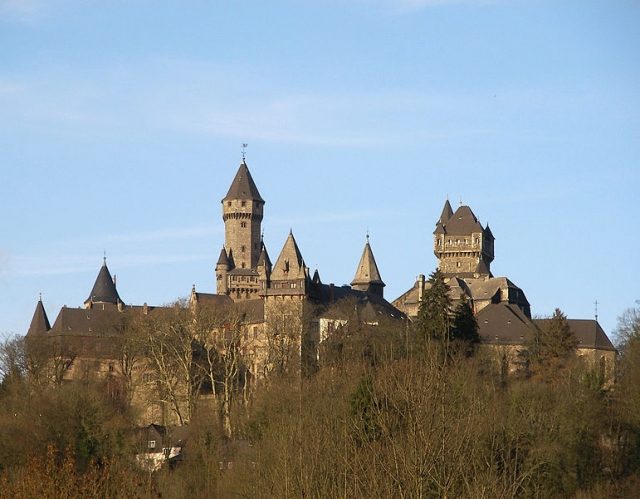
Braunfels Castle is located on a basalt hill west of the spa town of Braunfels in the Lahn-Dill district of Central Hesse. Since the 13th century, it has been the seat of the Counts of Solms and remains in the family possession of the Counts of Oppersdorff zu Solms-Braunfels in the 21st century.
The castle was first mentioned in a document in 1246 as Castellum Bruninvels. Originally a defensive castle against the Counts of Nassau, it became the residential castle of the Counts of Solms from 1280. After the division of noble property among three lines and the destruction of the ancestral castle Solms by the Rhenish League of Cities, Braunfels Castle became the new ancestral seat of the Counts of Solms-Braunfels in 1384, who were the only one of the three lines to survive and inherited the entire property in 1418. After further division and reunification, this line still exists today.
Between the 15th and 17th centuries, extensive additions were made to the core castle. Count Otto II had the medieval castle expanded into a fortress around 1500. The late Gothic castle church dates from this construction phase. The engraving by August Rumpf, depicted by Matthäus Merian in his Topographia Hassiae of 1655, provides information about the state of the castle before its Baroque transformation into a palace (from 1680).
During the Thirty Years' War, Braunfels Castle was contested and severely damaged. Due to his support for Frederick V, Count Johann Albrecht I zu Solms-Braunfels fell under imperial ban. His Braunfels Castle was occupied without a fight by Spanish troops on behalf of the Emperor in 1621. In 1629, Count Philipp Moritz von Hohensolms successfully besieged the town and castle of Braunfels. Emperor Ferdinand II then enfeoffed Johann t'Serclaes von Tilly with the castle in 1630. In 1632, the castle was conquered by Swedish troops, who, however, lost it again to the Imperial forces in 1634. A year later, in 1635, Count Ludwig Heinrich von Nassau-Dillenburg occupied the castle with a surprise attack. In 1640, after a siege, troops from the Duchy of Saxe-Weimar conquered the castle. Count Johann Albrecht II zu Solms-Braunfels was able to retake possession of it in 1641.
Count Heinrich Trajektin (1648–93) had the residence transformed into a Baroque castle, which fell victim to a widespread town fire in 1679. However, his successor, Count Wilhelm Moritz, managed a rapid reconstruction at the beginning of the 18th century. His plans and those of his master builder Johann Philipp Meyer from Wetzlar for the construction of an extensive Baroque castle around 1720 were not realized.
With the Imperial Deputation Act of 1803, the political independence of Prince Ferdinand zu Solms-Braunfels ended; the territory fell to the Duchy of Nassau. The castle remained in princely family possession and was the seat of the Princely Solms-Braunfels government from 1828 to 1848.
Prince Ferdinand had neo-Gothic alterations and restorations carried out around 1840. From a romantic mindset of recreating the Middle Ages, an idealized fantasy castle was created, which in reality did not exist in this form in the Middle Ages. The model for the work was the expansion of Rheinstein Castle in the spirit of Rhine Romanticism. Parallel to the expansion of the castle, Prince Ferdinand had Dianaburg near Greifenstein built as a hunting lodge.
Around 1880, Prince Georg added a second keep, as well as extensions and additions of oriels and small towers in the Historicist style; master builders whose ideas he and his architects Edwin Oppler, Hugo von Ritgen, and Rudolf Wiegmann drew inspiration from were Eugène Viollet-le-Duc, as well as Émile and Paul Boeswillwald.
The Majorate of Braunfels passed to his son-in-law, Hans Georg Graf von Oppersdorff-Solms-Braunfels (1920–2003), with residence in Braunfels, upon the death of the last male descendant of this line, Prince Georg Friedrich zu Solms-Braunfels (1890–1970), in 1970.
Exterior+
The exterior in its current state is stylistically heterogeneous due to its building history. Its essential compositional elements are
- the core castle from the 13th century with the border watchtower (Friedrichsturm), keep (Alter Stock), palas, and shield wall; despite later alterations, Romanesque stylistic elements (massive masonry with round-arch bifora with relieving arch, central column with leaf capitals) are still clearly discernible;
- extensions with an outer bailey and battlements to the east towards the town (attack side): Lowest gate around 1350, middle gate tower around 1460 (Baroque superstructure and transformation into a bell tower in 1682), upper castle gate with pointed arch portal from 1491; castle church as a three-aisled hall church above the galleries of the uppermost zwinger (1501, wall paintings from 1504);
- the Baroque additions: So-called Ottonian Building (Princely Building), New Gate (Archive Gate) in the northwest, stables, castle guard, barracks (first built shortly before the town fire of 1679 and then reconstructed);
- in Historicist style: A second keep with flanking turrets (1884)
Due to continuous alterations, the older buildings also underwent constant change; for example, in the 19th century, Alter Stock, Palas, and the North Tower were provided with battlements, and open spaces between previously isolated building structures were closed.
Interiors+
The interiors are designed as a museum and are partly accessible with a guided tour. A distinction is made between the princely state rooms, the collections from Altenberg Monastery, and the family museum.
Princely Rooms
The furniture and art historical collections of the princely family of Solms range from the 13th to the 19th century.
- The Knight's Hall in the medieval Palas, restored in the 19th century, contains striking, stabbing, and firearms, as well as armor for warriors and horses from the Middle Ages to the Baroque period. The oldest objects are a Gothic sword and a chainmail shirt from the time of the Crusades, consisting of 60,000 small rings (forging time 1-2 years). Armor from the Maximilian era presumably comes from Milan.
- In the Staircase Room and the Picture Gallery hang oil paintings – especially family portraits, mythological and allegorical scenes – from the schools of Italian, Spanish, Dutch, and German masters from the Renaissance to Classicism. In the center of the Staircase Room stands the bust of the 99-day Emperor Frederick III.
- The Tapestry Room is characterized by five Flemish tapestries from around 1600, depicting hunting and pastoral scenes. The fireplace dates from 1674 from the Asslar foundry.
- An art historical highlight is the Flemish Room with portraits, seascapes, and genre scenes. Represented are, among others, Adriaen van de Velde, Jan Miense Molenaer, and Adriaen van Ostade. Here, too, there is a fireplace from Asslar.
- The Tischbein Room is named after the family of painters who worked for several generations in the 18th century on behalf of the Counts of Solms.
- Further portraits, hunting pieces, and genre paintings are found in the Deiker Gallery (court painter to Prince Ferdinand 1843–1868), the Blue Salon, and the Pink Salon. Among the family's antiques in the state rooms are vases of East Asian provenance, from the St. Petersburg and Berlin porcelain manufactories. A small glass collection is also displayed in a showcase, including Venetian filigree glasses and Römer glasses.
Altenberg Rooms
The so-called "Altenberg Rooms" contain inventory from the former Altenberg Monastery. Upon its secularization with the Imperial Deputation Act of 1803, the Princes of Solms took over the furnishings.
- The Gothic Room contains a late Gothic altar and a Rhenish Madonna (around 1400). A chest from Gertrud von Altenberg allegedly contained objects belonging to her mother Elisabeth of Thuringia. When Elisabeth had to leave Wartburg Castle after the death of her husband, Landgrave Ludwig IV (Thuringia), in 1227, and became a nurse in a Franciscan hospital she founded in 1229 under the aegis of Konrad von Marburg, she had to send her then 4-year-old daughter Gertrud to Altenberg Monastery for education at the instigation of her confessor.
- Even more presumed mementos of Saint Elisabeth, demonstrably from the 13th century, are kept in the adjacent Vestment Room. Whether the silver jug from which Elisabeth dispensed wine to the sick, and the ring, a gift from the Landgrave, with the large oval stone, which is said to have shattered at the moment of his death, truly belonged to Elisabeth, can no longer be proven. Tourism at Braunfels Castle thrives on this history and/or legend.
- The Altenberg Altar, dating from around 1330, a winged altar with Gothic tracery, is considered the work of an unknown master. Originally, a sculpture of a Madonna with Child from the second half of the 14th century was placed on this altar.
Family Museum
The Family Museum in the Long Building (individually accessible by coin insertion) contains further weapon and art collections, coins, orders, clothing, and a collection of Bohemian glass from the Princes of Solms. Furthermore, there is a prehistoric section, which can be traced back to a collaboration between Prince Wilhelm around 1815 and the archivist Jakob-Carl Schaum, who was in lively correspondence with Johann Wolfgang Goethe. An unexplained find is a fertility god from the 3rd millennium BC, excavated in 1959 near Kraftsolms, of a type usually found in Asia Minor. Among the family's antiques is also a collection of Meissen porcelain and a Bohemian glass collection, a sculpture collection, and table silver.
Outdoor Facilities+
To the north is the battery, on which four bronze cannons from the 16th century are placed. From the terrace, the view extends far to the southeast over the old town of Braunfels and into the countryside.
Protection under the Hague Convention+
On June 8, 2010, it was announced that the castle – like, for example, the Wilhelmsturm (Dillenburg), the Hohe Schule Herborn, or the Fortuna Mine – would henceforth be subject to the protection of the Hague Convention for the Protection of Cultural Property in the Event of Armed Conflict. An intentional attack and damage would constitute a war crime in the event of war and could be prosecuted by the International Criminal Court.
Surroundings+
Nestled in a forest and park landscape that extensively surrounds the castle to the north and west, lies a hilly and technically challenging 18-hole golf course, designed in 1971 by Bernhard von Limburger. The course is rich in historic trees, and natural ponds serve as water hazards. The clubhouse is a converted half-timbered manor house.
Take Mobile History with you
You are reading this text for free. Premium adds what matters on the road: descriptions read aloud, sites found through your camera, whole regions taken offline.
- Every description, including the ~17,700 Premium sites
- Audio guide: have descriptions read to you on location
- AR finder: see sites through your camera, with distance and bearing
- Unlimited saved sites
14 days free, then from €2.99 a month. Cancel anytime.
Location: 50.5137, 8.3875