The Castle can be visited
Museum
CastleCottbus
Branitz Castle
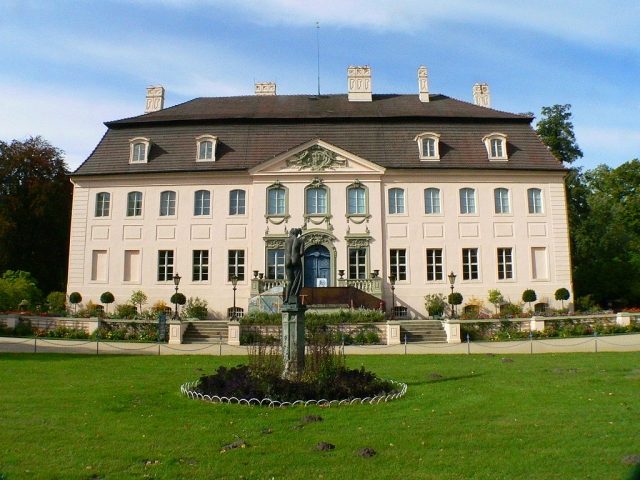
In the center of the park lies the castle, built in Baroque style from 1770 to 1772 and remodeled around 1850. Today, it houses the Fürst Pückler Museum. It showcases historic living quarters as well as exhibitions on the life and work of Hermann von Pückler-Muskau and a painting collection of works by the landscape painter Carl Blechen, born in Cottbus. Additionally, the Marstall regularly hosts special exhibitions.
Among the special features of Branitz Park are the pyramids. The larger water pyramid, erected in 1856/57, represents an artificial island in the lake. Inside the tumulus lie the graves of Pückler and his wife Lucie von Pückler-Muskau, who died in 1854 and was reinterred after the Prince's death. On the southeastern shore of the lake is the stepped land pyramid.
Park+
Branitz Park is a landscape park designed by Prince Pückler-Muskau near Branitz in Cottbus. The estate came into the possession of the Pückler count family in 1696. At that time still leased, the design of the park began in 1845 when Hermann von Pückler-Muskau had to give up his then residence, Muskau Castle in Muskau, and its park due to financial problems and moved to Branitz. Here he began to create this further landscape park modeled on English examples, which was to become one of the most beautiful in Lusatia.
Through his park creations, especially that of Branitz Park, Pückler-Muskau became one of the most famous German garden designers of the 19th century, alongside Peter Joseph Lenné and Friedrich Ludwig Sckell. As Pückler's successor, Heinrich von Pückler completed the park.
The listed Branitz Park is a garden monument on the monument list of the state of Brandenburg.
Structure and Design+
Branitz Park is divided into stylistically differentiated areas. The "Inner Park" extends over 100 hectares and includes the grounds of the economy and the nursery. The "Outer Park" covers an area of approximately 600 hectares and includes the fields surrounding the "Inner Park". Around the castle, the Prince created a pleasure ground equipped with flower beds, sculptures, and ornamental shrubs.
An artificially created water system with canals, ponds, and lakes, fed by groundwater and the nearby Spree, runs through the forest and meadow areas. With the earth masses freed by the excavation of the water beds, Pückler modeled the terrain relief. In this way, a park landscape with hills and plains was created.
In summer, the narrow-gauge Cottbus Park Railway connects Pückler Park with Eliaspark, Spreeauenpark, and the zoo.
Take Mobile History with you
You are reading this text for free. Premium adds what matters on the road: descriptions read aloud, sites found through your camera, whole regions taken offline.
- Every description, including the ~17,700 Premium sites
- Audio guide: have descriptions read to you on location
- AR finder: see sites through your camera, with distance and bearing
- Unlimited saved sites
14 days free, then from €2.99 a month. Cancel anytime.
Source: Wikipedia · Licence: CC BY-SA 4.0
This description draws on the facts documented in the linked Wikipedia article; Wikipedia content is licensed under CC BY-SA 4.0. Wording and editing: Mobile History.
Location: 51.7421, 14.3690