Condominium apartment
CastleBrandis
Brandis Castle
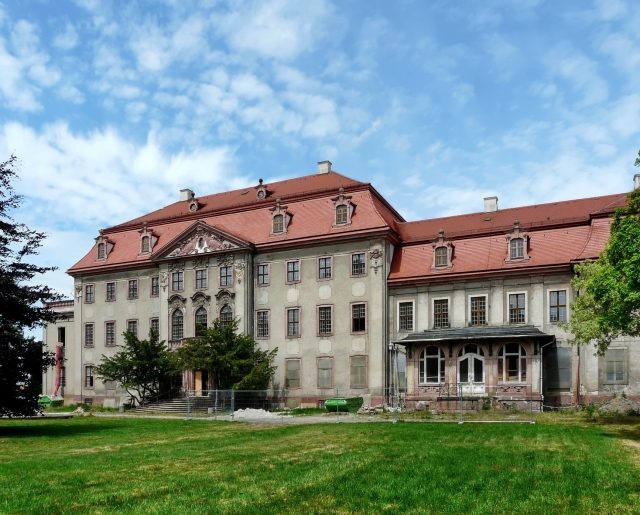
Brandis Castle is a Baroque castle with a castle garden in the immediate vicinity of the historic market square of the town of Brandis in Saxony. The castle and garden were built between 1700 and 1727 according to designs by David Schatz on behalf of Kraft Burchhard von Bodenhausen.
Brandis Castle is located approx. 12 km east of Leipzig, near the A 14 and B 6. It is centrally located in the town of Brandis, directly on the market square. The size of the castle is 54,730 m², of which approx. 39,000 m² are accounted for by the castle park alone.
The history of Brandis Castle spans almost 300 years, with the former knight's estate located there traceable back to the 12th century.
18th and 19th Century
Originally, the area of the present-day Brandis Castle functioned as a knight's estate, whose history can be traced back to the 12th century. Around 1700, the knight's estate was purchased by Kraft Burchhard von Bodenhausen. His son Otto Wilhelm von Bodenhausen had the present-day castle built between 1724 and 1727 according to plans by David Schatz. With the stately castle and the spacious farmyard, Otto Wilhelm von Bodenhausen had created one of the most imposing estate complexes in the Leipzig area. However, the original plan remained uncompleted. The west wing of the Baroque building was not executed. In 1849, Baron Friedrich von Pentz acquired the complex and had the castle renovated in 1875 and the western extension and the veranda on the garden front added.
20th Century
From 1930 until his expropriation and expulsion by the communists in 1945, Major Otto Busse was the owner of the castle complex. Under him, the castle and park were listed as art and cultural monuments in the Saxon State Monument List A in 1941. After the end of the Second World War, a battalion of US forces first moved into the castle, and a little later the military commandant's office of the Red Army. From May 1946, it was used as a hotel for trade fair visitors, owned by the USSR. From January 1950, the complex was leased as a financial school and partly used for stables. From 1968, the property passed into the possession of the city of Leipzig. A retirement and nursing home moved in, which existed until 2003.
21st Century
First Construction Phase (2006–2012)
After the dissolution of the retirement and nursing home in 2003, the castle remained unused for several years. In 2006, the castle was acquired by an investor, who then had the two side wings renovated. Around 50 apartments and maisonettes were created in the Orangery and Ailette Rustique. The entire inner courtyard was also designed according to monument protection requirements.
Second Construction Phase (from 2012)
The castle complex, with direct access to the market and located in the midst of the growing town of Brandis, consists of the following renovation sections in its development concept: castle building (main building) and park (area approx. 4 ha).
Castle Building
According to the current planning status, the main castle comprises 14 residential and commercial units ranging from 50 to 200 m². The building fabric in the main castle is well preserved, allowing the use of numerous historical details such as fireplaces, stucco, windows, thick walls, vaulted ceilings, and various room solutions. During the extensive renovation work, an attempt is made to preserve the historical structure as much as possible, while still ensuring that it meets today's living requirements.
Park
The park, which is still very well preserved in its basic structure (paths and layout), only needs to be revised, the tree population partially trimmed, and the small lake dredged and recultivated. Discussions are underway with the city of Brandis regarding the lower part of the park (meadow area and connecting piece to the city park).
The Brandis Castle Park+
The castle park in Brandis has a history of over 250 years. The layout of the castle park can possibly be attributed to the castle's architect, David Schatz. Few visible elements of the original layout remain, as it has undergone several redesigns over time. Its current state dates from the 1920s. In the garden there is a mausoleum, built in 1854 for the then owner Baron von Pentz, a water tower from 1884, a pavilion, a fountain, and several lion sculptures. After 1875, the castle park was significantly expanded. Noteworthy here is the planting of impressive groups of exotic trees such as the catalpa, the copper beech, the red oak, and the plane tree, which were introduced to Europe from this time. These large trees were planted on the periphery around the park to shield it from the outside.
Important for the park's current appearance was the design phase from 1912. The castle park was divided into two parts. The upper part, closer to the castle, was redesigned in the style of a Baroque garden. Flower beds were planted along the paths and around the fountain. Therefore, this part of the castle park was called the "Rose Garden". The lower part of the castle park was laid out in a landscape style, characterized in particular by the planting of hornbeams in the outer areas of the park.
At the beginning of the 1960s, the castle park was divided and the rose beds along the paths were removed. While the upper, northern part remained part of the castle, the southern part was used as a public green area by the city of Brandis. This division continues to this day.
Although no pruning and maintenance work was carried out at the latest after the dissolution of the retirement and nursing home in 2003, the structures of the castle park, as laid out by Baron von Pentz, have largely been preserved. However, numerous buildings such as the mausoleum, the pavilion, the water tower, or the open-air theater are in great need of repair. Furthermore, the formerly numerous existing sculptures and statues such as the lion sculptures, the sandstone monument, or the fountain are only partially or in poor condition. Due to this, the castle park has been in an extensive recultivation and repair phase since 2012.
Take Mobile History with you
You are reading this text for free. Premium adds what matters on the road: descriptions read aloud, sites found through your camera, whole regions taken offline.
- Every description, including the ~17,700 Premium sites
- Audio guide: have descriptions read to you on location
- AR finder: see sites through your camera, with distance and bearing
- Unlimited saved sites
14 days free, then from €2.99 a month. Cancel anytime.
Source: Wikipedia · Licence: CC BY-SA 4.0 · Image: Thomas Eichler
This description draws on the facts documented in the linked Wikipedia article; Wikipedia content is licensed under CC BY-SA 4.0. Wording and editing: Mobile History.
Location: 51.3328, 12.6080