To be privately owned
CastleBrand
Brand Castle
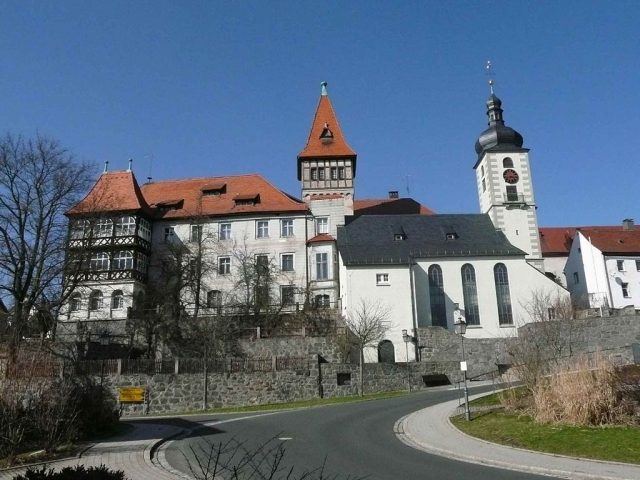
Brand Castle is located on the northern edge of the historic town center of Brand bei Marktredwitz, which is divided into two halves by the Kössein river. The complex was first mentioned in a document in 1221 and was the seat of ministeriales in the Middle Ages.
The town and the noble family of Brand are first attested with Meino de Brande, who appears as a witness in a document from Waldsassen. The Branders were originally probably dependent on the Lords of Liebenstein. After their extinction in 1291, Brand came into the hands of the Notthafft and Paulsdorfer families, who in turn enfeoffed the Branders with it.
In the Egerer Landsteuerbuch of 1392, Prant is still listed among the places belonging to the Egerland. In 1414, "Prannt das dorff mit gesessen vnd kirchen, on des Erhart Prantners teyl" (Prannt the village with seats and churches, excluding Erhart Prantner's share) is found in a list of properties that Burgrave Johann III of Nuremberg had withdrawn from the Egerland. Although the Burgrave promised to return various properties, including Brand, to the Egerers, Brand remained in Hohenzollern territory and was incorporated into the Arzberg judicial district. According to the wording of a complaint from 1414, which speaks of "gesessen" in the plural, there must have been several noble residences at that time - perhaps already three, as in 1499 - which were located close together within the castle estate. The residences were then inhabited by Erhard Brantner and his uncle Berthold Brantner. Berthold Brantner had obviously submitted to Burgrave Johann III at the beginning of the 15th century.
In 1441, Berthold Brantner's sons, Nickel and Hans, enfeoffed their entire property in Brand to Margrave Johann Alchymista, which led to a dispute with the Notthafft zu Weißenstein family that smoldered for generations until 1625, when an arbitration court determined that the entire Brand estate was under the feudal lordship of the Notthafft family. The famous composer Jobst von Brandt, who lived in Brand Castle and created his late works here, was also involved in this dispute.
The family of Brand retained their namesake ancestral seat until after the Thirty Years' War. In 1662, the widow of Hans Wilhelm von Brand sold her property to Georg Christoph Renner. Hans Wolff von Brand sold the remaining shares to Wolf Adolph Marschall in 1682. On April 19, 1690, a fire destroyed the existing castle buildings, but already in the following year, the topping-out ceremony could be celebrated at the rebuilt castle.
The 18th century brought a series of rapidly changing castle owners. The feudal lordship of the Notthafft family over the knight's estate continued into the 19th century. On May 29, 1801, at the request of the then owner Christian Freiherr von Lindenfels, the feudal association was dissolved. From 1864 to 1884, the manufacturer Hans Max Philipp von Beust was the owner of the castle. The last noble owner of the estate was Albert Evan Edwin Reinhold Freiherr von Seckendorff, who had acquired it in 1890 from Johanna von Voß, née Freiin von Beust. From his stepdaughter Liane von Plänckner, the castle came into the possession of the Bavarian State Forest Administration in 1937. Between 1938 and 1943, the interior of the castle was largely altered by the Kreisbauernschaft of the Reichsnährstand. During the Second World War, Brand Castle served as a secret laboratory for the Arbeitsgemeinschaft Kernphysik. Otto Hahn also stayed at the castle on several occasions.
From 1969 to 2007, Brand Castle was in the hands of Bischofshofbräu Regensburg. Since then, the new owner, the association "Markgräfliches Collegium Historiae e. V.", has been striving for a proper renovation of the historic building.
Complex+
Brand Castle essentially consists of two freestanding castle buildings, which are connected by a tower built on a rectangular ground plan, now serving as a staircase. The enormous wall thicknesses visible in the ground floor plan of the northeastern building suggest a medieval core of this house. The remaining building fabric probably dates back to the time of reconstruction after the fire of 1690, but was heavily altered in the 19th and especially the 20th century. The portal building attached to the north side of this wing probably originated in the 18th century and stylistically shows the transition from late Baroque to Classicism. The former brewery production building attached to the east of the northeast wing is a 19th-century addition.
Take Mobile History with you
You are reading this text for free. Premium adds what matters on the road: descriptions read aloud, sites found through your camera, whole regions taken offline.
- Every description, including the ~17,700 Premium sites
- Audio guide: have descriptions read to you on location
- AR finder: see sites through your camera, with distance and bearing
- Unlimited saved sites
14 days free, then from €2.99 a month. Cancel anytime.
Source: Wikipedia · Licence: CC BY-SA 4.0
This description draws on the facts documented in the linked Wikipedia article; Wikipedia content is licensed under CC BY-SA 4.0. Wording and editing: Mobile History.
Location: 50.0175, 12.1417