To be privately owned
CastleBollschweil
Bollschweil Castle
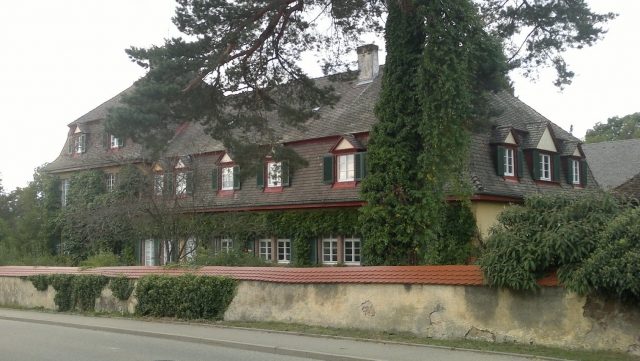
A document from 1472, preserved in the Generallandesarchiv in Karlsruhe, testifies, among other things, that Hans Snewlin Bernlapp von Bollschweil had received the then-current estate as a fief from the House of Austria, represented by Duke Sigmund, with the Snewlin family already being mentioned in documents as residing in Bollschweil in the 13th century. A still visible testament from this long-past era is the tombstone of a Snewlin descendant who died in childhood, immured next to the door to the former laundry room.
The lordship of Bollschweil remained in the possession of the Snewlin Bernlapp von Bollschweil until the 19th century, even though the moated castle originally built in today's lower garden was destroyed in the Peasants' War. On July 19, 1837, the Grand Ducal Baden Chamberlain, Baron Franz Xavier, died in Freiburg as the last representative of all Breisgau Snewlins. During his lifetime, he had already returned all fiefs to the Baden state.
His legal successor was the Baden Minister of State, Baron Wilhelm Ludwig Leopold Reinhard v. Berstett, who came from the Alsatian town of Berstett, and whose family had been driven from their homeland during the French Revolution. Berstett, as the Baden envoy to the Congress of Vienna, was instrumental in ensuring that Baden could maintain its independence. For this, the Grand Duke rewarded him with a number of estates and castles, including Bollschweil. Despite the political nature of his merits, rumors soon circulated that the Baron was involved in the contemporary, legendary scandal surrounding the Kaspar Hauser affair. Bollschweil as hush money? One will never know.
When Reinhard v. Berstett's granddaughter, Amélie, married the Grand Ducal Master of the Horse, Adolf v. Holzing, the family received the right in 1864 to use the double name Holzing-Berstett, as there were no male descendants of Berstett. Bollschweil Castle and estate passed into the possession of the current owners. The house, however, remained empty. It was uninhabitable, the main house could not be heated, and the side wings were barns and sheepfolds.
Only after the German defeat in the First World War did Colonel and Wing Adjutant to Kaiser Wilhelm II, General Max Reinhard Freiherr v. Holzing-Berstett (son of Amélie), move to Bollschweil. His wife Elsa, born Freiin v. Seldeneck, had, at his behest, had the sheepfolds converted and central heating installed. The oldest part of the horseshoe-shaped building complex is the Trottschopf, an open hall built during the Thirty Years' War, where wine used to be trodden. Today it is called the "Riding Arena." The General, a famous dressage rider, trained his horses there.
In the middle of the courtyard, surrounded by four lime trees over 200 years old, stands a fountain with a Nepomuk as its guardian. If one turns west and ascends the steps of the recently restored garden staircase, one overlooks the lower garden, designed in the French style. The complex is the work of the General's son, Adolf Max, known as Peter. Having escaped from Russian captivity, he built another farm building on the northern periphery in 1952, which his son Adrian and his wife Franziska, the current owners and residents of the castle, had converted into apartments. The estate includes agricultural land and the Kohlwald forest in the immediate vicinity of the village.
In the 20th chapter of her prose work "Beschreibung eines Dorfes" (Description of a Village), Marie Luise Kaschnitz, Peter's sister, erected a literary monument to her parental home, "House No. 84."
Take Mobile History with you
You are reading this text for free. Premium adds what matters on the road: descriptions read aloud, sites found through your camera, whole regions taken offline.
- Every description, including the ~17,700 Premium sites
- Audio guide: have descriptions read to you on location
- AR finder: see sites through your camera, with distance and bearing
- Unlimited saved sites
14 days free, then from €2.99 a month. Cancel anytime.
Source: Wikipedia · Licence: CC BY-SA 4.0 · Image: Jörg Heldt
This description draws on the facts documented in the linked Wikipedia article; Wikipedia content is licensed under CC BY-SA 4.0. Wording and editing: Mobile History.
Location: 47.9206, 7.7840