Cultural Events
CastleTrebbin-Blankensee
Blankensee Castle
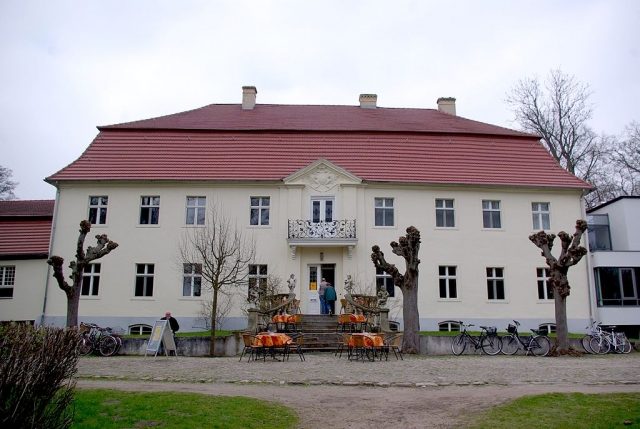
Blankensee Castle, also known as Sudermann's Refuge, in the town of Blankensee in Brandenburg, was allegedly built in 1740 (according to other sources, 1701) on the foundations of an old German castle for the Saxon district captain Christian Wilhelm von Thümen, after whose ancestors, who had resided here since 1446, the region was long known as Thümenscher Winkel or Thümscher Winkel. Sudermann was able to acquire the estate from the heavily indebted last Thümen lord, Viktor, at an extremely favorable price. The manor house is considered a typical example of Märkisch Baroque architecture and, with its unity of house and park, is exemplary for manor house complexes in the 18th and 19th centuries in the Mark Brandenburg. The two-story plastered building is now owned by the Brandenburgische Schlössergesellschaft and was used as a conference and guesthouse by the Berlin-Brandenburg Academy of Sciences until December 31, 2004. Since May 1, 2006, the castle's rooms have again been offered for events by the hotelier couple Beate and Jürgen Keck from the AKZENT-Parkhotel Trebbin. While the park is freely accessible, the castle can only be entered for guided tours of the Sudermann Room as part of the Bauernmuseum's tours. The tours take place at Easter and Pentecost. The castle is a protected monument.
The Castle Park+
The manor house, between 1902 and 1928, belonged to the writer Hermann Sudermann (1857–1928) as its last private owner, who maintained a city apartment in Berlin in addition to this country estate. The East Prussian dramatist and novelist (Die Ehre, Frau Sorge, Der Katzensteg) furnished the castle park, originally designed in 1832 according to plans by Peter Joseph Lenné, with statues he brought back from his travels. Curved bridges over several side arms of the Nieplitz, an Italian garden, marble benches, small temples, and gods and goddesses amidst dense trees transform what is now called Sudermann Park into an enchanted southern refuge in a Märkisch idyll. Sudermann described the atmosphere in the park with the following words:
... from whose interior here and there came a glow of columns and bridges and white, vine-covered masonry ... From the background, from a hill darkly overshadowed by black firs, a solemn round temple with Tuscan columns and a shimmering green roof looked out ...
Even without Sudermann's round temple and sculptures, the park appeared much more pristine to Theodor Fontane about 50 years earlier during his wanderings through the Mark Brandenburg with its alder marsh and two lakes:
The manor house is most beautifully situated. In front, an alder marsh, on the wings two wide lake mirrors, and between the castle and the park a watercourse connecting these two lake surfaces – that is, in broad strokes, the scenery.
Take Mobile History with you
You are reading this text for free. Premium adds what matters on the road: descriptions read aloud, sites found through your camera, whole regions taken offline.
- Every description, including the ~17,700 Premium sites
- Audio guide: have descriptions read to you on location
- AR finder: see sites through your camera, with distance and bearing
- Unlimited saved sites
14 days free, then from €2.99 a month. Cancel anytime.
Source: Wikipedia · Licence: CC BY-SA 4.0 · Image: http://commons.wikimedia.org/wiki/File:Trebbin_Blankensee_Gutshaus.jpg
This description draws on the facts documented in the linked Wikipedia article; Wikipedia content is licensed under CC BY-SA 4.0. Wording and editing: Mobile History.
Location: 52.2400, 13.1290