Municipal offices
CastleBischofroda
Bischofroda Castle
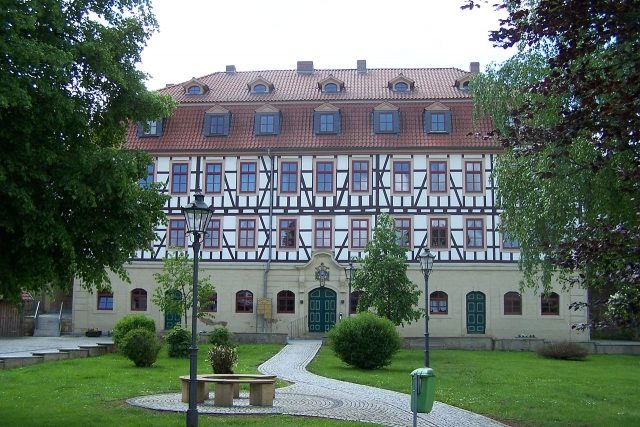
Bischofroda Castle is a castle in the municipality of Bischofroda in the Wartburg district. It is located in the western part of the village, immediately south of the village church. The castle is a protected architectural monument.
The area around Bischofroda has formed a Catholic enclave since the 16th century. It was asserted by the Archbishopric of Mainz against the claims of the Saxon Dukes, who were contractually bound by a condominium over the Ganerbschaft Treffurt, in force since the 14th century, with the Landgrave of Hesse and the Archbishopric of Mainz, to preserve the existing borders and lordships. The village of Bischofroda and the associated provostry of Zella were subordinated to St. Peter's Monastery in Erfurt and had been able to bind a branch of the Knights of Creuzburg as patrons, who died out with the death of Colonel Georg Ernst von Creuzburg in 1742. The previous castle was a considerable, but simply designed, half-timbered building and served the Creuzburgers as a secondary residence, as they initially also inhabited the moated castle Schloss Berka in the neighboring village of Berka vor dem Hainich.
Due to the small size of the Bischofroda exclave, the new administrator had only limited tax revenues at his disposal; the current castle was also built as the main house of the Bischofroda estate. Building materials were obtained from quarries in Madelungen, 5 kilometers away. The main portal is adorned with the episcopal coat of arms as a reference to the suzerainty of St. Peter's Abbey in Erfurt. The administration of the property, which had been converted into a chamber estate, was taken over by tenants: Johann Philipp Kümmel managed the Bischofroda estate from 1773 to 1796, followed by a Mr. Goldammer. After the Napoleonic occupation of Erfurt, the territories belonging to the Archbishopric of Mainz in Thuringia were expropriated. The ownership rights to the Bischofroda estate passed to the district administration in Creuzburg; Napoleon gifted the likewise expropriated Probsteizella to a French general as an award. As the third tenant, Friedrich Hähnert was appointed from 1841 to 1853, followed by his son Theodor Hähnert from 1853 to 1880. The last estate administrator appointed was Ökonomierat Schambach; after his retirement in 1901, the estate was dissolved. A cooperative formed by 86 Bischofroda residents had been awarded the contract for the estate, and the agriculturally used fields were divided according to the contract. In 1902, a Hessian colonel, Ernst von Kietzell, acquired the castle building as his retirement residence. The family lived in the house until 1941 and sold the building to a real estate administration of the Reich government. From 1941 to 1945, the castle served as a training center for the Reich Labor Service and finally as a camp for a group of Belgian prisoners of war. After the end of the war, the municipality of Bischofroda was given ownership of the building. The numerous rooms were used as apartments and administrative offices; at times, the kindergarten and primary school classrooms were also housed in the castle. After the reunification, the castle was extensively renovated and is still the seat of the Bischofroda municipal administration.
Take Mobile History with you
You are reading this text for free. Premium adds what matters on the road: descriptions read aloud, sites found through your camera, whole regions taken offline.
- Every description, including the ~17,700 Premium sites
- Audio guide: have descriptions read to you on location
- AR finder: see sites through your camera, with distance and bearing
- Unlimited saved sites
14 days free, then from €2.99 a month. Cancel anytime.
Source: Wikipedia · Licence: CC BY-SA 4.0 · Image: http://commons.wikimedia.org/wiki/File:WAK_Bischofroda_009.jpg
This description draws on the facts documented in the linked Wikipedia article; Wikipedia content is licensed under CC BY-SA 4.0. Wording and editing: Mobile History.
Location: 51.0564, 10.3617