Cultural Events
Museum
Restaurant
CastleBiedenkopf
Biedenkopf Castle
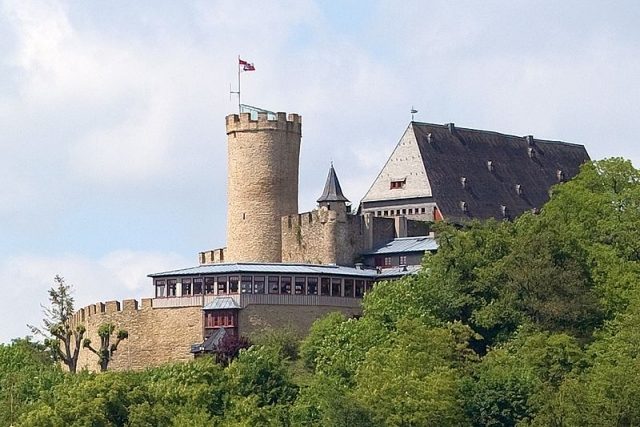
Biedenkopf Castle is a castle in the Central Hessian town of Biedenkopf and the town's landmark. It stands on the 386-meter-high Schlossberg, a conical hill above the old town center.
According to dendrochronological investigations, the northern tower of the castle was probably built after 1175. A family of Biedencap(h) was first mentioned in the late 12th century. The first representative of the family, Harmouthdus von Biedencaph, was a ministerialis of the Archbishops of Cologne. The family descended from the family of Hohenfels.
Around 1231, the castle came into the possession of Landgrave Konrad of Thuringia, who administered the Hessian possessions of the Ludowinger and had the town of Biedenkopf built below the castle. During the time of the Thuringian Landgrave Heinrich Raspe, the castle, together with the castles in Frankenberg and Gladenbach, served as a western border defense.
After 1296, Landgrave Otto I of Hesse "relocated" the castle to "forne uff den Berg"; he probably built a castle at the present location on the south side of the mountain. The castle, still accessible today, was significantly expanded between 1360 and 1365 under Landgrave Heinrich II of Hesse. According to building investigations, the palas was rebuilt in the second half of the 15th century (1455–1460 and 1480–1483).
In the 15th/16th century, the castle increasingly lost its importance and was structurally neglected. From 1579, the palas served as a granary. In 1604, the castle was ruinous. During the Thirty Years' War, it was occupied several times and severely damaged.
Between 1843 and 1847, the castle was restored and rebuilt in the spirit of Historicism under Grand Duke Ludwig II of Hesse-Darmstadt and district architect Sonnemann. This construction measure is often mistakenly attributed to the architect Georg Moller. From 1886 to 1891, the palas was renovated. In 1908, a local history museum was established in the castle by the Biedenkopf District Historical Society.
From 1988 to 1993, the castle was closed to the public due to dilapidation. For the subsequent extensive renovation of the castle, the district of Marburg-Biedenkopf was awarded the Hessian Heritage Protection Prize in 1993. In the following years, further parts of the castle complex were repaired and renovated, including the castle wall in 2007/2008 and the inner courtyard in 2010 with the restoration of the original paving.
Complex+
The current castle is located on the south side of the Schlossberg. The keep is integrated into the curtain wall on the town side. A Zwinger (outer bailey) is located in front of the keep. Remains of the town fortifications connect to the curtain wall or the Zwinger. On the east side of the castle are the palas and a square residential tower.
North of the castle, ruins of an approximately rectangular castle were found, which could have been a predecessor building of the current castle.
Current Use+
Hinterlandmuseum
The Landgrave's Castle houses the Hinterlandmuseum, which features permanent exhibitions as well as changing exhibitions related to the region. The Schlossverein Biedenkopf e. V. (Biedenkopf Castle Association) is responsible for the preservation and promotion of the complex. The Hinterlandmuseum is located on four floors in the former palas, the main residential building of the castle complex. Here, topics such as history, living conditions, crafts, and traditional costumes in the Hessian Hinterland, the Grenzgang (historic folk festival), the geological structure of the region, and local wildlife are presented. The museum has an exhibition area of approximately 700 m². The museum is operated by the Marburg-Biedenkopf district.
Knight's Hall
The Knight's Hall in the palas is used for cultural events, especially for the "Herbstabende" (Autumn Evenings) series with theater performances, concerts, and lectures on local and regional history. The Otto-Ubbelohde Prize is awarded there annually. The Biedenkopf registry office offers the use of the hall for weddings.
Outdoor Area
The inner courtyard of the castle complex is occasionally used for concerts and theater performances. Medieval markets take place in the adjacent parking area.
Gastronomy
In 1950, a restaurant was installed, which was expanded in 1960. The expansion consisted of the construction of a large upper floor above the existing restaurant and the castle wall. Due to its terraced character, it was named "Schlossterrasse" (Castle Terrace) and has since been used as a restaurant and café.
The previous restaurant (with a bay window in the castle wall) was closed and only renovated in the 1980s and reopened for gastronomic use under the name "Eiserner Heinrich" (Iron Heinrich). It is used as needed as an extension of the "Schlossterrasse" or by private parties.
The gastronomic ensemble is seasonally complemented by a beer garden in front of the castle wall.
Take Mobile History with you
You are reading this text for free. Premium adds what matters on the road: descriptions read aloud, sites found through your camera, whole regions taken offline.
- Every description, including the ~17,700 Premium sites
- Audio guide: have descriptions read to you on location
- AR finder: see sites through your camera, with distance and bearing
- Unlimited saved sites
14 days free, then from €2.99 a month. Cancel anytime.
Source: Wikipedia · Licence: CC BY-SA 4.0
This description draws on the facts documented in the linked Wikipedia article; Wikipedia content is licensed under CC BY-SA 4.0. Wording and editing: Mobile History.
Location: 50.9154, 8.5267