Museum
Restaurant
CastleWitzenhausen - Hübenthal
Berlepsch Castle
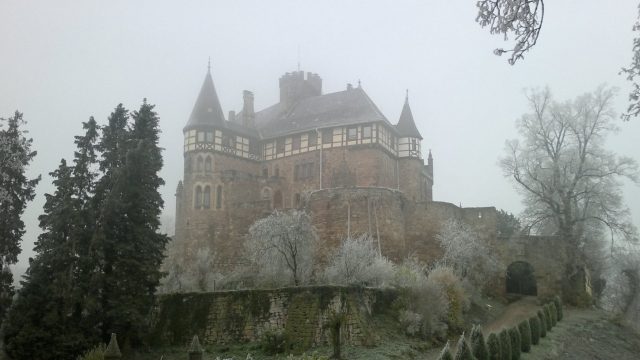
Berlepsch Castle, also known as Berleipse, Berlepse, or Berleiffen, is a three-winged complex with an inner courtyard and park, located approximately 400 meters northeast of the Witzenhausen district of Hübenthal in Hesse. The castle is only a few hundred meters from the state border with Lower Saxony and southwest of the Friedland district of Mollenfelde and the Neu-Eichenberg district of Hermannrode in the Göttingen district.
After the destruction of their ancestral castle Barlissen in the 14th century, the Berlepsch family settled on the Werra, where they already owned estates. Initially, they inhabited the Landgrave of Hesse's Bischoffhausen Castle. It was located above Bischhausen (today part of the Witzenhausen urban area on the left bank of the Werra) on the Badenstein (356 m above sea level). A little further north, near Hübenthal, Arnold von Berlepsch then had the "nuwe Hus Berleybischhin" built between 1368 and 1369 on the site of the present Berlepsch Castle. Since 1369, a defensive wall with a portal has enclosed the north side of the three-winged complex.
In 1369, Arnold von Berlepsch received the villages of Hübenthal and Albshausen, both now districts of Witzenhausen, from the Hessian Landgrave Heinrich II. He also received Hermannrode (today a district of Neu-Eichenberg) and Grebenhain as fiefs, and the family was appointed hereditary chamberlains. After the death of Arnold's son Hans von Berlepsch, who remained childless, the castellan Thilo von Berlepsch from Ziegenberg took possession of the castle in 1392 against the will of the Landgrave. In 1400, the castle was destroyed by Hessian troops and rebuilt. In 1461, the knight Sittich von Berlepsch was enfeoffed with the castle; he surrounded the castle with strong walls and reinforced it with towers and zwinger. In 1593, the stair tower with a Renaissance portal was erected.
During the Thirty Years' War, Tilly's mercenaries plundered and burned the castle in 1623. In 1625, Wallenstein's troops attacked the castle, and in 1631, the castle was once again devastated by Tilly's troops. In addition to Tilly and Wallenstein, the troops of Aldringen and Fugger also ravaged the area around 1631 and 1632. Villages were plundered and Berlepsch Castle was devastated. Richard von Berlepsch calculated the damage at 2813 thalers. After armies from Braunschweig and Hesse fought against Gottfried Heinrich zu Pappenheim in the area of the Leine and Diemel in the spring of 1632, Pappenheim took Richard von Berlepsch prisoner as a hostage for unpaid sums. Two years after his ransom, Richard died in 1635. The family's prosperity declined due to the ongoing fighting. Lands could not be cultivated, and some of the buildings of the estates and outworks lay in ruins. Berlepsch, Ellerode, Hübenthal, and the farm at Gladebeck had been completely burned down, the family's debt amounted to 48000 thalers, while the consequences of the war did not subside. In 1636, an imperial army marched from Göttingen through the lands, provoking battles near Wendershausen, and a year later, the Croats, who had come into the area due to the arson ordered by Pappenheim in 1632, raged along the Werra. New war dangers in 1646 prompted the Berlepsch family to move the rest of their archives to a safe place.
On August 14, 1801, Goethe visited Berlepsch Castle. In 1809, Friedrich Ludwig von Berlepsch lived in the castle. From 1881 to 1894, Count Karl von Berlepsch and from 1893 his son Hans gave the castle its present appearance through extensive renovations and alterations, which also included a ceiling painting by Carl Wiederhold. These changes are exemplary of late Hanoverian Neo-Gothic and were planned by the architect Gustav Schönermark. The ornithologist Hans von Berlepsch established an ornithological collection in the castle, and Karl von Berlepsch occasionally gathered a circle of well-known poets at the castle. The coat of arms of the two Berlepsch lines is walled into the escutcheon on the outermost of the three gates.
After the Second World War, Berlepsch Castle was converted into a hotel with a restaurant by Hubertus von Berlepsch.
In 1980, both had to close because Hans-Sittich Graf von Berlepsch founded the Sannyasin Center Arvind for followers of Bhagwan at the castle. The Sannyasin Center was dissolved as early as 1982. In the following years, the Bhagwan followers rented apartments as a commune in the Hübenthal manor, which belonged to the Berlepsch family. The Bhagwan followers were responsible for the conversion and restoration of the former stable buildings and barns. They founded the Mandir Association, which purchased the twelve-sided, marble-lined meditation room in 2005. 35 members of the Bhagwan followers founded the Parimal Gut Hübenthal e.G. cooperative on October 31, 2007, which also purchased the 1st floor of the Green House on June 17, 2008. In addition to the kitchen and dining room, the Sangha community room and living space were created here. In 2014, the cooperative already had over 90 members. The remaining buildings are now used for a mix of residential and commercial purposes.
Since 2011, the castle has offered tourist attractions such as gastronomy, guided tours, and regular events. The gastronomic offerings embrace the "medieval" theme.
Complex+
Park
The park belonging to the castle dates from the 18th century and features characteristics of an English landscape garden. The castle chapel is located within it, just below and west of the medieval enclosure.
Tourism+
Berlepsch Castle offers two restaurants (Berlepscher Tafelrunde, Schlosstaverne) as well as guided castle tours with small exhibitions from the Berlepsch family inventory.
Since August 18, 2011, tourist signs on the A7 motorway point to Berlepsch Castle.
The Werra-Burgen-Steig, a long-distance hiking trail along the Werra from Hannoversch-Münden to the source of the Werra, passes Berlepsch Castle.
Take Mobile History with you
You are reading this text for free. Premium adds what matters on the road: descriptions read aloud, sites found through your camera, whole regions taken offline.
- Every description, including the ~17,700 Premium sites
- Audio guide: have descriptions read to you on location
- AR finder: see sites through your camera, with distance and bearing
- Unlimited saved sites
14 days free, then from €2.99 a month. Cancel anytime.
Source: Wikipedia · Licence: CC BY-SA 4.0 · Image: Jörg Heldt
This description draws on the facts documented in the linked Wikipedia article; Wikipedia content is licensed under CC BY-SA 4.0. Wording and editing: Mobile History.
Location: 51.3961, 9.8322