Nursing home
CastleRees-Haffen
Bellinghoven Castle
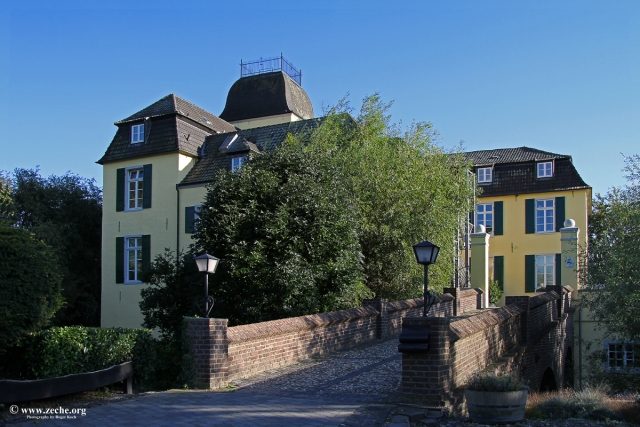
Bellinghoven Castle is a moated castle in Haffen, a district of Rees in the North Rhine-Westphalian district of Kleve. It is located six kilometers southeast of Rees in a former loop of the Rhine.
First mentioned in a document in the 14th century, the former castle was a fief of the Counts of Kleve. Partially destroyed by Spanish troops in the Eighty Years' War, the most important parts were subsequently rebuilt in the style of a castle and modified again in the 17th century. The complex is now used by the Caritas Association Oberhausen and can only be viewed from the outside.
The Beginnings
The roots of today's castle complex are to be found in a motte, which was probably an offshoot of the Oberhof in Mehr. The artificially raised earth mound, together with its wooden tower with a high entrance, was not only surrounded by a moat at the time, but also protected by a palisade. The castle's task was to protect the surrounding land. Gradually, it was expanded with stone buildings.
A Gerard von Bellinghoven was already mentioned in a document in 1206. The castle itself, however, was only mentioned in a document in 1325, when its construction by Dietrich von Bellinghoven († 1305) was completed and he enfeoffed it to Dietrich VII von Kleve on December 20 of that year. The castle thus became an open house for the Counts of Kleve. In 1470, Otto von Hetterscheid acquired the property, but granted his cousin Johann von Bellinghoven the right to buy it back for 300 Rhenish guilders. This must have happened - at least in part - because Johann and his wife Agnes sold their share of Haus Bellinghoven to the knight Wilhelm von Bernsau in 1481. The sale had become necessary due to high debts. In 1492, Wilhelm von Bernsau acquired from Johann von der Horst, Drost of the Dinslaken region, and his wife Maria also "half and their share" of Haus Bellinghoven and all associated rights.
Modern Era
During the Eighty Years' War, the castle was besieged by Spanish troops in 1598. After the castle garrison had been able to repel two attacks, the Spaniards conquered the complex on the third attempt, plundered it and murdered all inhabitants. A contemporary report on the event states: "two storms repelled, the third lost: everything plundered, and everyone who was on it murdered." The buildings partially burned down. After the Spaniards withdrew, the then castle owner Konrad von Bernsau had the most important buildings rebuilt in the style of a castle.
After Konrad's death in 1607, the Kleve bailiff in Bislich-Mehr-Haffen, Wyrich von Bernsau, succeeded him as owner. He had the castle supplemented with some additions and details on the buildings changed. During his time as castle owner, the Great Elector Friedrich Wilhelm of Brandenburg elevated Bellinghoven, including the parishes of Haffen and Mehr, to a lordship in 1649. Upon Wyrich's death in April 1656, his son Wilhelm inherited the complex. However, he mostly stayed in Holland, where his family also had possessions through his mother. In the Dutch War, French troops plundered and devastated the castle in 1672. It thus shared the fate of the nearby Sonsfeld Castle. Wilhelm belonged to the Reformed faith and gave the local Protestant church community permission to hold services in his Bellinghoven Castle every 14 days. However, this custom ended after his death under his Catholic son-in-law. Wilhelm's daughter Margareta had married Count Franz Kaspar Adrian Schellart von Obbendorf against her father's will. After his death, she entered into a second marriage with Franz Kaspar Schellart von Obbendorf, from which her only two children, two daughters, were born. The elder of the two, Elisabeth Henriette Maria Victoria, married Wilhelm Adrian von und zu Hoensbroech, hereditary marshal of the Duchy of Geldern, who resided at Haag Castle in Geldern, on July 26, 1695, and brought him Bellinghoven Castle in 1704 - after her mother's death in 1702.
With the permission of the Prussian king, Joseph von Hoensbroech sold the complex on July 1, 1788, to the Reformed preacher Johann Gottfried von Manger. He had the buildings of the then parliamentary manor house rebuilt and essentially gave the complex its present appearance. During the French period, von Manger held the office of mayor in the Mairie Haldern, but had lost the sovereign rights formerly associated with Bellinghoven due to the Napoleonic administrative reform. After von Manger's death in 1823, Bellinghoven changed hands several times through purchase and sale. Among these are the families Luyken, Münster, and Haniel.
Current Use
After the Second World War, the Walsum mining company acquired the complex. The associated land was given as compensation to farmers who had to give up their farms due to mining. The castle itself, with a little land, was left to the Catholic Youth Work in Duisburg-Hamborn. This passed it on free of charge in 1974 to the association "Die Brücke", which turned the building into a home for at-risk young people. For this purpose, extensive renovation work as well as conversion and expansion measures were carried out from 1974 to 1976. During this time, medieval pottery shards and bone remains were found in the castle courtyard. Since 1983, the Caritas Association Oberhausen has operated a therapeutic educational institution for young adults with mental disabilities in the castle.
Description+
Bellinghoven Castle stands on a rectangular, water-surrounded island, the entire area of which is occupied by a basement, above which the castle building with a mansard roof rises. The level of the island is slightly higher than that of the surrounding land, so the main access, a three-arched stone bridge on the northern long side, rises from the outer edge of the moat to the castle island. Another, narrow access exists on the east side. The eastern part of the island is occupied by a three-winged main building in a horseshoe shape, while the western part forms a kind of terrace. It is surrounded by a parapet wall and has slender, square corner towers with a tent roof. The two side wings of the main house are of different sizes: the younger northern one is narrower than its southern counterpart, and its two floors are lower than the two floors of the south wing. The central wing has a four-story tower in its middle with a baroque curved dome and a crowning viewing platform surrounded by a wrought-iron railing, as is also the case at Falkenlust Castle. The portal of the house located in the south wing is framed by four pilasters and shows simple stucco ornaments from the 18th century above the lintel.
The current buildings probably date from the 16th and 17th centuries, but stand on presumably older basements, as indicated by their significantly greater wall thicknesses. Outside the castle island, there are no ground structures that indicate a former garden or park. Such are also not recorded in old maps, and there is no indication of them in documents either. Bellinghoven Castle is thus one of the few manor houses on the Lower Rhine for which neither a garden nor a park can be proven.
Take Mobile History with you
You are reading this text for free. Premium adds what matters on the road: descriptions read aloud, sites found through your camera, whole regions taken offline.
- Every description, including the ~17,700 Premium sites
- Audio guide: have descriptions read to you on location
- AR finder: see sites through your camera, with distance and bearing
- Unlimited saved sites
14 days free, then from €2.99 a month. Cancel anytime.
Source: Wikipedia · Licence: CC BY-SA 4.0 · Image: http://www.zeche.org/
This description draws on the facts documented in the linked Wikipedia article; Wikipedia content is licensed under CC BY-SA 4.0. Wording and editing: Mobile History.
Location: 51.7428, 6.4820