To be privately owned
CastleBedburg
Bedburg Castle
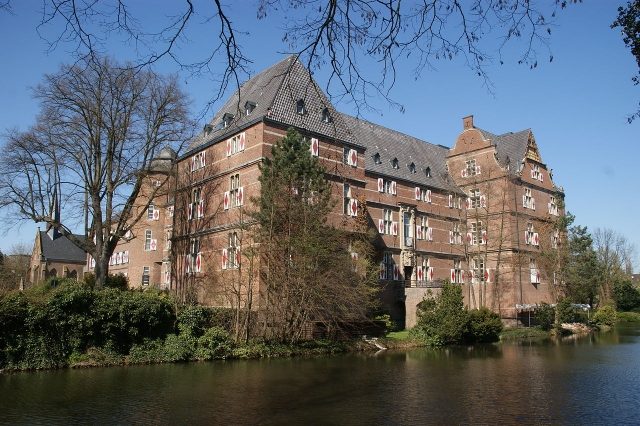
Bedburg Castle is a castle near Bedburg in the Rhein-Erft-Kreis in North Rhine-Westphalia, Germany.
Its origins lie in the 12th century, when a castle of the Lords of Bedburg was first mentioned. Located in the marshy Erft lowlands, the moated castle probably served to secure the Erft crossing. Only through extensive alterations and additions did the castle transform over time into the castle it is today.
Construction Phases+
The castle is characterized by several different construction phases, some of which are still recognizable today.
From the first construction phase of the moated castle, a tuff stone wall remnant is still preserved today in the cellar under the entrance hall. The castle was destroyed in 1278 by the Archbishop of Cologne, Siegfried von Westerburg.
Then followed a new construction of the Gothic moated castle by Johann von Reifferscheid. Received as a fief from Siegfried von Westerburg, he built a "castellated" complex with three wings around an inner courtyard, which were fortified by two rectangular and two round towers (which are still preserved today). Built of bricks, it is today one of the oldest brick castles in the Rhineland. Previously, castles were only built of wood and natural stones.
During the Truchsessian War, the castle was destroyed again in 1584, and Count Werner von Salm-Reifferscheid had a new building erected in Renaissance style. The square towers disappeared, the Renaissance staircase was created, and the two existing inner courtyard arcades were built. Presumably, the Jülich-Berg court architect Alessandro Pasqualini or one of his successors was the creator of these arcades. This marked the transition from a castle to a palace.
After its acquisition by the "Rhenish Knighthood" in 1839, the castle was converted into the Rhenish Knight Academy from 1842 to 1853 and expanded with a four-story school wing. At the same time, the chapel was built by Vincenz Statz.
In 1922, the Knight Academy ended, and the castle passed into the possession of the Neurath trade union. It served as an administrative center and was expanded and restored by the architect W. Felten. Among other things, the Neo-Baroque gatehouse on Graf-Salm-Straße was built.
In the 1970s, a first renovation was carried out by the newly founded castle association and the city of Bedburg. In 1980, it was then thoroughly restored by the so-called "Castle King" Herbert Hillebrand and made accessible for private and commercial use. The most recent renovation took place in the summer of 2008 (renovation of the knight's hall and taproom).
Take Mobile History with you
You are reading this text for free. Premium adds what matters on the road: descriptions read aloud, sites found through your camera, whole regions taken offline.
- Every description, including the ~17,700 Premium sites
- Audio guide: have descriptions read to you on location
- AR finder: see sites through your camera, with distance and bearing
- Unlimited saved sites
14 days free, then from €2.99 a month. Cancel anytime.
Source: Wikipedia · Licence: CC BY-SA 4.0
This description draws on the facts documented in the linked Wikipedia article; Wikipedia content is licensed under CC BY-SA 4.0. Wording and editing: Mobile History.
Location: 50.9961, 6.5773