Museum
Administration department
Town hall
Restaurant
CastleAulendorf
Aulendorf Castle
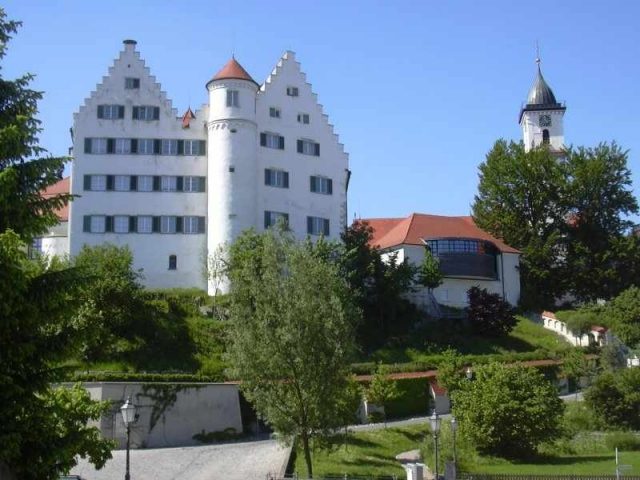
Aulendorf Castle is the landmark of the city of Aulendorf (Baden-Württemberg), built by the Counts of Königsegg-Aulendorf and is directly attached to the Catholic city parish church of St. Martin.
Significance+
The over 800-year history of Aulendorf Castle is reflected in a highly impressive manner in the variety of forms and styles of the current building complex. The oldest surviving structural elements of the original castle date back to the 12th century. After the Thirty Years' War, the now fortified 16th-century castle transformed into a Baroque residence. The crowning achievement of Aulendorf Castle's architectural development, which took its inspiration from contemporary French castle architecture, was the redesign of the main building into a representative palace.
Due to its outstanding and striking historical architectural value and the high artistic rank of its individual buildings, Aulendorf Castle represents a cultural monument of particular importance.
Nevertheless, the preservation of the castle complex was recently called into question. Inadequate partial use and neglected building maintenance led to enormous structural damage. A particular danger came from dry rot, which spread to almost all buildings within a few years. In some parts, the structural framework was already so weakened that shoring was necessary to secure the substance. In some rooms, parts of the stucco ceilings collapsed. The entire, almost empty interior was dilapidated. All attempts to counteract this decay failed due to the financial capabilities of the then monument owner. Only the transfer of the property to the state of Baden-Württemberg in 1987 paved the way for urgent rescue measures.
Since the state saw no immediate use for the castle, it specifically founded a holding company and entrusted it with both further substance preservation and the search for a use appropriate to the monument.
An adequate usage concept for the Aulendorf castle complex was finally established in 1992. It was possible to persuade the city administration to take over the two buildings, which were medieval in their core, and to establish a branch museum of the Württemberg State Museum in the Baroque and early Classicist buildings.
Another building from the 19th century houses the new council chamber for the municipal council.
With this unusual rescue measure – only possible through the great financial commitment of the state of Baden-Württemberg – the existence of this important cultural monument has been secured for future generations.
Builders+
The family of Königsegg acquired the former Welf, then Staufer, property in 1381. A Ulrich first called himself von Königsegg zu Aulendorf in 1386. Hans von Königsegg (1440 - 1484) moved the family crypt here. Around 1490, the Königsegg family was elevated to the status of Imperial Barons.
In 1629, they were elevated to the status of Imperial Counts. Subsequently, the Counts of Königsegg, who also frequently held high offices at the Viennese court, expanded Aulendorf into their residence. This continued until the end of the Imperial County, which belonged to the Swabian Circle, through the Confederation of the Rhine Act in 1806. Aulendorf was then assigned to the new Kingdom of Württemberg, and the Counts became Württembergian Standesherren (privileged nobility).
After the mediatization, the Counts of Königsegg retreated to Hungary and Vienna. Aulendorf was only temporarily inhabited, but was extensively modernized at the beginning of the 20th century. In 1941, the Counts sold the castle, which increasingly fell into disrepair under changing owners and passed to the state of Baden-Württemberg in 1987.
Aulendorf Castle, the landmark of the city of Aulendorf, situated on a hill above the Schussen, dominates the landscape far and wide with its Gothic stepped gables. Towards the city, however, it presents itself with its classicist show facade, whose central risalit is crowned by a copper count's coat of arms.
The building, which grew over centuries, unites five style epochs. Its various construction phases and uses are visible after the renovation in the castle courtyard and inside the building: including remnants of a massive castle complex from the early 13th century and a three-story half-timbered residential building from 1480. The castle owes its stepped gables to its expansion into a late Gothic residential castle in the 16th century.
In the 18th century, the castle transformed into a representative palace: in 1741, the complex was supplemented by the opposing farm buildings grouped around a kind of courtyard of honor, with stables and official residences. In 1756, the connecting building to the church was built.
From 1778 to 1781, the still defining redesign was carried out by Pierre Michel d'Ixnard, who expanded the city-side wing and clad it with an early Classicist facade. The last modernization was initiated around 1900 by a Viennese architectural firm. A magnificent main staircase leads to the bel étage.
Johann Georg Dirr provided the designs in 1778 for the stucco decoration in the Marble Hall with depictions of the four elements and the seasons, and in the Music Salon with allegories of the arts. Alabaster reliefs above the doors of the Marble Hall show scenes from ancient mythology. The Music Salon alone contains wallpapers from around 1800. The adjoining rooms were extended in the late 19th century with ceiling stucco and wall paneling in the Classicist style.
The catastrophic structural condition at the end of the 20th century initially led to thoughts of partial demolition, until the state formed a holding company in 1989 to save the castle and provided the financial resources. The concept for the restoration was developed in cooperation with the State Office for Monument Preservation. The construction measures were completed in 1997.
Current Use+
The older parts of the castle now house the city hall, while the younger Classicist wings on two floors accommodate a branch museum of the Württemberg State Museum Stuttgart. In the basement, there is a cozy café.
Toy Museum
The toy collection of the Württemberg State Museum Stuttgart is displayed in the former library on the ground floor of the castle. In four rooms, toys from the beginning of the 18th century to the present day can be found.
The oldest part of the collection consists of dolls, some of which still belong to the Baroque period. Many of the historical dolls come from the possession of the well-known Ludwigsburg writer Tony Schumacher (1848-1931). A selection of dollhouses, doll's rooms, and doll's kitchens reflects the development of domestic life since the Biedermeier era.
Artistic wooden toys document the reform movement at the end of the 19th century, which demanded sophisticatedly designed toys. However, the wooden toy collection also includes the traditional products of Erzgebirge craftsmanship.
Construction and experiment kits, steam engines and drive models, optical, acoustic, and electrotechnical apparatuses represent the broad field of technical educational toys, which were intended to impart knowledge of natural sciences and technology.
The most extensive part of the collection, however, is the model railway toys with products from the renowned Württemberg manufacturers Rock & Graner, Ludwig Lutz, Märklin, and Kibri.
Art of Classicism
The castle offers an ideal setting for works of Classicist art, as its representative rooms, the staircase, the music salon, and the marble hall date from this period.
The cool and elegant atmosphere of the castle results from the clear lines and a strict ornamentation influenced by antiquity. This reflects the new taste. It is a consequence of the changed view of the world and humanity that the Enlightenment opened up. The ideals now propagated find their expression in the exhibited sculptures, furniture, and paintings.
Marble copies of ancient artworks speak for the newly awakened longing for antiquity. Sensitive depictions of deceased relatives stand for the pleasure of mourning and the display of emotion. Idyllic landscape paintings convey the new ideas, shaped by Rousseau, of life in harmony with nature and simplicity.
Ancient heroes, rediscovered as models of republican virtues, are presented in decorative historical paintings. In the portraits, the people who lived in the age of absolutism and the Enlightenment come alive.
Take Mobile History with you
You are reading this text for free. Premium adds what matters on the road: descriptions read aloud, sites found through your camera, whole regions taken offline.
- Every description, including the ~17,700 Premium sites
- Audio guide: have descriptions read to you on location
- AR finder: see sites through your camera, with distance and bearing
- Unlimited saved sites
14 days free, then from €2.99 a month. Cancel anytime.
Source: Wikipedia · Licence: CC BY-SA 4.0 · Image: http://de.wikipedia.org/wiki/Datei:AulendorfSchloss.jpg
This description draws on the facts documented in the linked Wikipedia article; Wikipedia content is licensed under CC BY-SA 4.0. Wording and editing: Mobile History.
Location: 47.9540, 9.6384