The Castle can't be visited
CastleAub
Aub Castle
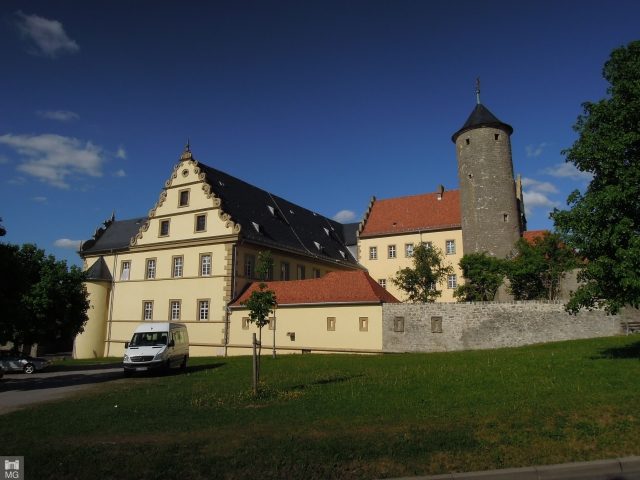
Aub Castle is a castle in the town of Aub in the Lower Franconian district of Würzburg (Bavaria).
The castle is located in the southwesternmost corner of the town and occupies the highest position. It is integrated into the town's fortifications.
Parts of the Romanesque castle of the Hohenlohe family, dating from the 13th century and reaching down to the bottom of the moat that still exists on the north side, are the last remnants of the original castle. However, they are no longer recognizable from the outside. In a pledge document from 1369 by Gerlach von Hohenlohe to the Rothenburg citizens Holtschuher and Goltsmit, the fortress in Awe belonging to the Hohenlohe family is mentioned in writing for the first time.
The oldest still visible part of the castle consists of remnants of the later castle with a castle house and keep, which date back to the Truchsess von Baldersheim, who held the court office of Truchsess (Latin "dapifer") with the Hohenlohe family, meaning he was responsible for administrative tasks, housekeeping, food, and drinks. In the castle's and hospital's cellars, the tithe wine, which the former winemakers of the Gollach valley had to deliver, was stored. Several of Aub's numerous inns also formerly possessed the so-called brewing rights.
The etymological meaning of the word Truchsess comes from the fact that he presided over the retinue. Truchsess therefore roughly means chairman of the retinue. The depicted representation of the town and castle is a Wandereisen woodcut from 1523. The town was attacked and plundered by the Swabian League because members of the local Rosenberg family conspired with the robber knight Thomas von Absberg.
In 1436, when Aub's defensive wall with its then 15 towers was completed after three decades of construction, the ownership of the Aub urban area was divided. Since then, the castle, together with the opposite tithe court, where farmers had to deliver their grain payments (now privately owned, recognizable by the high archway of the courtyard entrance), and the other houses between the upper market row and today's Johannes Böhm Street, formed the Truchsess quarter.
Aub Castle was a Ganerbenburg (jointly inherited castle), and after the extinction of the Hohenlohe family (around 1390), the Aub urban area belonged half to the Weinsberg family, a quarter to the Truchsess family, and a quarter to the Rosenberg family. With the extinction of the Weinsberg family (between 1507 and 1521), later the Truchsess family (1602), and finally the Rosenberg family (1632), the Aub property fell piece by piece to the Prince-Bishopric of Würzburg. Prince-Bishop Julius Echter von Mespelbrunn renovated it - together with the hospital and the town church - in the course of the Counter-Reformation, converted it into the seat of the Aub office in the Late Renaissance style, and made it one of his hunting lodges, which was also used by later Prince-Bishops of Würzburg. On the keep, there is a griffin as a weather vane, bearing the coat of arms of Prince-Bishop Johann Philipp von Greiffenclau. It is the same coat of arms that also adorns the entrance of house No. 16 in Mühlstraße at the foot of the Mangsteige.
Take Mobile History with you
You are reading this text for free. Premium adds what matters on the road: descriptions read aloud, sites found through your camera, whole regions taken offline.
- Every description, including the ~17,700 Premium sites
- Audio guide: have descriptions read to you on location
- AR finder: see sites through your camera, with distance and bearing
- Unlimited saved sites
14 days free, then from €2.99 a month. Cancel anytime.
Source: Wikipedia · Licence: CC BY-SA 4.0 · Image: Mobile Geschichte
This description draws on the facts documented in the linked Wikipedia article; Wikipedia content is licensed under CC BY-SA 4.0. Wording and editing: Mobile History.
Location: 49.5511, 10.0645