To be privately owned
CastleRoitham
Au Castle
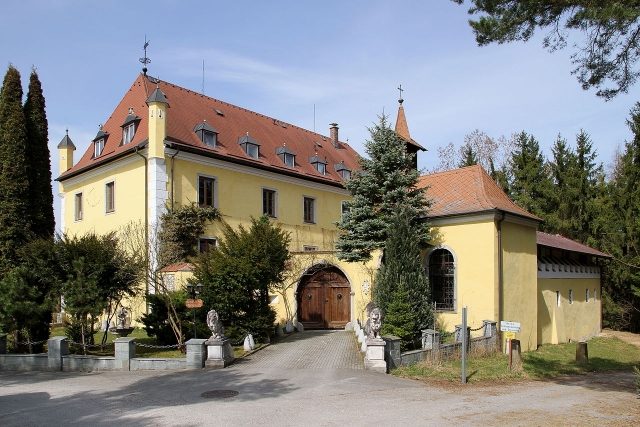
Au an der Traun Castle is located in the village of Roitham in the Gmunden district of Upper Austria. It is a protected monument.
Au an der Traun was probably built around 1100 as a fortified castle and was a knightly fief of the Lords of Ort Castle near Gmunden. In 1363, a Wernhart der Awer is mentioned. The name Au is first documented in 1446 in the "Wallseerisch Lehensbuch usque 1446" as "a seat in Rewthaim auf der Au with its appurtenances". Without this being individually verifiable, it can be assumed that Au Castle was built by the Wallsee family, who had come to Austria with the Habsburgs and were keen to build up their own knightly retinue. In 1492, a Hans of a knightly family originating from Theuerwang is named as the owner. Later, Au is referred to as a Liechtenstein fief. In 1517, Au was owned by Hans Pinter von der Au from Gmunden. He was succeeded by Albrecht Kynast von Tamberg. In 1535, Au was owned by the Raidt family. Ulrich Raidt's daughter married Balthasar Wiellinger in 1557, and thus Au came to the Wiellinger family, who henceforth called themselves "von Au". In 1571, Au came into the possession of Gotthard von Salburg by purchase. In 1602, the imperial iron chamberlain David Seebacher appears as the owner; around 1639, Georg Wilhelm von Fränking is the holder of the now princely fief. In 1642, Au came to Johann Fördl, who was freed from the fiefdom by Emperor Ferdinand III upon payment of 300 fl. In 1651, Johann Baptist Kuttner von Kutniz bought the "ancient noble country estate Au an der Traun" including its jurisdiction and hunting rights. On May 30, 1653, the abbot of the Benedictine monastery of Lambach, Placidus Hieber von Greifenfels, acquired the "ancient noble country estate Au an der Traun".
The estate, which served as a recreation and hunting lodge, was sold in 1820 to the monastery's court clerk, Franz Gebhard Hofbauer, due to the effects of the Napoleonic Wars. In 1824, Franziska Hofbauer sold the castle to Johann Solterer von Mühlwang. Further owners in the following decades were Count Erich von Bentzel Sternau (1878), Count Georg von Kesselstatt (1897), Max August de la Vigne von Erkmannsdorf (1911) and Anna Lise de la Vigne (1943), married Ruttnig. Since 1968, it has been owned by the son Johann Ruttnig and his family.
In 1925, the "German School Home on the Traun" was housed in the castle. The educational home on the Traun ("Traunschulheim") was designed according to the principles of the rural school movement (Wandervogel). It was intended to serve a völkisch and religious youth education without affiliation to a political party. From 1925-1938, a Realschule (i.e., a grammar school with a strong emphasis on "realia") for boys (and girls) from the age of 10 was run here, with Latin as a subject in the upper grades, which enabled access to colleges and universities in Austria and Germany. Emphasis was placed on art (music), physical education, and handicrafts (also gardening, agriculture; principle of the "work school"). The first director was Kurt Picker; from 1928, a Dr. Otto Richard Flatter (Altona) was entrusted with the management. In 1927, it was decided to found a school newspaper ("Der Auer Bote", later also called "Aus der Chronika derer von Au"), which was intended to facilitate exchange with the "Association for Rural School Homes of the German Youth Movement" and to maintain cohesion with parents. At the same time, this school newspaper was intended to be a supplement to the "Newsletter of the Association for Rural School Homes of the German Youth Movement". Approximately 30 pupils are believed to have been housed in the home.
During the Second World War, it housed a home economics school for women of the National Socialist People's Welfare.
A variant of the legend of "The Wild Hunt and the Wild Hunter" is also associated with the castle.
Description+
Au Castle is situated on a rock above the Traun river. It is a rectangular, three-story building with small corner turrets, a gabled roof, and a weak curtain wall. The wall does not enclose the castle but is built onto the building and extends the walls. To the east is the freestanding castle chapel from around 1660, dedicated to St. Apollonia. The altar in the chapel is by Joachim von Sandrart. Behind the chapel are two outbuildings, connected to the castle by a wall. A postern with a small turret is integrated into this wall. As can be seen in Georg Matthäus Vischer's engraving from 1674, a bridge formerly led over a moat to the castle courtyard. This moat was filled in 1911. Access still leads through the corresponding stone portal. The castle building has hardly changed in the last 300 years.
In 2011, a fire destroyed the knight's hall in the castle. According to fire experts, the cause was heat accumulation in a fireplace stove.
Take Mobile History with you
You are reading this text for free. Premium adds what matters on the road: descriptions read aloud, sites found through your camera, whole regions taken offline.
- Every description, including the ~17,700 Premium sites
- Audio guide: have descriptions read to you on location
- AR finder: see sites through your camera, with distance and bearing
- Unlimited saved sites
14 days free, then from €2.99 a month. Cancel anytime.
Source: Wikipedia · Licence: CC BY-SA 4.0 · Image: http://commons.wikimedia.org/wiki/File:Roitham_-_Schloss.JPG
This description draws on the facts documented in the linked Wikipedia article; Wikipedia content is licensed under CC BY-SA 4.0. Wording and editing: Mobile History.
Location: 48.0259, 13.8181