Museum
CastleAtzenbrugg
Atzenbrugg Castle
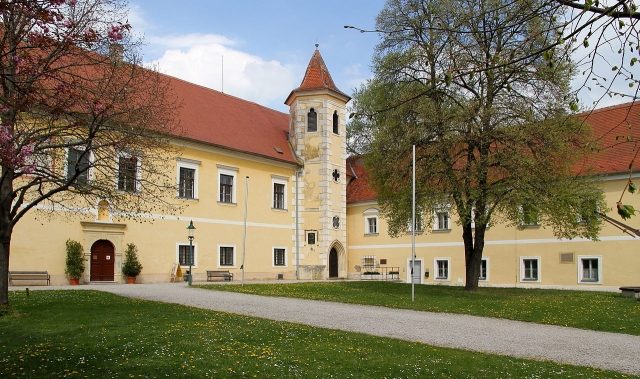
Atzenbrugg Castle, a former country castle in Atzenbrugg in the western Tulln Basin, Lower Austria, is a museum dedicated to the life and work of the composer Franz Schubert.
A "Herrschaft," a landed estate, in the area of today's market town of Atzenbrugg is documented as early as the early 12th century. The name of the place is attributed to its owner, Azzo. There is also evidence of Celtic and Carolingian inhabitants. Around 1190, a woman Gertrud von Azzenpruck is mentioned, and since 1313, a coat of arms of the Lords of Azenbruck has been traceable. The building history of the current castle can be traced back to the Middle Ages. Initially, this castle had a moated ditch. Since 1379, the country castle was owned by Klosterneuburg Abbey, and in 1398, an existing chapel was extended and consecrated to Saint Catherine.
During the second Turkish siege (1683–1686), severe damage occurred, and in 1691, repairs were carried out by the Italian stucco artist Domenico Piazzol. Around 1746, further restoration work took place.
Development into the Schubert Museum+
In the early 19th century, the legal advisor Joseph Derffel (born around 1766, died after 1843) was the estate manager of the Herrschaft. Through his nephew Franz von Schober, the composer Franz Schubert and many of his friends (including the Spaun family, Leopold Kupelwieser, Moritz von Schwind, Eduard von Bauernfeld) visited Atzenbrugg several times for a few days and entertained themselves there with music and ball games, among other things. Schubertiads took place there for several years.
Towards the end of the 20th century, the activities of a number of Schubertians – including Rosa Schwab (1921–2009) – led to concert cycles by internationally celebrated Schubert interpreters, such as Robert Holl, who provided the proceeds for the renovation of the castle and the establishment of a Schubert Museum. The lock of Schubert's hair, exhibited as a "loan from the private collection of Ernst Hilmar," actually comes from the estate of Schubert researcher Ignaz Weinmann, which belongs to the Wienbibliothek. While Hilmar was head of the music collection of this library, parts of this estate found their way into the Viennese antiquarian book trade, and Schubert's lock of hair also disappeared from the Wienbibliothek's inventory. As can be seen from the clearly visible insect eggs, this lock definitely comes from Schubert's exhumation in 1863.
The castle has been owned by the municipality since 1977.
Take Mobile History with you
You are reading this text for free. Premium adds what matters on the road: descriptions read aloud, sites found through your camera, whole regions taken offline.
- Every description, including the ~17,700 Premium sites
- Audio guide: have descriptions read to you on location
- AR finder: see sites through your camera, with distance and bearing
- Unlimited saved sites
14 days free, then from €2.99 a month. Cancel anytime.
Source: Wikipedia · Licence: CC BY-SA 4.0 · Image: http://de.wikipedia.org/wiki/Schloss_Atzenbrugg#mediaviewer/Datei:Atzenbrugg_-_Schloss_%282%29.JPG
This description draws on the facts documented in the linked Wikipedia article; Wikipedia content is licensed under CC BY-SA 4.0. Wording and editing: Mobile History.
Location: 48.2924, 15.9057