To be privately owned
CastleEichenberg
Arnstein Castle (Eichenberg)
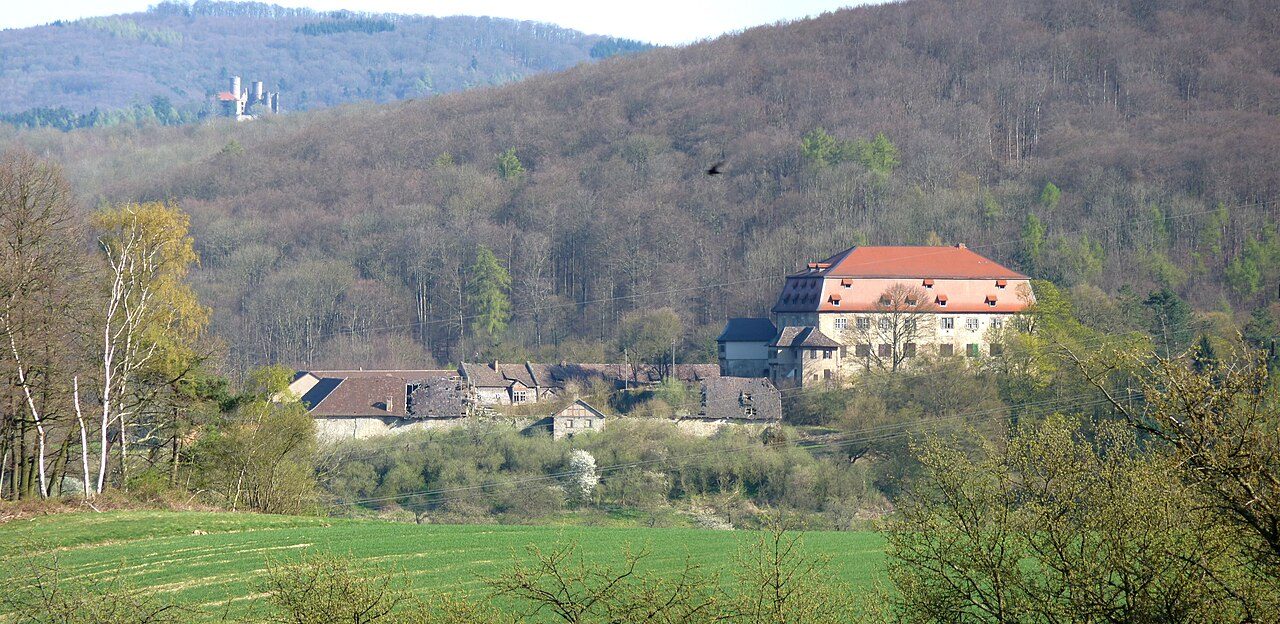
Arnstein Castle is a manor house that emerged from an originally late Gothic castle, was redesigned several times, and is located in the Eichenberg district of the municipality of Neu-Eichenberg in the Werra-Meißner district of northern Hesse.
The castle is located about 1.2 km south-southeast of Eichenberg on a narrow ridge 263 m above sea level, east and above the B 80/B 27 and the Halle-Kassel railway line or the Werra Valley line of the Hanoverian Southern Railway from Kassel via Hann. Münden and Eichenberg to Göttingen. To the north of the castle is a large two-winged manor farm from the 19th century.
The original castle complex probably dates from the 12th century and was presumably built as a border castle against Braunschweig and against the Mainz Eichsfeld. Arnstein was probably one of the "eight fortified places" on the lower Werra mentioned by the chronicler Johannes Rothe, which the Wettin Landgrave of Thuringia, Henry the Illustrious, in the treaty with Sophie of Brabant in 1264, which ended the Thuringian-Hessian War of Succession (1247–1264), transferred to her son, Landgrave Henry I of Hesse, in return for his renunciation of further inheritance claims in Thuringia.
The castle was subsequently pledged several times. For example, in 1337, the Lords of Rusteberg are mentioned as pledge holders. However, they acted as robber knights from Arnstein, thereby incurring the wrath of Archbishop Henry III of Virneburg of Mainz and the Landgrave of Hesse. These two joined forces in 1342 to punish the Rustebergers. The Rustebergers were driven from Arnstein, and the Lords of Berlepsch took their place. A document from 1366 attests to a preferential grant of pledge money by the Hessian Landgrave to the von Berlepsch family to erect further buildings on Arnstein. A document from 1371 mentions Arnold and Hans von Berlepsch, Odomar von Bodenhausen and his wife Mechthild von Rusteberg, as well as the brothers Thilo and Heinrich von Rusteberg, as pledge holders of Arnstein Castle. The castle was destroyed in 1396 but rebuilt. From 1434, it was a Hessian landgravial fief of the Lords of Bodenhausen, who, through marriage and inheritance, succeeded the Rusterbergers, who died out in the male line in the 1430s, and owned the property until 1938.
Around 1600, the castle was demolished and the three-story, castle-like manor house was built. In 1623, during the Thirty Years' War, it was devastated by Tilly's troops. By 1750, the manor house was already very dilapidated. Complete destruction occurred in 1760, during the Seven Years' War, by the French occupation and Prussian artillery.
Current Complex+
During the reconstruction of the severely dilapidated buildings at the beginning of the 19th century, the mighty late medieval structure was transformed into a two-story castle with a mansard roof, to which a terraced garden was added around 1804. The castle is a largely uniform, rectangular rubble stone building with corner quoins and a baroque portal. On both sides of the narrow side facing the manor farm, there is a small pavilion from the renovation phase around 1600, each with a solid ground floor and a half-timbered upper floor with an ornamented sill and ornamented infill timbers, of which the left (western) one serves as a gatehouse.
The complex is privately owned. A visit is not possible.
Take Mobile History with you
You are reading this text for free. Premium adds what matters on the road: descriptions read aloud, sites found through your camera, whole regions taken offline.
- Every description, including the ~17,700 Premium sites
- Audio guide: have descriptions read to you on location
- AR finder: see sites through your camera, with distance and bearing
- Unlimited saved sites
14 days free, then from €2.99 a month. Cancel anytime.
Source: Wikipedia · Licence: CC BY-SA 4.0 · Image: Jan Stubenitzky (Dehio) / CC BY-SA 3.0 via Wikimedia Commons
This description draws on the facts documented in the linked Wikipedia article; Wikipedia content is licensed under CC BY-SA 4.0. Wording and editing: Mobile History.
Location: 51.3601, 9.9075