District Court
School
CastleAlzey
Alzey Castle
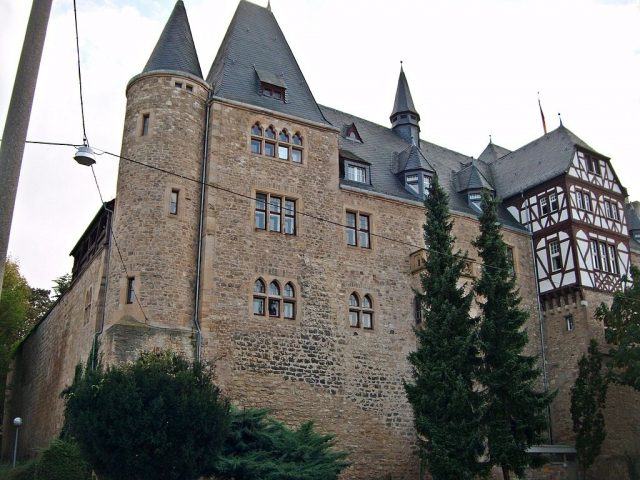
Alzey Castle probably originated from a Staufer imperial castle and was expanded into a castle in the 16th century.
It was destroyed in 1689 during the War of the Palatine Succession and only rebuilt at the beginning of the 20th century by the Grand Duchy of Hesse. Before its destruction, the castle was the seat of the district administration and today houses the district court of Alzey and the girls' boarding school of the Alzey Aufbaugymnasium.
Building Structure+
It is a rectangular castle complex on the eastern edge of the old town center, which was rebuilt from a ruin around 1905. Historical pictorial material largely served as a template for this. To the east, towards the formerly open terrain, it has a mighty shield wall; to the west, towards the town, it adjoins the town wall with an outer bailey. Two gates lead through it into the outer bailey. To the south is the so-called Friedrichsbau, now used as a boarding school; to the north is the imposing ensemble of the Philipps- and Ludwigsbau, which serve as the district court and courthouse. In the southwest corner sits a widely visible, thick round tower, which was built as a gun tower under Elector Friedrich I. In the northwest corner stands a gate tower, through which the only entrance to the castle led from the outer bailey. A curtain wall with parts of a battlement, which formerly ran completely around the complex, surrounds the inner castle.
Origin+
The origin of the castle in Alzey cannot be precisely dated today. However, it was built at the earliest in 1125 after the Staufer family came into possession of the imperial estate in Alzey.
Before the Staufer Duke Friedrich II took over the imperial estate, a flourishing manor existed in Alzey. Whether this was already fortified is not clear. Duke Friedrich II was experienced in castle building and would also have had political interest in a fortification in Alzey. It is therefore quite possible that he laid the foundation stone for Alzey Castle. However, this cannot be clearly proven. It could therefore be that not Duke Friedrich II, but only his son Palatine Count Konrad, who had spent his childhood in Alzey, initiated the construction of the castle. At least he seems to have considered Alzey as a seat of power. However, no corresponding activities of the Palatine Count in Alzey can be proven.
After Konrad's death, Alzey came into the possession of the Welfs through the famous love marriage of his daughter Agnes with Heinrich the Long, but they showed no interest in this "distant possession". This epoch (1195–1213) is therefore rather unlikely as a founding date.
Only in 1214, when Alzey fell to the Wittelsbach Palatine Count Ludwig I, would have been another favorable time to erect a castle in Alzey. This third variant for the time of the castle's origin could be based on two considerations: firstly, no building components dating from before 1200 have been found at the present castle, and secondly, a castle (castrum) Alzey is mentioned for the first time in 1278. This could indicate that the construction of the castle had only taken place shortly before.
This could also explain the "great dispute" of 1260, in which the town fortifications were damaged. At that time, the citizens of Worms, for whom the lords of Alzey Castle had long been a thorn in their side, attacked the town. The construction of a castle could have been the trigger for the aggression.
For all possible periods of the castle's origin in Alzey – around 1125, around 1168, and shortly after 1214 – neither written sources nor archaeological findings can be presented. It is also not possible to say exactly what the early castle complex might have looked like. It was probably a motte-and-bailey castle.
Legend of the Raugravial Castle
Older historical research, in particular, has assumed that a fortification was already built in Alzey in the 11th century. This assumption goes back to the tradition handed down by the Sponheim abbot Johannes Trithemius. However, this anecdote has been exposed as improbable by modern research.
First Documented Epoch
The complex is first mentioned in 1278. At that time, Werner Truchsess von Alzey, the founder of the Cistercian convent Sion in Mauchenheim, was in command of the castle. The ministeriales of Alzey had been granted the title of Truchsess von Alzey in 1190. They were probably commissioned with the construction of the castle. After its completion, it was then left to them by the builders – i.e., either the Staufer or the Palatine Counts – as an hereditary fief. A typical procedure at the time, which was quite advantageous for both sides. The builder did not have to worry about the administration, manning, and maintenance of his castle. His feudal sovereignty also secured him a say in the future of the castle.
In Alzey, however, this system worked poorly. The Truchsesses regarded the feudal castle as their own property and used their gained position in Alzey to build up their own sphere of influence between the Rhine and the Donnersberg.
Take Mobile History with you
You are reading this text for free. Premium adds what matters on the road: descriptions read aloud, sites found through your camera, whole regions taken offline.
- Every description, including the ~17,700 Premium sites
- Audio guide: have descriptions read to you on location
- AR finder: see sites through your camera, with distance and bearing
- Unlimited saved sites
14 days free, then from €2.99 a month. Cancel anytime.
Source: Wikipedia · Licence: CC BY-SA 4.0 · Image: http://de.wikipedia.org/wiki/Datei:Alzey_Burg_Nordostecke1.JPG
This description draws on the facts documented in the linked Wikipedia article; Wikipedia content is licensed under CC BY-SA 4.0. Wording and editing: Mobile History.
Location: 49.7460, 8.1163