To be privately owned
CastleAltshausen
Altshausen Castle
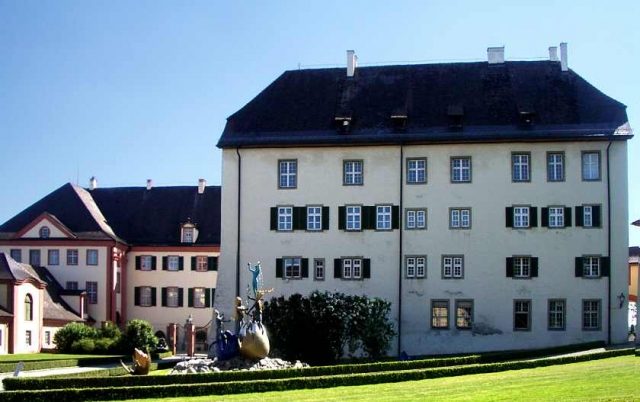
Altshausen Castle in Altshausen (Ravensburg district, Upper Swabia) was the residence of the Land Commander of the Teutonic Order Bailiwick of Swabia-Alsace-Burgundy and is today the residence of the head of the House of Württemberg, Carl Duke of Württemberg, and part of the administrative buildings of the Court Chamber of the House of Württemberg.
Castle of the Counts of Altshausen
Altshausen Castle was the seat of the Counts of Altshausen, Gau Counts of Eritgau, first mentioned in 1004. Here, on July 18, 1013, Hermann the Lame (Hermannus Contractus) was born as the son of a Count Hermann. At the age of seven, the boy was handed over to Reichenau Monastery as an oblate. Later he became one of the great scholars of the Middle Ages. His astronomical knowledge, his spiritual compositions still performed today, and his world chronicle made the paralyzed monk famous. After his death on September 24, 1054, Hermann the Lame was buried in the family crypt of his father's Altshausen Castle; the burial site is no longer known today.
Residence of the Teutonic Order
In the 12th century, the Counts of Altshausen moved to Veringen and subsequently called themselves Counts of Veringen. Altshausen Castle and village came into the possession of the Imperial Chamberlains of Bigenburg in 1246, who donated it to the Teutonic Order in 1264. The first settlement of the Teutonic Order in Marbach near Saulgau had already taken place in 1228. The Teutonic Order house founded in 1264 on Bigenburg (also called Beienburg) was moved to Altshausen in 1268. In 1444, the Altshausen Commandery was subsequently elevated to the seat of the Alemannic-Swabian Teutonic Order Bailiwick of Swabia-Alsace-Burgundy, after Beuggen Castle, and thus became the permanent residence of the Land Commander.
After a devastating fire in 1434, which also did not spare the town of Altshausen, only remnants of walls remained of the Old Castle, parts of the ground floor in the Old Castle. A new building was immediately erected on the ruins, which was rebuilt and enlarged again in 1544 and 1589. During the Thirty Years' War, Swedish troops set the Old Castle on fire. The upper floors burned out and were rebuilt in Renaissance style from 1655. In the 17th century, the castle complex no longer met the representational requirements as the seat of a Land Commander, so the construction of a new castle was undertaken. The Old and New Castles were connected by the Capuchin building with arcades on the courtyard side on the ground floor. In 1691, work began to enlarge the New Castle by extending its main wing to the east. These works lasted until 1710.
In 1729, the Teutonic Order commissioned Johann Caspar Bagnato as master builder with the task of planning an extensive castle complex. A design in the form of an intarsia picture by Franz Josef Denner is contained in the Württemberg State Museum in Stuttgart. However, only fragments of this planning were executed, for example, the riding stable (1729–31), the gate building as a seminar building, the utility buildings connecting the gate building with the New Castle and the riding stable (since 1732), the riding school (1733), and the official residences in front of the castle (since 1741), today partly school buildings, partly in municipal and private ownership. A stately avenue led straight to the border of the small dominion. Here, around 1800, the Teutonic Order had a maze and a lake park with an extensive canal system, artificial islands, and romantic buildings laid out. It is also noteworthy that the castle complex and the avenue built by Bagnato were aligned symmetrically with Jerusalem. Over the several thousand kilometers long distance, the symmetry deviates only by a few kilometers to the northeast.
On the Old Castle, the coat of arms of Land Commander Hugo Dietrich von Hohenlandenberg with the year 1589 is found, which was probably moved from another location. Above the entrance to the New Castle, on the gable, are the coats of arms of Grand Master and Teutonic Master Franz Ludwig von Pfalz-Neuburg (1694-1732), brother of the Elector Palatine, then below left the black cross of the Teutonic Order and below right the coat of arms of Land Commander Marquard Franz Leopold von Falkenstein (1709-1717 Land Commander). In the church, a huge triple coat of arms was placed on the chancel arch: In the center appears the coat of arms of Grand Master Elector Clemens August of Cologne (from the House of Wittelsbach), below left the cross of the Teutonic Order, below right the coat of arms of Land Commander Philipp von Froberg.
In 1750, the renovation of the rooms in the New Castle began, and the castle church of St. Michael was baroqueized (1748–53). When Bagnato died on Mainau in 1757, his son Franz Anton Bagnato continued the work. He completed the New Castle, the church, and built the garden pavilion around 1774. Around 1780, the expansion of the park facilities in the Hartwald on the border with the territory of Weingarten Monastery began. At that time, the Hartweiher was transformed into a lake park. One could row through the forest on kilometers of canals.
Residence of the House of Württemberg
After the dissolution of the Teutonic Order in the German Empire (1809), its possessions passed to the state. Initially, the Teutonic Order dominion of Altshausen went to Bavaria, before it fell to Württemberg in 1807. King Friedrich of Württemberg exchanged Altshausen Castle with extensive estates and forests from the state of Bavaria for the dominion of Weiltingen in 1810; he acquired the estates for the family property. The castle remained uninhabited until after the First World War. Before the construction of the railways, it served as an intermediate station for the royal family's travels from Stuttgart to Friedrichshafen, but also for occasional hunting stays. A court chamber office housed in the castle administered the private property of the Württemberg royal family in Upper Swabia.
With the relocation of the ducal family after the end of the monarchy, the estate experienced a new revitalization after the First World War. In 1919, Duke Albrecht (1865–1939) moved from Stuttgart to Altshausen, after King Wilhelm II had left him the castle as a residence. Three years later, after the death of the last Württemberg king, Altshausen Castle, with the entire court chamber estate, passed into the possession of the younger line of the House of Württemberg. Today it is owned by Carl Duke of Württemberg, the grandson of Duke Albrecht. Since the death of his father Philipp in 1975, Carl has lived with his family in Altshausen Castle. Various elaborate construction measures in recent years have served to preserve Altshausen Castle and its facilities for future generations.
Further Sights+
The castle itself is private property and cannot be visited; the former orangery can also only be seen from a distance. However, the public part of the park and St. Michael's Church with the chapel established in 2003, in which the completely preserved Baroque Holy Sepulchre of Altshausen from 1763 is displayed, are freely accessible. Altshausen Castle presents itself as a complex where important Baroque building principles can still be observed today.
- Castle and Parish Church of St. Michael
- Crypt with the tombs of 21 Land Commanders [not accessible]
- Current burial place of the House of Württemberg with 16 sarcophagi
Take Mobile History with you
You are reading this text for free. Premium adds what matters on the road: descriptions read aloud, sites found through your camera, whole regions taken offline.
- Every description, including the ~17,700 Premium sites
- Audio guide: have descriptions read to you on location
- AR finder: see sites through your camera, with distance and bearing
- Unlimited saved sites
14 days free, then from €2.99 a month. Cancel anytime.
Source: Wikipedia · Licence: CC BY-SA 4.0 · Image: http://de.wikipedia.org/wiki/Datei:Altshausen_Schloss_Alter_Bau_2005.jpg
This description draws on the facts documented in the linked Wikipedia article; Wikipedia content is licensed under CC BY-SA 4.0. Wording and editing: Mobile History.
Location: 47.9356, 9.5378