Cultural center
Museum
CastleAltranstädt
Altranstädt Castle
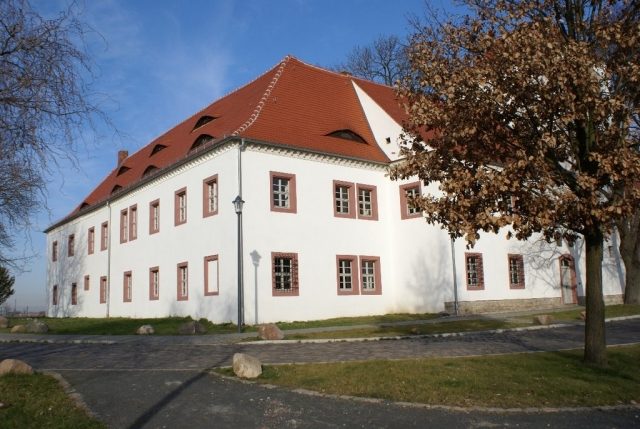
Altranstädt was probably founded towards the end of the 11th century. In 1206, a church is mentioned, which later had three filial churches in Großlehna, Oetzsch, and Treben. In 1213, Altranstädt is mentioned as a manor (grange) of the Cistercian monastery Altzelle near Nossen. The status of the monastery estate with its associated village existed until the secularization of Altzelle Monastery in 1540 by the Saxon Duke Henry the Pious as a result of the Reformation.
The estate now became a secular knight's estate. The owners of the Altranstädt knight's estate were:
- Wiedemann (until 1588)
- Schütz (1588–1594)
- Dr. Johann Badehorn (1595–1610), son of Leonhard Badehorn
- von Weißenbach (1646–1689) (ancestors of the Russian Empress Catherine the Great - her great-great-grandmother was born in Altranstädt)
- Frau von Brandenstein née Weißenbach (1676/81 share)
- Frau von Helldorf née von Weißenbach (1679–88 share)
- von Meusebach (1689–1696)
- von Friesen (1696–1715)
- Cammann (1715–1771)
- von Hohenthal (from 1771)
In 1620, a castle was built as a three-wing complex connected to the church, which was newly built in 1745, for the knight's estate.
During the Great Northern War, the young Swedish King Charles XII had his headquarters in Altranstädt Castle from September 1706 to September 1707.
On September 24, 1706, the Peace of Altranstädt was concluded in the castle between Charles XII and Augustus the Strong, through which Augustus the Strong lost the Polish royal crown (at least for a few years). On September 1, 1707, the Convention of Altranstädt was signed between Charles XII and the Austrian Emperor Joseph I, which guaranteed freedom of religion to Protestants in then Austrian-ruled Silesia.
Thus, the castle was the political center of Northern Europe during this period. Before his departure, the Swedish king is said to have personally inscribed the saying "Adieu Altranstätt, je vais à Suede, ton Séjour nome plait pas." into a round window pane.
In the mid-18th century, the castle was owned by the Counts of Hohenthal. In 1907, on the occasion of the bicentennial of the Convention of Altranstädt, an obelisk was erected in the castle courtyard in the presence of the Swedish Crown Prince, referring to both the Convention of Altranstädt and the peace treaty.
In 1945, the owners were dispossessed and expelled by the communists. After this, the castle served residential purposes until 2000 and, to a modest extent, as a museum. In 2002, the "Förderverein Schloss Altranstädt e.V." was founded to preserve and renovate the castle and to utilize it. The renovated castle houses the Peace Room for the Peace of Altranstädt and an exhibition on the Great Northern War as a museum. Other rooms host temporary exhibitions on modern art and similar topics. The renovated church is also worth seeing.
Take Mobile History with you
You are reading this text for free. Premium adds what matters on the road: descriptions read aloud, sites found through your camera, whole regions taken offline.
- Every description, including the ~17,700 Premium sites
- Audio guide: have descriptions read to you on location
- AR finder: see sites through your camera, with distance and bearing
- Unlimited saved sites
14 days free, then from €2.99 a month. Cancel anytime.
Source: Wikipedia · Licence: CC BY-SA 4.0 · Image: Roland Neubert, Halle (Saale)
This description draws on the facts documented in the linked Wikipedia article; Wikipedia content is licensed under CC BY-SA 4.0. Wording and editing: Mobile History.
Location: 51.3159, 12.1747