Educational Institution
District Court
CastleSchwechat
Altkettenhof Castle
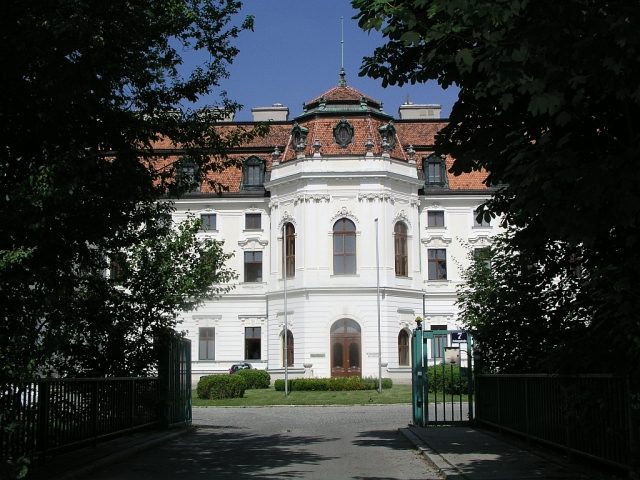
Altkettenhof Castle (also known as Dreherschloss, or Kettenhof Castle) is a Baroque castle in the Lower Austrian municipality of Schwechat.
The castle was built in the 13th century as a smaller complex in the Alt-Kettenhof district of Schwechat and was continuously expanded.
In 1760, the Archducal Austrian First Chancellor Heinrich Kajetan von Blümegen (1715-1788) became the new owner of the castle and expanded it. In 1766, he founded the Kettenhof Chintz and Calico Factory with two partners. His son Franz Heinrich Graf von Blümegen lived in the castle after his father's death with his daughters Josefine and Eleonora until 1813. In 1814, the estate was acquired by the art patron and banker Moritz Reichsgraf von Fries (1777-1826) and his brother Philip Jacob. After his death, Johann Ziegler (then director of the Kettenhof Chintz and Calico Factory) and Elonora Gräfin von Kálnoky acquired the building. The castle received new owners in 1826 with the brothers Josef, Moritz and Johann Freiherren von Ziegler, who sold it in 1830 to Karl Mayer.
In 1850, the castle was bought by the Austrian diplomat and foreign minister Johann Bernhard von Rechberg and in 1872 sold to the Schwechat brewing industrialist Anton Dreher junior. Rechberg lived in the building until his death on February 26, 1899.
Dreher had the castle rebuilt in 1902 by architect Emil Bressler (1847-1921) and the Schwechat master builder Johann Miksch in Neo-Baroque style for about 800,000 Austrian Kronen (approx. 4 million Euros). The interior design was created by the Viennese furniture maker and interior designer Portois & Fix. After Anton Dreher's death in 1921, it was inhabited by his wife Katharina Dreher (1850-1937) until her death and in 1938 was gifted by her son and sole heir Eugen Dreher to the city of Schwechat.
The mayor of the municipality of Schwechat, Josef Rupprecht, appointed by the NSDAP after the annexation of Austria, gifted the building to the German Labor Front. Rebuilt in 1938 by architect Hans Jaksch, the castle was used by the German Labor Front after its opening as a Reich Training Castle. The opening of the Reich Training Castle took place on July 25, 1938, in the presence of NSDAP Reichsleiter Robert Ley and Gauleiters Odilo Globocnik and Josef Bürckel.
During the Second World War, a military hospital was established in 1942. In occupied post-war Austria, it was taken over by the Red Army in 1945 and a short time later, after the signing of the Austrian State Treaty on May 15, 1955, returned to the municipality of Schwechat under Mayor Alfred Horn. This gifted it in 1956 to the Federal Ministry of Justice. After the building was restored, the Justice School was opened in 1964 by the then Federal Minister of Justice Christian Broda (1916-1987) and public prosecutor Franz Hetzenauer (1911-2006). The associated boarding school building with 103 residential units and 110 beds was put into operation in 1993.
Structure+
The U-shaped building, open to the east, is surrounded by an extensive park. The facade is richly decorated with pilasters and risalits. On the south side there is a large conservatory. On the north side, a balcony is used as a terrace.
The building is located between the rivers Schwechat and Kalter Gang. Not far from the confluence of the Liesing into the Schwechat, there was a bridge that led over the river. This was destroyed in the Second World War. The foundations of the bridge were preserved until 2009, but were completely removed during the flood protection project along the Schwechat between 2009 and 2010.
Usage+
Since 1960, the building has served as a district court and since 1964 as a justice school. From 1995 to 1999, the castle was extensively renovated for around 6 million Euros. The building is currently owned by the Bundesimmobiliengesellschaft (Federal Real Estate Company).
Take Mobile History with you
You are reading this text for free. Premium adds what matters on the road: descriptions read aloud, sites found through your camera, whole regions taken offline.
- Every description, including the ~17,700 Premium sites
- Audio guide: have descriptions read to you on location
- AR finder: see sites through your camera, with distance and bearing
- Unlimited saved sites
14 days free, then from €2.99 a month. Cancel anytime.
Source: Wikipedia · Licence: CC BY-SA 4.0 · Image: http://de.wikipedia.org/wiki/Schloss_Altkettenhof#mediaviewer/Datei:Schloss_Altkettenhof_front_2010.jpg
This description draws on the facts documented in the linked Wikipedia article; Wikipedia content is licensed under CC BY-SA 4.0. Wording and editing: Mobile History.
Location: 48.1371, 16.4717