Hotel
CastleBertsdorf - Hörnitz
Althörnitz Castle
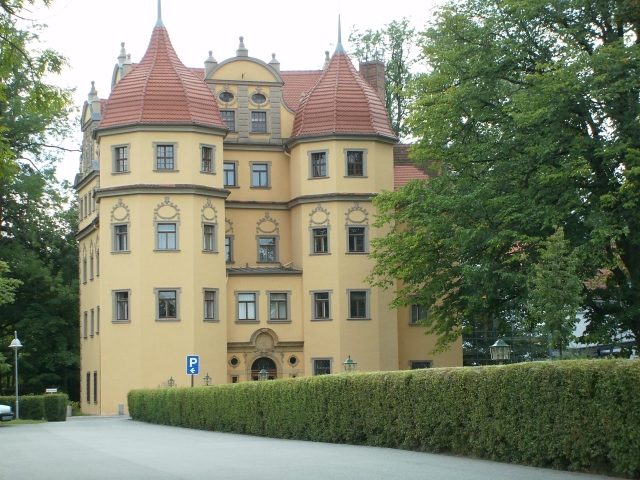
Althörnitz Castle is a 17th-century castle located in Bertsdorf-Hörnitz, Saxony.
The castle was built from 1651 to 1654 by the Zittau master builder Valentin for Mayor Dr. Christian von Hartig. It has a rectangular floor plan and the castle entrance is flanked by two octagonal towers with Welsch hoods, with the right, smaller tower only added in 1853 as a stair tower. The vestibule is also an addition from 1892. On the older, left tower, an inscription was embedded on a stone tablet:
- “For the pleasant leisure of honorable occupation and the spirit of the place due to the charm of its location, Christian von Hartig in Hörnitz, Knight of the Order of Saint Mark, dedicated this part.”
The lower floor of the old tower is covered by a cross vault. Here, Hartig's son, Jakob, together with the inventor of the burning mirror and fundamental researcher for Meissen porcelain, Ehrenfried Walther von Tschirnhaus, conducted alchemical experiments. During one such experiment, the laboratory caught fire. Jakob fled, and the frightened villagers secured the expulsion of the "black artist" Tschirnhaus. It is certain that important discussions about the development of Meissen porcelain took place in Hörnitz. Tschirnhaus then supervised Böttger's experiments. Christian von Hartig was the first in Zittau and the surrounding area to operate a greenhouse, a hothouse, and an orangery, for which he imported rare flowers. Althörnitz remained in the possession of the von Hartig family until 1771. They were followed by Karl A. von Kyaw, who sold it in 1781 to Johann Gottfried Kämmel from Waltersdorf. In 1826, it belonged to Ernst Wilhelm Friedrich Just, from 1840 to Moritz von Beschwitz from Großschweidnitz, and from 1871 to Mr. Heisen from Annaberg, who immediately thereafter built a spirit vapor distillery for potatoes and one of the largest cow sheds.
Thereafter, in 1881, the Saxon Chamberlain Hans Rudolf von Sandersleben acquired the manor with its associated property. Neuhörnitz and Althörnitz were united on July 1, 1912. After the Second World War, the von Sandersleben family was dispossessed, and the estate was then inhabited by resettlers. From 1948 to 1991, holidaymakers from the FDGB (Free German Trade Union Federation) of the GDR were accommodated here under simple conditions. Despite great help from the municipality of Bertsdorf-Hörnitz, the buildings subsequently fell into disrepair.
Rudolf von Sandersleben, Honorary Consul of the Kingdom of Sweden, who has been working as a banker in Leipzig and for the Leipzig Trade Fair group since 1990, his family, the municipality of Bertsdorf-Hörnitz, and the hotelier Karl-Dieter Gaydoul, from the Historical Hotels Cooperation, developed a concept for the new use of the castle and the castle park designed by Pückler's student Eduard Petzold. Together, they acquired the castle and the park from the Treuhandanstalt in 1993. After 16 months of construction, hotel operations could begin in February 1996.
Take Mobile History with you
You are reading this text for free. Premium adds what matters on the road: descriptions read aloud, sites found through your camera, whole regions taken offline.
- Every description, including the ~17,700 Premium sites
- Audio guide: have descriptions read to you on location
- AR finder: see sites through your camera, with distance and bearing
- Unlimited saved sites
14 days free, then from €2.99 a month. Cancel anytime.
Source: Wikipedia · Licence: CC BY-SA 4.0 · Image: Uwe Klimpke
This description draws on the facts documented in the linked Wikipedia article; Wikipedia content is licensed under CC BY-SA 4.0. Wording and editing: Mobile History.
Location: 50.8992, 14.7547