Children's home
CastleAltengottern
Altengottern Castle
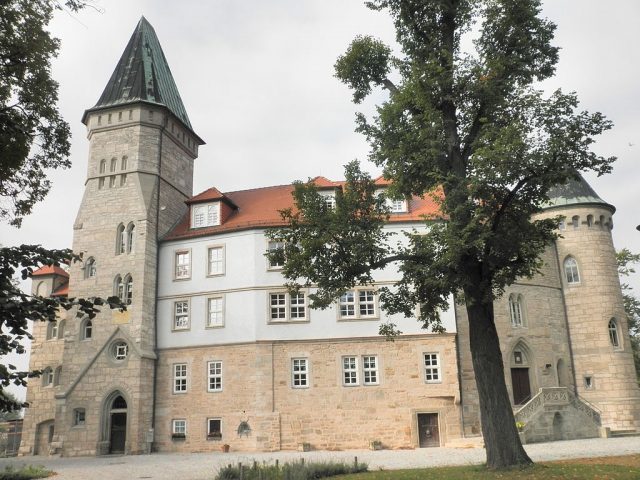
It is assumed that Altengottern also housed a royal court of Emperor Heinrich II, as his presence in the village was documented in 1017. A moated castle probably also stood at this time on the Unstrut, directly at the site of the later manor in the western part of the village, to secure the road across the river. From 1155, Ekkehardt von Gottern is mentioned in documents, who probably resided in the moated castle as a vassal. From 1180 to 1316, the Lords of Gottern are named as owners of the castle. From 1440, it was the Lords of Hagen. In 1632, Rudolf Levin Marschall von Herrengosserstedt married the heiress Anna Gertrud von Hagen. In 1641, the village and castle of Altengottern fell victim to the Thirty Years' War. The Marschalls, like the other surviving villagers, were expelled. In 1650, reconstruction and resettlement began. The farmers were provided with enough property so that some prosperity soon returned to the village. The central part of the castle and the churches St. Trinitatis in the upper village (replacing the previous church St. Martin) and St. Wigberti in the lower village, donated by Rudolf Levin's sons, date from the reconstruction period lasting until 1700. Local builders and artists were employed for this purpose. From 1820 to 1824, the north wing of the castle was renovated in the Romanesque style. At the same time, a new manor house in the classical style was built next to the castle. The small park was redesigned, and the library was expanded. In 1903, additions were made to the castle. The cellar vaults in the manor certainly still date from the time of the moated castle.
After the American occupation was replaced by the Russians, the Marschall family was expelled from the castle, then lived scattered in the village, and was also expelled from there on December 22, 1945 - under threat of internment in an NKVD special camp. The entire interior of the castle was removed, the valuable library destroyed, and most of the furniture and paintings ruined.
Take Mobile History with you
You are reading this text for free. Premium adds what matters on the road: descriptions read aloud, sites found through your camera, whole regions taken offline.
- Every description, including the ~17,700 Premium sites
- Audio guide: have descriptions read to you on location
- AR finder: see sites through your camera, with distance and bearing
- Unlimited saved sites
14 days free, then from €2.99 a month. Cancel anytime.
Source: Wikipedia · Licence: CC BY-SA 4.0
This description draws on the facts documented in the linked Wikipedia article; Wikipedia content is licensed under CC BY-SA 4.0. Wording and editing: Mobile History.
Location: 51.1641, 10.5739