Specialist clinic for psychosomatic illnesses
CastleAltenburg
Altenburg Castle
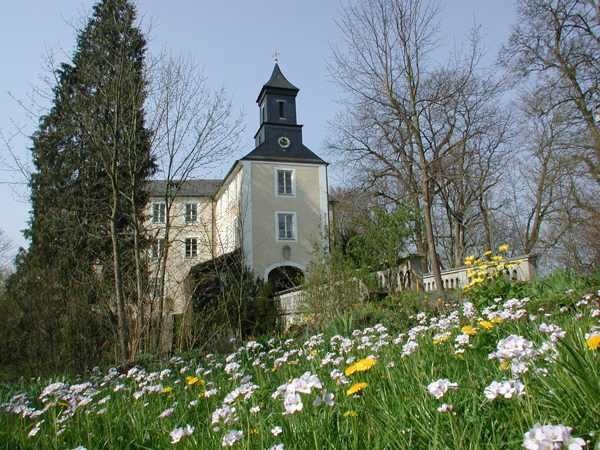
The first settlers in the landscape around today's Altenburg were the Teutons. Subsequently, the Celts came and built the first refuge castles in this area for their clearings.
From about 15 BC to approximately 500 AD, the great Roman Consular Road from Salzburg to Augsburg passed through here, secured by a fortified tower with a garrison. In the 6th century, the Agilolfinger then migrated into these southern regions (called Noricum), settled by Celts and Romans, and took possession of them without a fight.
In the area of the moraine landscape along the Mangfall, the Vaganer Gaugrafen family settled and became established at Altenburg. In this context, the entire area was cleared, as evidenced by the villages of Ober- and Niederreit, as well as Riedhof (land is power).
After the extinction of the Faganen, the Neuburg-Grafenstein family, under Count Sibito IV, took over the entire district and expanded the Roman watchtower into a fortified castle. This was confirmed by the Falkenstein Codex of 750, the first inventory of assets of a noble family.
Around 1050, Falkensteiner ministerials expanded the fortified site into a knight's castle with a drawbridge to monitor the salt road to Munich. In 1247, during the unfortunate Salzburg Bishop's War, the castle was destroyed and razed by Duke Otto II of Bavaria (Wittelsbach).
Around 1258, a larger castle with a residential wing and a stone bridge was rebuilt by the Knights of Schalchdorf. Approximately 100 years later, a renewed renovation was carried out by the Knights of Frundsberg.
In 1434, Count Otto II of Maxlrain acquired Altenburg and enlarged it. Until 1560, Altenburg was owned by Count Wolfgang of Maxlrain and Waldegg. In 1560, under Duke Albrecht of Bavaria, Altenburg was rebuilt into its current form.
During the Thirty Years' War, the castle was occupied by League mercenaries and a local band. Even after a long siege, it defied the attacking Swedes as the only castle in Bavaria.
After several changes of ownership, Altenburg Castle came into the possession of Count Georg von Wilding und Königsbrück, Prince of Radali, in 1879, from the Barons Friedrich zu Hofstetten, who used it only as a summer residence.
In 1953, after an agreement of the community of heirs, the castle was sold by the estate administrator Baron von Luttitz to the Missionsdienst für Christus, based in Stockdorf.
War and post-war damages necessitated an 8th renovation of the castle. In 1954, the school for social girls' professions could then begin operations. Due to insufficient utilization, this school operation had to be discontinued in 1992.
In 1995, the Evangelical-Lutheran Deanery of Munich took over Altenburg Castle and used it as a seminar and meditation house – "House of Silence."
In 2003, the Deanery sold the entire property to a course participant. She makes it available to the Schloss Altenburg – Haus der Stille e.V. association. It is now responsible for the meditation work.
Take Mobile History with you
You are reading this text for free. Premium adds what matters on the road: descriptions read aloud, sites found through your camera, whole regions taken offline.
- Every description, including the ~17,700 Premium sites
- Audio guide: have descriptions read to you on location
- AR finder: see sites through your camera, with distance and bearing
- Unlimited saved sites
14 days free, then from €2.99 a month. Cancel anytime.
Source: Wikipedia · Licence: CC BY-SA 4.0
This description draws on the facts documented in the linked Wikipedia article; Wikipedia content is licensed under CC BY-SA 4.0. Wording and editing: Mobile History.
Location: 47.9154, 11.8119