Museum
CastleAllstedt
Allstedt Castle
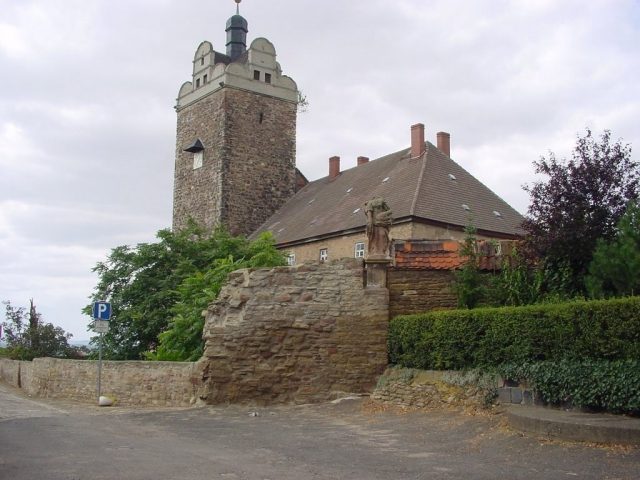
The Allstedt Palatinate was a palatinate in the area of the present-day town of Allstedt in the Mansfeld-Südharz district in the southwest of Saxony-Anhalt. From this emerged a High and Late Medieval castle, which was converted into a palace in the Baroque period. Allstedt Palace now houses a museum on the history of the Palatinate, castle, palace, and town of Allstedt, as well as a palace café. The complex is a stop on the Romanesque Road.
Location+
Allstedt is located about 12 km southeast of Sangerhausen. The palace stands about 800 m northeast of the old town on a spur of land projecting westward from the plateau. It is divided into three consecutive parts by remnants of moats and groups of buildings. On the adjacent field to the east, there is a wide depression, which is considered to be the remnant of a neck ditch.
During archaeological excavations on the Schlossberg in the 1960s by the State Museum for Prehistory in Halle under the direction of Bertold Schmidt, the upper part of a 12 m wide ditch was cut, separating the Schlossberg from the plateau. Due to its assumed form, possibly a V-shaped ditch, it is believed to have been built no later than the Ottonian period. Therefore, the royal palatinate is located at the site of the palace, while an economic court is presumed in the eastern part of the current settlement.
History and Building History+
Beginnings in the Carolingian Period
The place Allstedt was first mentioned in 777 in the Breviarium Sancti Lulli. The castle is first named as urbs Altstediburg in the Hersfeld Tithe Register, which was compiled between 880 and 899. The list includes several castles and a large number of settlements located in Friesenfeld and Hassegau, including Alstedi, whose tithe was paid to Hersfeld Abbey.
Castle and Economic Court under Ottonian Rule
In the 10th century, the imperial estate came into the possession of the new ruling dynasty of the Ottonians, who also owned numerous private estates in the area between the Harz, Saale, and Unstrut rivers. On October 12, 935, King Henry I issued a charter in Altstéti, in which he granted the ladies of Herford Abbey the right to elect.
Before or at the beginning of 979, Emperor Otto II and his wife Theophanu had founded the Benedictine monastery of Memleben on the Unstrut, about 20 kilometers south of Allstedt. On May 20, 979, Otto had a charter issued in Altstedi, in which he transferred to the monastery the chapels in the towns of Allstedt, Osterhausen, and Riestedt, which previously belonged to Hersfeld Abbey and which he had acquired through exchange. Memleben also received the tithe in Friesenfeld and Hassegau, especially from the castles there, among which Alstediburch is mentioned first.
The Palatinate and imperial estate around Allstedt, which also included a royal forest, were administered by the bailiffs of Allstedt from about 1150.
Palatinate of Saxony
In 1363, a Palatinate of Saxony-Allstedt is mentioned for the first time. According to Erich Heinze's research, Emperor Charles IV established it between 1348 and 1356 in connection with the granting of the title of Count Palatine to Duke Rudolf I of Saxony (-Wittenberg).
The Palatinate of Saxony-Allstedt included, in addition to Allstedt, the villages of Mönchpfiffel, Niederröblingen, Einzingen, Klosternaundorf, Winkel, Wolferstedt, and Mittelhausen, as well as Sittichenbach Monastery with Groß- and Klein-Osterhausen and Rothenschirmbach.
The oldest surviving building fabric dates from the mid-13th century. The oldest visible part of the castle, the residential tower to the right of the entrance, dates from around 1400.
The Noble Lords of Querfurt, who owned the castle from 1369 to 1496, had the old Allstedt Castle demolished, carried out several structural changes, and built the north wing, the west wing with the palas, kitchen, and large court hall, the shield wall in the south, and the shield wall in the east with the gate system. This largely created the current extent of the castle.
The current buildings, including the east wing, were essentially erected under the Ernestine rule of Elector Frederick the Wise from 1496 (until 1526).
In 1526, the Allstedt office was pledged by the Wettins to Count Albrecht of Mansfeld. In 1533, Count Albrecht had extensive construction measures and repairs carried out on the palace and the outworks. In 1542, due to high debts, he ceded the office to the Counts of Stolberg as a pledge. Count Wolfgang of Stolberg stayed in Allstedt for a longer period and died here. It was not until 1575 that the Counts of Stolberg lost their claims to the Allstedt office to the Ernestine Wettins.
Under the Dukes of Saxony, a further structural change to the upper floor took place in 1691, and the remaining parts of the core castle were converted into a residential palace. In 1721, the palace chapel was built in its present form.
Ernst August I of Saxony-Weimar-Eisenach had the front palace built in Baroque style in 1746/1747. However, he could no longer implement his plans († 1748). The conversion of the front palace was only carried out in a simple form, and the core castle remained in its original form.
In the course of the renovation work, building history investigations were carried out by Reinhard Schmitt between 1986 and 1991.
Coat of Arms+
The coat of arms of the Palatinate of Saxony-Allstedt: In a blue shield, a golden eagle - crowned because of the Imperial Vicariate. On the crowned helmet, a golden eagle with outstretched wings, carrying a golden ring in its beak.
The coat of arms of the Office of Saxony-Allstedt: The shield is split, the back divided from black over silver, above it two crossed red swords arranged, the front a halved crowned silver eagle on a red field.
Take Mobile History with you
You are reading this text for free. Premium adds what matters on the road: descriptions read aloud, sites found through your camera, whole regions taken offline.
- Every description, including the ~17,700 Premium sites
- Audio guide: have descriptions read to you on location
- AR finder: see sites through your camera, with distance and bearing
- Unlimited saved sites
14 days free, then from €2.99 a month. Cancel anytime.
Source: Wikipedia · Licence: CC BY-SA 4.0 · Image: Roland Neubert, Halle (Saale)
This description draws on the facts documented in the linked Wikipedia article; Wikipedia content is licensed under CC BY-SA 4.0. Wording and editing: Mobile History.
Location: 51.4083, 11.4017