To be privately owned
CastleAistersheim
Aistersheim Castle
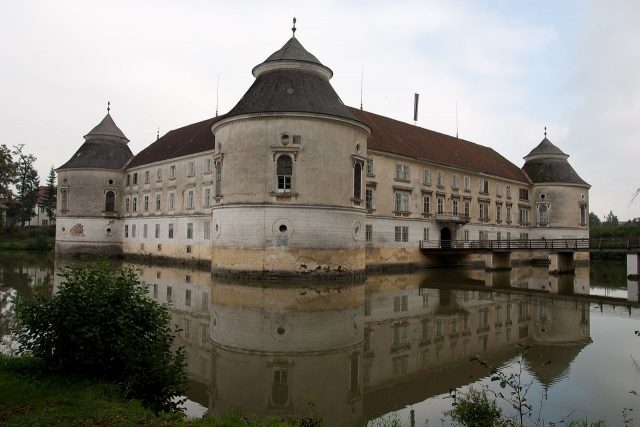
Aistersheim Castle is a late Renaissance moated castle in the center of Aistersheim in Upper Austria, approximately 12 km southwest of Grieskirchen.
The moated castle was first mentioned in a document in 1159 with Dietmar von Aistersheim, a ministerialis of the Styrian Otakars. The castle at that time remained in the possession of the Lords of Aistersheim until 1426, when Heinrich von Aistersheim, the last of his line, died. Its members also called themselves Lords of Aist, after their ancestral seat near Altaist in the Mühlviertel. The castle was a fortification on the border with Bavaria, which at that time ran near Haag am Hausruck. In 1464, Hanns von Hohenfeld bought the lordship. Aistersheim then remained with this family for over 350 years. Hanns von Hohenfeld had owned the medieval moated castle for less than seven years when it was shelled, conquered, and destroyed in the Liechtenstein Feud by the modern gunpowder artillery of Wolfgang von Schaunberg. Hohenfelder then had to be compensated with Jochenstein Castle. Aistersheim was hastily repaired, but then replaced by a new building in the second half of the 16th century. The most important builder of the late Renaissance castle that still exists today was probably the knightly representative Achaz von Hohenfeld. Construction was completed around 1600. Meanwhile, the Hohenfelds had converted to Protestantism. In 1619, Otto Achaz von Hohenfeld, as a militant representative of the Protestant estates, refused to pay homage to Emperor Ferdinand II as the new sovereign. As a result, Tilly's Bavarian troops besieged the castle the following year, which was defended by peasants under the steward Wolf Kessel. After a few days, it was captured. Kessel paid for his resistance with his head, and most of the peasants were hanged.
During the great Upper Austrian Peasant War under Stefan Fadinger, Aistersheim became one of the centers of peasant resistance. After Fadinger's death, it served Achaz Wiellinger von der Au as a headquarters and loot depot. At that time, the manorial archive was destroyed. During the subsequent conquest by the Bavarian governor in Upper Austria, Adam Graf Herberstorff, the building was severely damaged. Afterwards, dozens of peasants were hanged from the trees. The Hohenfelds eventually converted back to Catholicism. Their knightly status was confirmed, and Ferdinand von Hohenfeld was elevated to the status of Imperial Count in 1669. A fire in 1771 caused considerable damage, necessitating several baroque-style renovations. In the first half of the 19th century, the exterior facades were renewed. The family died out in 1824 with Field Marshal Lieutenant Otto Adolf Graf Hohenfeld. His four sisters sold the lordship in 1830 to Johann Karl Dworzak. His descendants owned Aistersheim until the second half of the 20th century.
In Worms Cathedral, there is an elaborate epitaph of Cathedral Dean Franz Carl Friedrich von Hohenfeld (1696-1757) which, according to the tomb inscription, identifies him as Lord of Aistersheim.
Description+
The Exterior
The three-story, rectangular complex features four squat, strongly projecting round towers at the corners. These towers are covered with conical roofs. The castle is still completely surrounded by a pond, over which two wooden bridges lead to the simple gates. The almost two-and-a-half-meter-thick outer walls rest on a large number of wooden piles. The ground floor, designed as a plinth, is rusticated. The gate tower on the north side facing the town dates from the 13th century. However, it was later built over and transformed into a slender clock and bell tower during the Baroque period. The preferred entrance today leads from the outbuildings to the rear facade. Above it is a balcony with a wrought-iron railing. The spacious inner courtyard features arcaded or loggia walkways on all four facades, with the arches of the second floor being only half as wide as those on the two lower floors, but twice as numerous. Two open staircases are diagonally opposite each other. Three pointed-arch gates still date from the Gothic construction period.
Interiors
The interior of the castle is predominantly modern. However, the two-story Knights' Hall is noteworthy, which formerly extended over the entire narrow side of the east wing. It is considered one of the most important Renaissance halls in Upper Austria. The Italian-influenced frescoes in the stucco-framed ceiling panels depict mythological scenes. The year 1645 can be seen on two large doorframes. The six oil paintings are works by the painter Kessler from Brixen im Thale. The castle chapel is located in the northeast corner tower. Under the stuccoed flat dome stands a mighty altar from 1658, adorned with life-size statues. The rest of the furnishings, including a rare portable organ, are also from the 17th century. An impressive Renaissance door with inlays and carved ornamentation leads into the chaplain's room.
Take Mobile History with you
You are reading this text for free. Premium adds what matters on the road: descriptions read aloud, sites found through your camera, whole regions taken offline.
- Every description, including the ~17,700 Premium sites
- Audio guide: have descriptions read to you on location
- AR finder: see sites through your camera, with distance and bearing
- Unlimited saved sites
14 days free, then from €2.99 a month. Cancel anytime.
Source: Wikipedia · Licence: CC BY-SA 4.0 · Image: http://commons.wikimedia.org/wiki/File:Wasserschloss_Aistersheim.jpg
This description draws on the facts documented in the linked Wikipedia article; Wikipedia content is licensed under CC BY-SA 4.0. Wording and editing: Mobile History.
Location: 48.1864, 13.7399