To be privately owned
CastleOberhundem (Kirchhundem)
Adolfsburg Castle
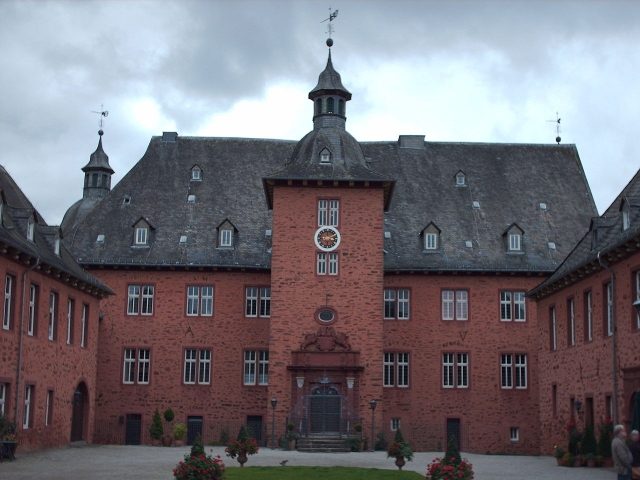
Adolfsburg Castle, also spelled Adolphsburg, is a moated castle in the Hundem Valley at the entrance to Oberhundem, a district of the municipality of Kirchhundem.
Adolfsburg Castle takes its name from its builder, Johann Adolf von Fürstenberg, who had it erected in the 1670s. It is a Baroque moated castle, primarily intended by the builder as a place of recreation and retirement. Johann Adolf von Fürstenberg, a scion of the family that had owned property in the Bilstein and Waldenburg offices, among others, since the 16th century, belonged to the clergy. He was a member of the cathedral chapter of Münster and a canon and provost of the Holy Cross in Hildesheim. It is presumed that he entrusted the Capuchin friar and architect Ambrosius von Oelde with the planning of the Adolfsburg.
Two fireplaces in the Knights' Hall and an alabaster bust of Johann Adolf von Fürstenberg are works by the sculptor Johann Mauritz Gröninger. The former Baroque furnishings of the Knights' Hall are also likely based on Gröninger's designs.
The construction was made possible by Johann Adolf's purchase of various farm estates in Oberhundem from the property of Wilhelm Heinrich von Bruch and Johanna Maria Stael von Holstein, including the so-called Waltmanns- or Brucher Hof. By diploma of February 20, 1676, Emperor Leopold I elevated the castle to a noble manor. Johann Adolf von Fürstenberg engaged in intensive land acquisition in and around Oberhundem, thereby consolidating his property there.
After Johann Adolf, who resided permanently at Adolfsburg Castle from 1679 until his death in 1704, two further generations of the von Fürstenberg family lived there: Clemens Lothar (1725–1791) with his family from 1758 until the end of the 1780s, and Friedrich Leopold, born there in 1766, from 1819 until his death in 1835.
Later generations of the von Fürstenberg family took up their ancestral seat in Herdringen Castle near Arnsberg. Therefore, the Adolfsburg served them only as a hunting lodge. To bring the building back into continuous use, it was leased in 1919 to the Missionaries of the Holy Family, who established their first mission school on German soil there. In 1940, the school was closed by the National Socialists. During the Second World War, evacuees were housed in the Adolfsburg. Furthermore, parts of the collection of the Düsseldorf City Museum were stored here for security reasons. Only in 1946 could the mission school resume operations with initially ten students. Since the order and the school moved into the "Maria Königin" monastery, built near Altenhundem in 1956, Adolfsburg Castle stood empty for several decades and was threatened with decay.
After years of intensive efforts to preserve the building, an investor was found in the mid-1980s who was willing to restore the castle and put it to appropriate use. On March 7, 1985, the Adolfsburg was entered as a historical monument in the monument list of the municipality of Kirchhundem.
Take Mobile History with you
You are reading this text for free. Premium adds what matters on the road: descriptions read aloud, sites found through your camera, whole regions taken offline.
- Every description, including the ~17,700 Premium sites
- Audio guide: have descriptions read to you on location
- AR finder: see sites through your camera, with distance and bearing
- Unlimited saved sites
14 days free, then from €2.99 a month. Cancel anytime.
Source: Wikipedia · Licence: CC BY-SA 4.0 · Image: https://commons.wikimedia.org/wiki/File:Schloss_Adolfsburg_Innenhof.jpg
This description draws on the facts documented in the linked Wikipedia article; Wikipedia content is licensed under CC BY-SA 4.0. Wording and editing: Mobile History.
Location: 51.0856, 8.1692