Foundation
CastleAdelsdorf
Adelsdorf Castle
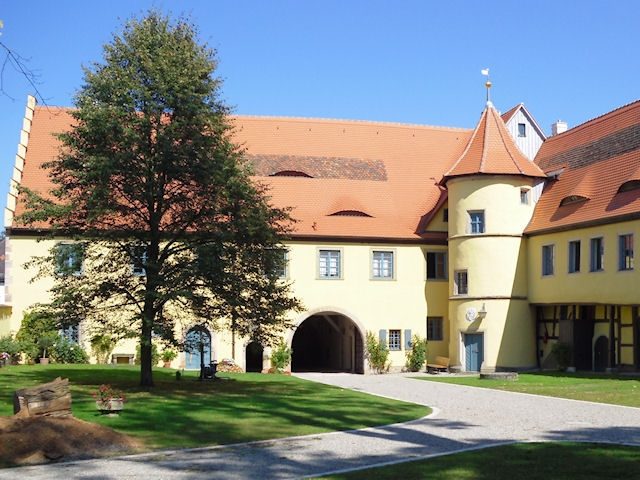
Adelsdorf Castle is the stately successor building to a vanished moated castle. This was located next to the parish church with a Romanesque chancel tower, which burned down and was demolished in 1929, its former location marked by a memorial cross in the cemetery.
The castle, built around 1120, was the ancestral seat of the noble family of Othlohesdorf (=Adelsdorf), who later named themselves after Schlüsselberg Castle (south of Waischenfeld). Remarkably, the manorial seat of Adelsdorf was on the periphery of the actual property complex between the Aisch and Reicher Ebrach rivers, with the high court district of Schnaid. Strategic reasons, such as controlling the Aisch river crossings, likely played a role.
In 1627, the later knightly estate of Adelsdorf still included remnants of the old castle or old palace, namely "... the castle site and old masonry next to the church, as it was enclosed with its moats, together with the cattle house, barn, cellar, stables, and an orchard nearby..." But by 1666 at the latest, the castle site was leveled, making the garden "larger than before, when the old castle moats still stood..." As relics of the castle site, only "the place" and "... the well-vaulted cellar..." "... built of beautiful pieces..." remained.
Schlüsselberg Seat
While Adelsdorf Castle remained in the possession of the noble Schlüsselberg family until its extinction in 1348, the ownership rights to the local estates temporarily changed with the extinction of the Adelsdorf line in 1277. Thus, on December 22, 1277, Bishop Berthold of Bamberg granted all fiefs in Otelesdorf (=Adelsdorf) to Burgrave Friedrich III of Nuremberg (1262 - 1297). After a correspondingly short burgrave period, the Adelsdorf estates reverted to the Schlüsselbergers, specifically to the still flourishing branch in the Franconian Jura.
Stift Vassal Fief Holders
Castle (fortress) and estates in Otelstorf (=Adelsdorf) had become the property of the Bamberg Abbey after the death of the last Schlüsselberger, Konrad II, by contract of May 8, 1348. In the years 1349 - 1513, the bishops had granted parts of the fief to various abbey vassals and to Schlüsselau Monastery. Only in the subsequent period did vassals come into possession of a closed fief of Adelsdorf.
The fief holder or vassal had to be of knightly birth and in full possession of honor. He swore the oath of fealty and pledged loyalty to his liege lord.
1696 Christoph Erhard v. Bibra
In the year of the donation, 1696, Bishop Lothar Franz exchanged the immediate imperial knightly estates of Adelsdorf and the Würzburg fief of Frankenwinheim near Gerolzhofen for Untereuerheim with Colonel Christoph Erhard von Bibra. This nobleman (whose epitaph can be found in the gate passage of Adelsdorf Castle), later Kurmainz General-Wachtmeister and commander of Erfurt, allegedly acted at the request of his warlord. "The cent jurisdiction" (i.e., the high jurisdiction or so-called blood or neck jurisdiction) remained with the knightly estate of Adelsdorf according to the exchange contract of April 10, 1696. In 1736, Frankenwinheim was sold to the Schönborns. In 1782, the Gleicherwiesen estate (near Hildburghausen in Thuringia) was added to the knightly estate of Adelsdorf by purchase, but was dissolved in the course of the peasant liberation in 1850. The Protestant vassal von Bibra was obliged, according to the letter of fealty from 1696, not to hinder the public practice of the Catholic religion by his subjects. In return, the von Bibra family, as well as their servants and attendants, were free to practice the Augsburg Confession privately in Adelsdorf Castle. As long as there was no castle chapel, a large hall on the upper floor of the central building facing the courtyard was used for many years as a prayer room for Protestant services. Later, this hall was structurally divided into various rooms and a central corridor.
The Lords of Bibra
The v. Bibra family is an ancient Franconian noble tournament family whose members were Würzburg ministerials. The ancestral castle Bibra is located in the valley of the Bibra stream, about 12 km south of Meiningen, and belonged to the Franconian knightly circle Canton Rhön-Werra. The Bibra fortress rises only a few meters above the market town of the same name, which encloses it structurally. The family first appears in documents with Rupertus de Bibera in 1119. Bishop Otto the Saint of Bamberg (1102-1139) names him as a witness. Several members of the imperial knightly family v. Bibra had risen to high ecclesiastical dignities, serving as prince-bishops in Würzburg and Fulda. They also held responsible positions in the Teutonic Order, served at spiritual and secular courts, provided counselors and military leaders, and occupied positions in the imperial knightly corporation. The von Bibra family was and remains widely branched to this day. The Adelsdorf line worked professionally as officers and lawyers.
Adelsdorf Knightly Estate
The knightly estate with the low hunt was a fief of the Bamberg Hochstift, the high hunt in a district around Adelsdorf a fief of the Bayreuth Margraviate. Later, both fief bodies were subject to the King of Bavaria. In 1907, the ancestral estate of Adelsdorf belonged to Messrs. August Freiherr v. Bibra, Major General (ret.), Ernst Frhr. v. Bibra, Higher Regional Court Judge (ret.), Dr. Richard Frhr. v. Bibra, Government Councilor, Friedrich Frhr. v. Bibra, Royal Captain (ret.) and Wilhelm Frhr. v. Bibra, economy intern. The property at that time comprised 53.35 ha, was not consolidated and was individually leased. In 1984, a partial area of 2383 m² of the original total area of 9011 m² of the manorial grounds was sold to the neighboring country hotel "Drei Kronen". A wall was professionally erected along the new property boundary, corresponding in size and appearance to the former boundary wall.
After the death of Dr. oec., Dipl.-Kfm., Hellmut Gustav Kuno Frhr. v. Bibra, in 1993 the municipality of Adelsdorf acquired the castle property with 6628 m² of land from the sole heiress Baroness Barbara von Bibra in an exemplary state of preservation.
Manorial Jurisdiction
The "office" of the respective court was located on the ground floor of the front half-timbered building, parallel to the gate passage. The entrance to the office was directly on the street side. The bricked-up entrance is still visible on the outer wall today.
Take Mobile History with you
You are reading this text for free. Premium adds what matters on the road: descriptions read aloud, sites found through your camera, whole regions taken offline.
- Every description, including the ~17,700 Premium sites
- Audio guide: have descriptions read to you on location
- AR finder: see sites through your camera, with distance and bearing
- Unlimited saved sites
14 days free, then from €2.99 a month. Cancel anytime.
Source: Wikipedia · Licence: CC BY-SA 4.0
This description draws on the facts documented in the linked Wikipedia article; Wikipedia content is licensed under CC BY-SA 4.0. Wording and editing: Mobile History.
Location: 49.7143, 10.8951