Hotel
Restaurant
CastleSababurg
Sababurg Castle
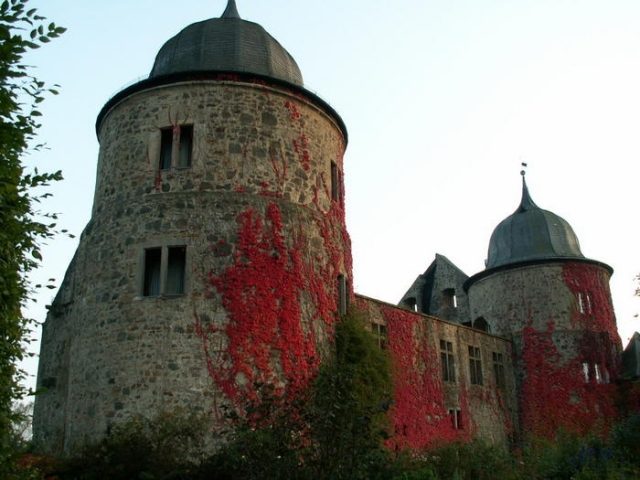
The Sababurg, formerly Zappenburg, then Zapfenburg, and today popularly known as the Sleeping Beauty Castle after the Brothers Grimm fairy tale, is a castle ruin in the legendary Reinhardswald, which stretches across the northern Hessian district of Kassel. Sababurg is also the name of the district of Beberbeck, a small part of Hofgeismar, located at the castle.
The hilltop castle was built starting in 1334 as Zappenburg to protect pilgrims to the nearby pilgrimage site of Gottsbüren. From the medieval castle complex, starting in 1490. In the surroundings, the Sababurg Wildlife Park and the Sababurg Primeval Forest are worth seeing. The idea for the board game Sagaland originated at the castle.
The Sababurg is located in the core area of the Reinhardswald in the district of Sababurg, named after it and belonging to the Hofgeismar district of Beberbeck (manor settlement with castle), in the east-northeast. It is situated between Beberbeck, about 4.5 km west-southwest of the castle ruin, and Gottsbüren (eastern district of Trendelburg), about 4.5 km (as the crow flies) north-northwest of it. The ruin stands on a sparsely wooded basalt hill at approximately. Southwest below the castle lies the Sababurg Wildlife Park, through which the small Donnebach, an eastern or right-sided tributary of the Holzape, flows in a northwesterly direction. The ruin, village, and wildlife park are surrounded as a Hofgeismar exclave by the unincorporated area of Gutsbezirk Reinhardswald, where the Sababurg Primeval Forest lies beyond the park.
Zappenburg
The Zappenburg (formerly: Zappaborgck and Zappenborgck) was built starting on April 19, 1334, for the protection and shelter of pilgrims to the nearby pilgrimage site of Gottsbüren, "where the incorrupt body of Jesus is said to have been found in 1330." Its foundation originated from the Diocese of Mainz, which was in constant competition with the Landgraviate of Hesse, the Diocese of Paderborn, and the Duchy of Brunswick, whose territories almost bordered each other here. Construction activities were probably financed by revenues from pilgrimages. With the completion of the work in 1336, Arnold von Portenhagen became the first castellan.
In 1346, conflicts arose in which Mainz was defeated. The castle was divided between the Landgraviate of Hesse and the Diocese of Paderborn and described as "desolate" in 1455. The castle came entirely into the possession of Hesse in 1462 after the end of the Mainz Diocesan Feud.
Zapfenburg and Sababurg
From 1490, Landgrave Wilhelm I (1466-1515) "had a magnificent hunting lodge built on the foundations of the original complex, which was to become the scene of countless splendid festivals and gatherings for 300 years." After this reconstruction or renovation, there was a great need for drinking water for people and livestock, which triggered the construction of a water pipeline. From 1508, construction work began on the palas, which was completed in 1519 under his grandson Philipp I (1504-1567). A stud farm was also present.
In 1582, the chancellery building, which still exists today, was erected, as the castle became the seat of the Gieselwerder office. During this time, the name Sababurg first appeared.
During the Thirty Years' War (1618-1648), the Sababurg was occupied by Catholic troops under Field Marshal Tilly (1559-1632) in 1628 and severely damaged. Afterwards, "the castle complex fell into that wild-romantic overgrown state in which popular belief, after the spread of the Children's and Household Tales" (published from 1812) "of the Brothers Grimm, saw the place where the story of Sleeping Beauty must have taken place." Since then, the castle has also been internationally known as Sleeping Beauty Castle. As described in the fairy tale, the castle is said to have been surrounded by a 5 km long and 3 m high thorn hedge from 1571 to 1591. It served to protect the livestock from wild animals. Only in 1651 were damages repaired.
Landgrave Karl (1654-1730) had the Sababurg slightly expanded. In 1724, the stud farm was moved to Beberbeck. In 1760, during the Seven Years' War (1756-1763), the castle was occupied by French soldiers and largely fell into disrepair. Later, it served as a forester's house. From 1824 to 1826, the west, east, and south wings of the castle were demolished.
Current Use and Condition of the Sababurg
The Sababurg complex has been gradually restored by the State of Hesse since 1957 and made accessible to the public. From 1959, the ruin was converted into an upscale hotel with a restaurant and café, which opened in 1960. In addition, it houses a registry office and the SabaBurgTheater.
Of the original fortifications of the Sababurg, parts of the curtain wall with a flank gate and moats have been preserved, also due to restoration work. The palas only exists in its outer walls. In addition to the two mighty corner towers with their Welsch hoods, which are now used by the hotel, a smaller stair tower has also been preserved. The chancellery building was extended in 1976 with a modern annex.
Sights in the Surroundings+
Among the sights in the surroundings of the Sababurg, in addition to the impressive landscape of the Reinhardswald, are the Sababurg Wildlife Park and the Sababurg Primeval Forest:
Sababurg Wildlife Park
In 1571, Landgrave Wilhelm IV (1532-1592) founded the Thiergarten Sababurg below the Sababurg, which is one of the first wildlife parks in Europe and is now called Sababurg Wildlife Park. It is about 130 ha. The park was redesigned according to the wishes of Landgrave Friedrich II (1720-1785) in baroque patterns. A rondel was created for parforce hunting, to which star-shaped clearings, still recognizable today as oak avenues, lead. At the end of the 18th century, the Hessian landgraves lost interest in the wildlife park. It became part of the Beberbeck stud farm, and around 1790, logging began in the hitherto largely forested park area.
At the beginning of the 1970s, the district of Kassel, as owner of the park grounds, began to reactivate the wildlife park. In 1973, it was reopened as a wildlife park. The park with its wide pastures once again hosts many native large game, including Heck cattle, wild horses such as Przewalski's horses or tarpans, wolves, but also exotic animals such as kangaroos, monkeys, penguins, and llamas.
Sababurg Primeval Forest
The Sababurg Primeval Forest, which directly borders the "Sababurg Wildlife Park" to the west, is a former pasture forest and, since 1907, a nature reserve of 88 to 92 ha according to various sources, with "800 to 1000-year-old oaks and meter-high ferns," where, among other things, red beeches also grow.
Source Text: Wikipedia
Take Mobile History with you
You are reading this text for free. Premium adds what matters on the road: descriptions read aloud, sites found through your camera, whole regions taken offline.
- Every description, including the ~17,700 Premium sites
- Audio guide: have descriptions read to you on location
- AR finder: see sites through your camera, with distance and bearing
- Unlimited saved sites
14 days free, then from €2.99 a month. Cancel anytime.
Source: Wikipedia · Licence: CC BY-SA 4.0
This description draws on the facts documented in the linked Wikipedia article; Wikipedia content is licensed under CC BY-SA 4.0. Wording and editing: Mobile History.
Location: 51.5436, 9.5375