The Castle can be visited
CastleWeißensee
Runneburg Castle
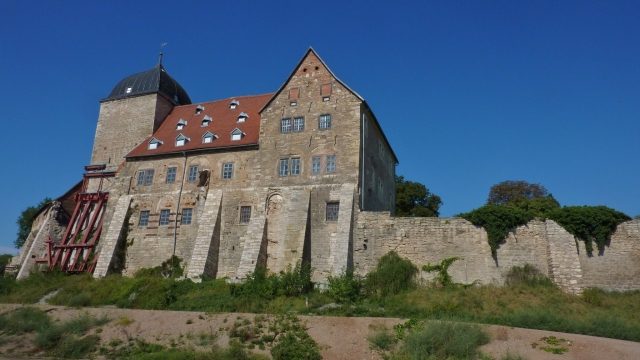
The Runneburg (modern name; in the Middle Ages called Burg Weißensee) is located in the town of Weißensee in the district of Sömmerda in Thuringia.
The assumption that the Runneburg was built on the remains of a 6th-century hillfort has since been disproven archaeologically. From 1168, Landgravine Jutta Claricia of Thuringia, a half-sister of Emperor Frederick Barbarossa, had the Runneburg expanded into a residence for the Landgraves of Thuringia with a two-story palas, a five-story residential tower, a castle gate, and a castle wall. The castle was first mentioned as Wyssense in 1174 in a document by Landgrave Ludwig III, the Mild of Thuringia. Weißensee came into the focus of German history in 1180, when Henry the Lion defeated the Thuringian Landgrave Ludwig III and his knights in the Battle of Weißensee. This was followed by unsuccessful sieges of the castle, first in 1204 by King Philip of Swabia and then in 1212 by Emperor Otto IV, who also used a trebuchet as a siege engine. Around 1220, a banqueting hall was added to the palas. Landgrave Ludwig IV, the Saint of Thuringia, husband of Saint Elisabeth, held a court day at Runneburg in 1225. With the death of King Heinrich Raspe in 1247, the Ludowinger dynasty died out. After the Hessian-Thuringian War of Succession, the Thuringian territories, and thus Weißensee and the Runneburg, fell to Margrave Heinrich III, the Illustrious of Meißen. The Wettin margraves frequently and regularly stayed at the castle. In 1382, the Runneburg came back into the possession of the Thuringians. In May 1440, the last Landgrave of Thuringia, Frederick IV, the Simple, died at the Runneburg, which then came into the possession of the Dukes of Saxony.
During the Peasants' War in 1525, the rebellious peasants were denied entry to the town and the castle. From 1554, the Runneburg served as a widow's residence for the Electors of Saxony. In the years 1580/1581, new residential buildings were erected. Around 1600, the gatehouse was built, followed by the coach house in 1738. Due to dilapidation, the old Romanesque keep (Streitturm) had to be demolished as early as around 1750. From 1656 to 1746, Weißensee and the Runneburg belonged to the Duchy of Saxe-Weißenfels. After the Congress of Vienna, the town and castle came to the Kingdom of Prussia in 1815; the King of Prussia became the lord of the castle. In the following years, the castle was converted for administrative purposes. In 1890, the new Prussian district office for the then district of Weißensee was built on the castle site, replacing an old military magazine barn. After the Second World War, the palas was used as a school in the GDR from 1952 to 1995, before the building section was closed by building authorities due to severe structural defects. Since 1988, building archaeological investigations have been taking place at the castle.
After German reunification in 1990, the association for the rescue and preservation of the Runneburg in Weißensee/Thür. e. V. was founded. At the same time, extensive structural safeguarding measures were and are being carried out. The residential tower had to be saved from collapse by a steel corset. In 1993, the 1st Castle Festival and the 825th-anniversary celebration of the Runneburg took place. In the same year, the museum (treasure vault) was opened on the ground floor of the palas. In 1995, the Historical Archive Weißensee was founded at the Runneburg.
The transfer of the Runneburg to the Thuringian Castles and Gardens Foundation, based in Rudolstadt, took place in 1996. In the same year, the castle restaurant Landgrafen-Schenke was opened and the Runneburg Betriebsgesellschaft Weißensee mbH was founded. In memory of the siege of the castle by Emperor Otto IV, a large trebuchet was rebuilt from 1996, which was successfully tested on June 1, 1997, with a stone throw over the allotment gardens of the city. In the Historical Archive Weißensee at the Runneburg, the Weißensee Purity Law of 1434 for brewing beer (hops, malt, and water) was discovered in 1998 by the historian Michael Kirchschlager.
On August 11, 1999, the day of the total solar eclipse, a fireball was thrown with the trebuchet for the first time. In December 1999, the first beer brewed according to the Weißensee Purity Law (Runneburger 1434er) was tasted at the castle.
Currently, further structural renovation measures are taking place on the medieval buildings. Since 2013, the "3B-Weißensee" education and meeting center has been located in the former Prussian District Office.
Site+
The castle grounds are freely accessible. Guided tours are possible by prior arrangement.
Take Mobile History with you
You are reading this text for free. Premium adds what matters on the road: descriptions read aloud, sites found through your camera, whole regions taken offline.
- Every description, including the ~17,700 Premium sites
- Audio guide: have descriptions read to you on location
- AR finder: see sites through your camera, with distance and bearing
- Unlimited saved sites
14 days free, then from €2.99 a month. Cancel anytime.
Source: Wikipedia · Licence: CC BY-SA 4.0 · Image: Joachim Schneeleopard
This description draws on the facts documented in the linked Wikipedia article; Wikipedia content is licensed under CC BY-SA 4.0. Wording and editing: Mobile History.
Location: 51.2003, 11.0622