The remains of the Castle can be visited
CastleWaltensburg
Kropfenstein Castle (Ruin) (Waltensburg)
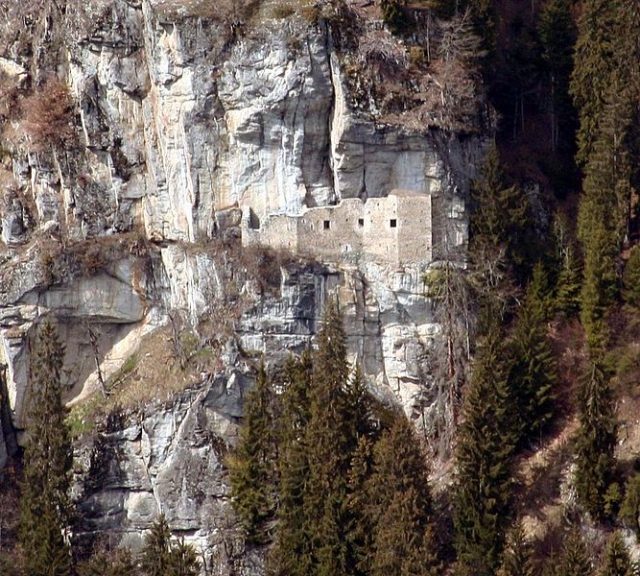
The ruin of Kropfenstein Castle is located in the municipality of Waltensburg/Vuorz in Surselva in the Swiss canton of Graubünden. Kropfenstein was one of the originally four castles in Waltensburg, alongside Jörgenberg, Grünenfels, and Vogelberg.
Location+
The castle is located west of the villages of Waltensburg and Brigels on the edge of a vertically dropping rock face and is easily accessible on foot from the western end of Waltensburg in about a quarter of an hour.
Name+
All medieval documents refer to Kropfenstein in various spellings: 1335 Crophenstain, 1342 Kropfenstain, 1343 Krophenstain and others. In Ulrich Campell, it appears as Cropfastenium. This mention indicates that the word "Kropf" (growth, excrescence) is present in the castle name, referring to the castle itself, which clings to the vertically dropping rock face like an excrescence. The transformation to the Rhaeto-Romanic castì grotta (cave castle) is of more recent origin and goes back to the Romanic grotta (cave, grotto).
Layout+
Access to the three-story elongated masonry is only possible via a steep, narrow path from the east, which was widened and secured with railings during a restoration in the 1950s. The project was initiated and financed by Paul Gabriel, a citizen of Waltensburg who had emigrated to Canada.
According to dendrochronological investigations, the complex dates from the beginning of the 14th century; a year of 1312 is mentioned. There is no evidence of a predecessor building.
The inner wall and parts of the roof are formed by the overhanging rock. The beam bearings of the former access are still recognizable today. The complex is entered through a low entrance gate. Above the gate, a square window and a loophole are embedded in the wall. The eastern part of the complex is a narrow passage of approx. 1.5 to 2 m width and, due to the cramped conditions, probably only served as a storage and for defense. The south wall is broken several times and adapted to the natural course of the rock face. It contains several embrasure windows for lighting as well as square windows with openings of approx. 70 by 50 cm.
The living quarters were located in the six-meter-wide western part of the complex. Remains of transverse walls, beam holes, windows with seating niches, a latrine bay in the west wall, and a sink on the second floor reveal the former layout. A relief found in the ruin, showing a man in a short skirt, is in the Rhaetian Museum; a copy is exhibited in the Waltensburg local museum. The interior of the building section is divided by two transverse walls, which are still preserved in their foundations. The partially still existing wooden beams were sawn off, which suggests a planned demolition and removal of the still usable beams. A lean-to roof built backwards against the rock is probably the most likely roof type.
There are no direct documentary testimonies about the castle or its builders. Kropfenstein is, however, considered one of those few cave castles that were not built in a dark hole as a refuge in times of need, but served as a residence for a respected family who, among other things, provided bailiffs and district judges. Possibly, the family of minor nobility from Kropfenstein, based in Luven (Maschieras), built or acquired Kropfenstein Castle or named themselves after it, while a branch of this family remained resident in Luven.
On November 28 or 29, 1328, a Jocobus de Strotznstein was killed during a procession in Rueun. It is uncertain whether this was an early owner of Kropfenstein or of an as yet unidentified Stotznstein Castle in the Waltensburg area.
In 1335, a Bürklin von Cropfenstein is mentioned, who served several times as a judge, as well as Albrecht von Kropfenstein in 1396, a bishop's judge in Ilanz. His name is mentioned several times in the coming years. In 1401, Florin von Kropfenstein is mentioned.
In 1433, Clara von Kropfenstein sold some properties to a Donat von Kadunau. In the same year and again in 1437, Junker Hans von Kropfenstein is mentioned, who bore the nickname "Muschieras," which again indicates a connection to Luven. Close relationships with the Barons of Rhäzüns are demonstrable. A letter of feud from Ulrich von Rhäzüns and Hans von Kropfenstein to the castellan of Freudenberg from May 3, 1437, has been preserved.
The most famous Kropfensteiner was Marquart von Kropfenstein, who was district judge of the Grey League in 1438/39 and 1442/43. In 1473, Junker Jörg von Kropfenstein is mentioned, who at that time affixed his seal to a purchase agreement of a Waltensburger. Towards the end of the 15th century, perhaps with Junker Jörg, the Kropfenstein family must have died out and the castle began to decay.
Take Mobile History with you
You are reading this text for free. Premium adds what matters on the road: descriptions read aloud, sites found through your camera, whole regions taken offline.
- Every description, including the ~17,700 Premium sites
- Audio guide: have descriptions read to you on location
- AR finder: see sites through your camera, with distance and bearing
- Unlimited saved sites
14 days free, then from €2.99 a month. Cancel anytime.
Source: Wikipedia · Licence: CC BY-SA 4.0
This description draws on the facts documented in the linked Wikipedia article; Wikipedia content is licensed under CC BY-SA 4.0. Wording and editing: Mobile History.
Location: 46.7696, 9.1015