The remains of the Castle can be visited
RuinWildstein
Wildstein Castle (Ruin)
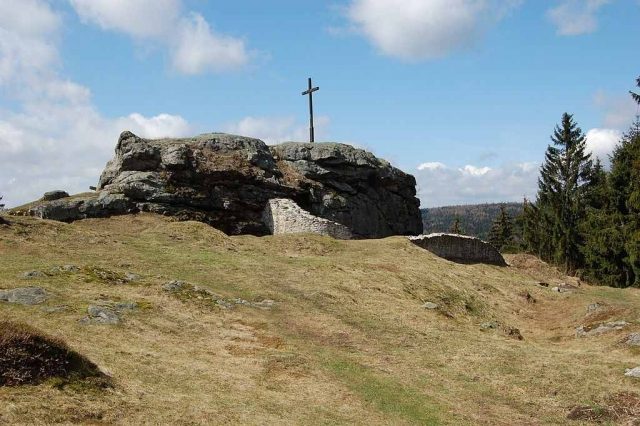
Wildstein Castle was first mentioned in the early 14th century. Today, the complex located near Wildstein, in the municipality of Teunz in the Upper Palatinate district of Schwandorf, is only preserved as the remains of a motte-and-bailey castle.
The remains of the Wildstein motte-and-bailey castle are situated at an altitude of 744 m on a hill, southwest of the village of Wildstein. The remains of the complex can be reached from the village in ten minutes. In clear weather, visitors have a magnificent panoramic view over the "Waldbuckel" (forest hills) of the Upper Palatinate Forest.
First Settlement
Around 1000 AD, Nordgau referred to the area of the central and northern Upper Palatinate. The land was gradually settled (nearby clearing settlements include: Zeinried, Kühried, Pullenried, Wildeppenried), including the areas into which the Slavs (Slavic settlements include: Teunz, Gleiritsch) had already advanced colonially from the east. Castles therefore secured the area against the east. The Upper Palatinate is therefore the region with the most castles in Germany. In the immediate vicinity of Wildstein were the castles of Kunzenstein, today a motte-and-bailey castle about 2 kilometers northwest, Flossenbürg, Leuchtenberg, Trausnitz, Tännesberg, Gleiritsch (Plassenberg Castle), Haus Murach (Obermurach), Thanstein, Reichenstein near Stadlern, and Frauenstein near Weiding. In the Middle Ages, trade routes to the east passed through the area. However, invasions into the newly settled areas of the Bavarian Nordgau also repeatedly occurred from the east.
Wildstein Castle, like the other castle complexes, served to administer the area, protect and control trade routes, and repel invasions.
Lords of Wildstein Castle
"On October 28, 1355, a document was issued at Wildstein Castle, according to which Egid Paulsdorfer zu dem Tennesberg and his wife sold the three Oeden zu dem Nesseltoch to their uncle Konrad dem Krätzlein zum Wildstein." Heinrich von Wildstein, mentioned around 1300, is to be attributed to Wildstein Castle in Skalna (near Eger). Sovereignty and high justice were disputed in the 1350s. On October 4, 1356, district judge Otto der Zenger von Schwarzeneck decided in favor of Count Palatine Ruprecht the Younger. After "Knight Cunrad der Chraetzel" died, the Wildstein manor was sold on March 27, 1373. Elspet Chrätzel transferred ownership to Landgrave Johann von Leuchtenberg.
In 1379, Andre der Zenger von Fronhof was "pfleger ze Wildstain" (administrator of Wildstein). On July 1, 1409, Wildstein Castle was sold by Landgrave Johann von Leuchtenberg to Hermann den Frankengruner. He, in turn, granted it as a fief to Count Palatine Johann. Wildstein was a fiefdom of the Palatinate. In 1476, Jörg Rabe inherited half of the castle from his cousin Nikolaus Rabe. In 1488, Hager, in his description of the art monuments of Bavaria, names Georg and Fritz Holtzschuher von Nürnberg as owners of Wildstein. They had bought the Wildstein estate from Albrecht and Hans den Raben. As owners of Wildstein, the Holzschuher had the obligation to "serve as needed" to the Palatine sovereign.
On July 23, 1499, Wildstein passed from the Holzschuher to Hainz Ochs, followed in 1507 by the brothers Utz and Hanns Ochs, who divided the property in 1520. In 1525, "Florian vnd Hanns Ochs" are mentioned. From 1548, "Florian Ochß zum Wildstain" is listed alone as a local noble. Jorg Ochs followed. On October 19, 1562, Hans Rüdiger and Hans Sigmund Machenwitz received half of Wildstein Castle. Since the Machenwitz had been placed under imperial ban, Wolf Satzenhofer von Fuchsberg was appointed as feudal lord of Wildstein on September 12, 1564. He was appointed for Anna Ochs, the wife of the deceased Florian Ochs. In 1583, Anna Ochs died. Since she had no male successors and the estate could not be passed on to female descendants, the Wildstein fief was confiscated and assigned to the Murach office. Since the Machenwitz had been placed under imperial ban, it is possible that in the year of the inheritance, i.e., 1562, the Wildstein property had already reverted to the Palatinate. In 1622, after the places Kühried, Wildstein, and Eppenrieth, it is noted: "These next mentioned 3 villages have reverted to the Electoral Palatinate as open fiefs about 60 years ago."
Decline of Wildstein Castle
In 1589, Wildstein Castle is depicted completely preserved on a map of the Murach office. In 1793, the building appears as a ruin on a map of the Pullenried parish. Around 1850, treasure excavations took place on the site (see also legends). In 1905, the Wildstein motte-and-bailey castle was declared an archaeological monument.
In May 1998, excavations began by members of the Society for Archaeology in Bavaria e.V. The ruin of a late medieval flanking tower from the first half of the 15th century was excavated. Bernhard Klier (Wildstein) and Harald Schaller (Pfreimd) spent three years of their free time uncovering these wall remains and documenting the results. Thus, in 1999, the fire and destruction layer was documented. In 2000, Klier and Schaller were able to uncover a fire layer west of the tower, and securing measures were carried out on the tower ruin.
Description of Wildstein Castle
The motte-and-bailey castle is located 744 meters above sea level on the summit of the Wildstein, near the village of Wildstein. It is thus the highest point in the municipality of Teunz, to which the village of Wildstein now belongs. The terrain slopes gently towards the northeast (Wildstein) and steeply towards the south (Kühried) and west. There are several rocks on the summit. In addition to the excavated remains of the tower and parts of the wall, the extent of the complex can be guessed based on the ground conditions.
Legends+
In connection with Wildstein Castle, there are a number of legends, often related to treasures on the Wildstein. Around 1850, treasure excavations also took place on the site. Legends include, for example, The White Maiden of Wildstein, The Sunday Child, The Venetians, The Earth Mirror.
Take Mobile History with you
You are reading this text for free. Premium adds what matters on the road: descriptions read aloud, sites found through your camera, whole regions taken offline.
- Every description, including the ~17,700 Premium sites
- Audio guide: have descriptions read to you on location
- AR finder: see sites through your camera, with distance and bearing
- Unlimited saved sites
14 days free, then from €2.99 a month. Cancel anytime.
Source: Wikipedia · Licence: CC BY-SA 4.0
This description draws on the facts documented in the linked Wikipedia article; Wikipedia content is licensed under CC BY-SA 4.0. Wording and editing: Mobile History.
Location: 49.5208, 12.4079