The remains of the Castle can be visited
RuinWerdenstein
Werdenstein Castle (Ruin)
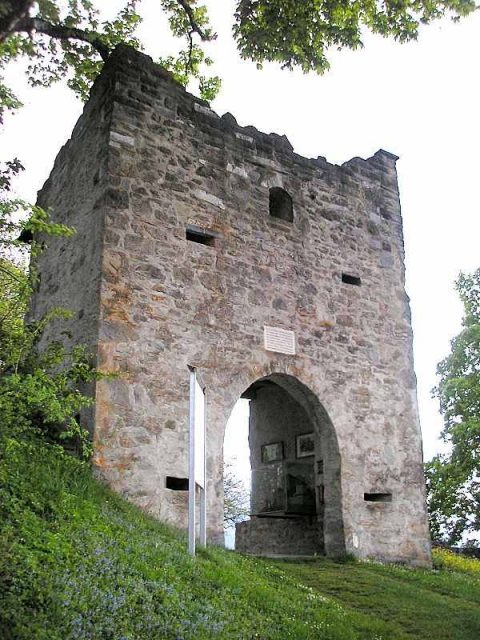
The ruin of Werdenstein Castle (Immenstadt im Allgäu, district of Eckarts) lies on a sandstone hill above the Iller Valley in the district of Oberallgäu in Swabia. Apart from minor wall remnants, only the gatehouse of the high to post-medieval castle complex has been preserved.
The fortress is the ancestral seat of the Lords of Werdenstein. The originally certainly free noble family early joined the retinue of Kempten Abbey. The first bearer of the name, Hildebrand von Werdenstein, appears in 1239 as a witness in a document of the monastery.
From 1350, the Werdensteiners served the Abbey as hereditary chamberlains and received, among other things, four houses in Kempten as a fief. At the beginning of the 15th century, however, the family submitted to the House of Austria. Apparently, they wanted to achieve greater independence from the Prince-Abbey and also assert themselves against the powerful Counts of Montfort, who resided only a few kilometers southeast on the large double castle Rothenfels-Hugofels.
In 1457, Count Hugo von Montfort besieged Werdenstein during a feud. In 1464, the hilltop castle appears among the Austrian "Swabian fiefs". The Werdensteiners had thus subjected their dominion to the Archdukes and received it back as a fief. In 1491, Hildbrand von Werdenstein was in the service of Maximilian I.
In 1525, the rebels plundered the castle during the Peasants' War. The lord of the castle, Georg, fled behind the protective walls of the nearby imperial city of Kempten and recorded the war events in the "Werdenstein Chronicle".
After the family moved to their newly acquired dominion of Dellmensingen near Ulm in 1659, the hilltop castle was only inhabited by an administrator. Occasionally, the Werdensteiners used their ancestral castle as a summer residence until 1782.
At the end of the 18th century, the last Baron von Werdenstein was in financial difficulties and had to sell the castle to the Counts of Königsegg-Rothenfels in 1785. Anton Christoph von Werdenstein wanted to at least preserve the dominion of Dellmensingen for his daughters. With the Baron, the old Allgäu noble family died out in the male line in 1796. His two sons had already died in childhood.
The Counts of Königsegg themselves had no use for the old noble seat and had the roofs removed shortly thereafter. The castle then finally began to decay. In 1804, the Habsburgs acquired the dominion from the Königseggs.
Already in 1805, the property came into the possession of the Bavarian state, which sold the castle ruin to the estate owner Gruber in 1821. The new owner exploited the wall remnants as a quarry. In 1898, the Rapp family bought the site and has since managed the farm in front of the castle. In 1988, the owners began renovating the castle remnants and converting them into a beer and guest garden for the associated castle café.
Description+
The freely accessible castle ruin largely serves today as a beer garden for the Burg-Café on the site of the former farm or building yard. The ruins of the fortress were largely removed in the early 19th century. The partially preserved gate tower and the few foundation remnants in the south were renovated and somewhat rebuilt in the last decades of the 20th century.
The highest hilltop in the north bore the keep, of which around 1825, the south wall still stood upright. The area is fenced off and inaccessible. According to the survey by Nessler (1985), minor foundation traces are still preserved here.
The palas formerly stood on the south side. At the site of the medieval castle chapel below the keep, a small chapel was re-consecrated during the renovation measures.
The Gatehouse
The gate tower was formerly accessible from the farmyard via a bridge. The modern access along the castle hill dates from a later period.
The tower, still about six meters high, was built from sandstone and rubble, re-roofed during the renovation, and supplemented by a few layers of stone. The corner quoins consist of larger and more regular stones. Unusual are the four western loopholes of the two floors. The embrasures were designed for the use of arquebuses and appear on the field side as horizontal slits, but run vertically inside. On the narrow sides, some small square, obliquely guided openings break through the masonry.
Above the archway, a commemorative plaque (1929) with some data on the castle's history is embedded:
Castle and Lordship Werdenstein
of the Imperial Knights of Werdenstein,
first mentioned 1239. Hereditary Chamberlain
of Kempten Abbey. Conquered and plundered
in the Peasants' War 1525. Sold
to the Counts of Königsegg-Rothenfels
in 1787. Castle taken over
in 1791 by the castle estate tenant
Martin Gruber.
Such plaques were installed in the first half of the 20th century on the initiative of Kempten's mayor and passionate castle researcher Otto Merkt at numerous Allgäu castle ruins. In the vicinity of the Werdenstein ruin, the farmyard west of the castle and the castle mill (Fleschermühle) to the north also bear corresponding inscriptions. The information on the stones is not always historically accurate.
Take Mobile History with you
You are reading this text for free. Premium adds what matters on the road: descriptions read aloud, sites found through your camera, whole regions taken offline.
- Every description, including the ~17,700 Premium sites
- Audio guide: have descriptions read to you on location
- AR finder: see sites through your camera, with distance and bearing
- Unlimited saved sites
14 days free, then from €2.99 a month. Cancel anytime.
Source: Wikipedia · Licence: CC BY-SA 4.0
This description draws on the facts documented in the linked Wikipedia article; Wikipedia content is licensed under CC BY-SA 4.0. Wording and editing: Mobile History.
Location: 47.6041, 10.2447