The remains of the Castle can be visited
RuinIppinghausen
Weidelsburg Castle (Ruin) (Ippinghausen)
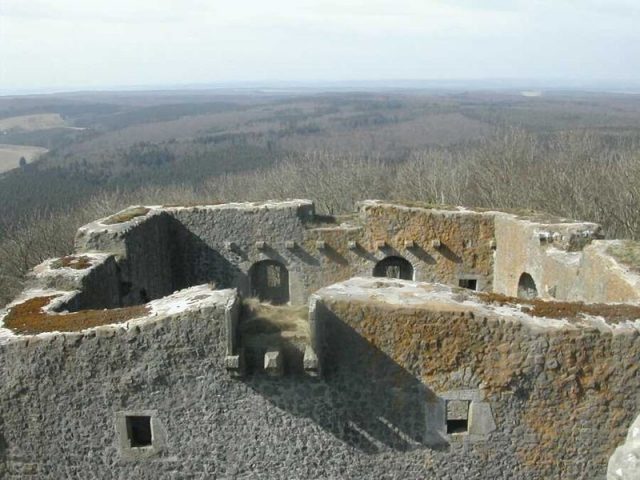
The Weidelsburg is the castle ruin of a hilltop castle near Wolfhagen-Ippinghausen in the district of Kassel in Hesse. It is considered the largest castle ruin in Northern Hesse.
Built in the 12th century, the Weidelsburg had been uninhabited and dilapidated since the end of the 16th century. From 1979 to 1987, it was partially restored with great effort. High wall and tower remains, massive palas buildings, castle gates, and zwinger are preserved.
From the former East Palas, there is a magnificent view over the landscape of the Habichtswald Nature Park with its characteristic basalt domes. The castle can be seen from afar and thus forms a landmark of the Wolfhager Land, which includes part of the Waldecker Forest.
The Weidelsburg is located in the western part of the Habichtswald Nature Park south of Ippinghausen (a southern district of Wolfhagen). It stands on the dome-like and wooded Weidelsberg, which rises above or south of the village. The Eder tributary Elbe runs approximately 170 m below the castle.
The Weidelsburg stands in the former tri-border area between the Landgraviate of Hesse, the County of Waldeck, and the Kurmainz enclave of Naumburg, as well as on the old tribal border between Franks and Saxons.
The Weidelsburg, whose exact time of origin and builders are not known, was first mentioned in a document in the 12th century. It was built as a defensive castle to protect trade routes and the Ludowingian state border against Waldeck and Mainz. Acquired by the Archbishopric of Mainz by purchase in 1266, it was destroyed by Landgrave Heinrich I of Hesse in 1275 during the dispute between Archbishop Werner von Eppstein and the Landgrave. The parts still preserved today stem from the reconstruction undertaken 100 years later.
In 1380, Landgrave Hermann II of Hesse and Count Heinrich VI of Waldeck had the Weidelsburg rebuilt, but had to stop work just two years later because the Mainz Archbishop Adolf I of Nassau asserted older rights. Only seven years later, Archbishop Adolf initiated the reconstruction by the Lords of Hertingshausen. In the ongoing feud between Mainz and Hesse, the castle was besieged and partially destroyed by Landgrave Hermann II in 1402/03.
In 1431, Reinhard von Dalwigk was appointed as the new Mainz bailiff at the castle by Archbishop Konrad III von Dhaun. As a breaker of the public peace, he was besieged there twice, in 1443 and 1448, by troops of Landgrave Ludwig I and Archbishop Dietrich Schenk von Erbach, forced to submit, and punished, the second time, among other things, by permanent expulsion from the Weidelsburg.
As a result of the Hessian Landgrave's policy of public peace, the castle soon lost its strategic importance. It was abandoned at the latest by the end of the 16th century and has been a ruin ever since, probably after a fire.
Legend of Goliath and the Giant Stone
The giant Goliath from Homberg an der Efze hurled the Giant Stone to destroy the Weidelsburg. The stone slipped from his little finger, and he then shed bloody tears because his reputation as a castle conqueror was lost. He sat on the Giant Stone, on the Heiligenberg (located southeast of Naumburg), and out of sorrow forgot to eat and drink. Thereupon he died. Even today, one can see the indentation where the giant sat after his missed throw.
Take Mobile History with you
You are reading this text for free. Premium adds what matters on the road: descriptions read aloud, sites found through your camera, whole regions taken offline.
- Every description, including the ~17,700 Premium sites
- Audio guide: have descriptions read to you on location
- AR finder: see sites through your camera, with distance and bearing
- Unlimited saved sites
14 days free, then from €2.99 a month. Cancel anytime.
Source: Wikipedia · Licence: CC BY-SA 4.0
This description draws on the facts documented in the linked Wikipedia article; Wikipedia content is licensed under CC BY-SA 4.0. Wording and editing: Mobile History.
Location: 51.2731, 9.1439