The remains of the Castle can be visited
RuinFisching
Wehrstein Castle (Ruin)
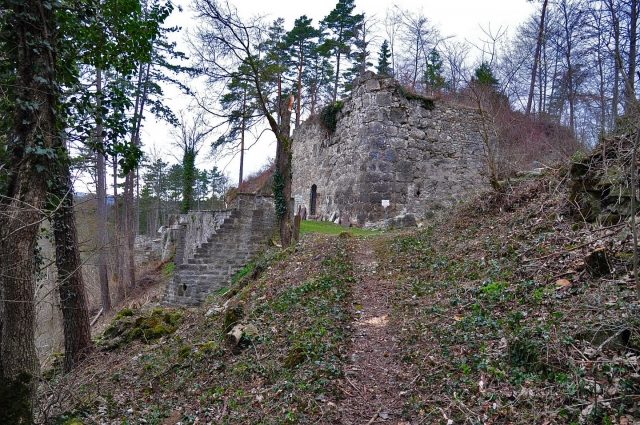
The former Wehrstein Castle is a ruin on a hill above Fischingen near Sulz am Neckar, Rottweil district in Baden-Württemberg, Germany.
According to legend, Charlemagne is said to have met his wife Hildegard, a Swabian, at Wehrstein Castle in 752. In 772, the towns of Fischingen and Empfingen are mentioned for the first time in documents. Around 1100, the noble free lords of Wehrstein are mentioned for the first time as a high noble family, when Marquard von Wehrstein and his wife Gepa made a donation to Hirsau Monastery. At this time, the Wehrstein coat of arms, a golden anchor, also appeared for the first time. It is said to have commemorated a Wehrsteiner, who is said to have participated in a crusade with Frederick Barbarossa, being saved from mortal danger during a storm at sea.
The Lords of Wehrstein appear in documents from 1101 until around 1395. Their dominion included, in addition to the castle and the Wehrstein estate, the towns of Fischingen, Betra, and Empfingen, and was initially a Palatine-Tübingen, then a Hohenberg, and from 1381 an Austrian fief.
In 1318, Hiltibold von Wehrstein († 1329) became Abbot of St. Gallen. The Wehrstein family presumably died out with the death of Benz von Wehrstein in 1409. But already in 1331, Count Rudolf von Hohenberg (1302–1336) is mentioned as the owner of Wehrstein Castle. The Counts of Hohenberg thus took over the dominion, which included Fischingen, Betra, and Empfingen.
In 1373, the Counts of Hohenberg pledged the dominion of Wehrstein to the Lords of Weitingen, who subsequently further expanded the castle. In 1381, Duke Leopold of Austria bought the entire Hohenberg property, which also included the dominion of Wehrstein. Thus, Wehrstein became an Austrian fief, and Austria would remain the suzerain until 1806.
In 1400, the dominion was pledged to Burkard von Mansperg, who had his ancestral castle Mansberg near Kirchheim/Teck. Soon the pledge was converted into a fief. In 1419, the Weitingers reacquired the dominion as a fief. The castle survived the Peasants' War of 1525 unscathed.
In 1528, Count Christoph von Nellenburg-Tengen acquired the dominion of Wehrstein. He died in 1539 and was buried in the church in Empfingen.
In 1552, Jos Niklas II von Zollern bought the dominion for his cousin, Count Karl I von Hohenzollern. In the Hohenzollern family compact of 1575, the dominion was assigned to Hohenzollern-Haigerloch. After the extinction of the Zollern line Hohenzollern-Wehrstein/Haigerloch in 1634, Wehrstein did not go to Hohenzollern-Hechingen, but to Hohenzollern-Sigmaringen.
Until 1585, the dominion was administered by a Vogt, who resided in the castle.
During the Thirty Years' War, the castle was almost completely destroyed in 1643 by Bavarian troops, but subsequently rebuilt.
With the Peace of Pressburg in 1805, Austrian suzerainty ended and Wehrstein passed entirely into the possession of Hohenzollern-Sigmaringen. Fischingen and Betra were initially assigned to the Oberamt Glatt, which was merged into the Oberamt Haigerloch in 1854.
Around 1830, the dilapidated castle was then demolished. In 1842, major repairs were carried out on the ruin, which was protected from further decay by Prince Karl Anton von Hohenzollern-Sigmaringen.
In 2003, the "Burgruine Wehrstein" (Wehrstein Castle Ruin) Friends' Association was founded, which has set itself the task of protecting the ruin from further decay.
In June 2006, the Wehrstein castle ruin was bought by Alois Gfrörer, an aggregate plant owner from Empfingen.
Take Mobile History with you
You are reading this text for free. Premium adds what matters on the road: descriptions read aloud, sites found through your camera, whole regions taken offline.
- Every description, including the ~17,700 Premium sites
- Audio guide: have descriptions read to you on location
- AR finder: see sites through your camera, with distance and bearing
- Unlimited saved sites
14 days free, then from €2.99 a month. Cancel anytime.
Source: Wikipedia · Licence: CC BY-SA 4.0
This description draws on the facts documented in the linked Wikipedia article; Wikipedia content is licensed under CC BY-SA 4.0. Wording and editing: Mobile History.
Location: 48.3926, 8.6738