The remains of the Castle can be visited
CastlePfäfers
Wartenstein Castle (Ruin) (Pfäfers)
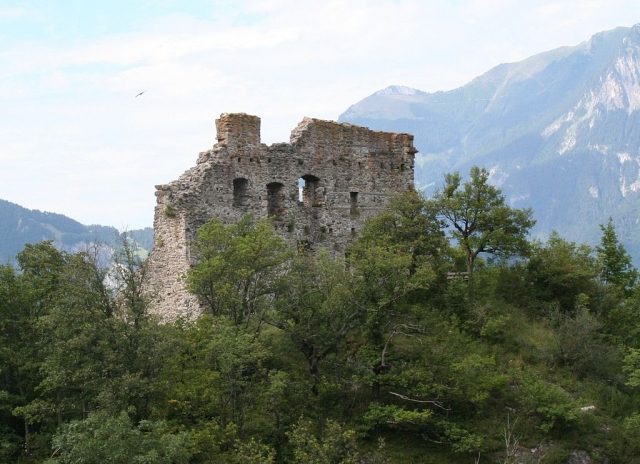
The ruins of Wartenstein Castle are visible from afar, high above the Rhine Valley on a steep rocky outcrop southwest of Bad Ragaz on the road to Pfäfers in the canton of St. Gallen, Switzerland. They are easily accessible from the road via a footpath in a few minutes. The name is derived from the word "Warte" (watchtower) and means "stone from which a lookout is kept".
Wartenstein was built around 1206 on behalf of Konrad von Zwiefalten, the abbot of the Imperial Abbey of Pfäfers. The castle was first mentioned in 1208, when Emperor Otto IV pledged the protective vogtei over the monastery's estates to Knight Heinrich von Sax. In 1210, he pledged the vogtei to Heinrich von Falkenstein. In 1217, the castle was mentioned as "domum, quam Wartenstain nominartunt". In 1257, Abbot Rudolf III von Bernang bought back the vogtei for 300 marks of silver from the new owners, the Empire and the von Sax family.
In 1261, the Lords of Wildenberg, who at that time inhabited Freudenberg Castle near Bad Ragaz, were appointed as monastic vogts by the monastery.
In the 14th century, the Counts of Werdenberg-Heiligenberg succeeded the Wildenbergers as monastic vogts. Their cousins, the Counts of Werdenberg-Sargans, promised the abbot not to damage Wartenstein or even to take possession of it.
In 1341, the Pfäfers abbot Hermann II von Arbon had the castle rebuilt and repaired. A chapel was erected in the fortress, which, however, can no longer be located today. Around 1430, Wartenstein served as a residence for Abbot Gerold von Eroltzheim.
In 1482, Sargans became the seat of the bailiff of the Confederates, who also took over the protective vogtei over the Pfäfers monastery and Wartenstein. During the Swabian War, the castle was put into a state of readiness for war and served as a base for the Confederates. After the end of the war, Wartenstein was returned to the abbey in 1504. Under Abbot Wilhelm von Fulach, it was renovated and equipped with weapons.
During the Reformation, the then bailiff Aegidius Tschudi had the castle reoccupied in 1531 in view of a threatened monastery storm.
After the mid-16th century, sources describe the castle as dilapidated. The Pfäfers Abbey abandoned the now worthless complex in 1586 and left it to the residents as a quarry. After the monastery fire in 1665, Abbot Bonifaz Tschupp had the castle largely demolished to obtain building materials.
In 1838, the old Imperial Abbey was dissolved. Wartenstein became state property and was leased to the director of the spa facilities in Bad Ragaz. In 1951, stabilization work prevented further decay. From 1974 to 1976, the core castle was renovated, and in 1991, the entire complex was restored.
Complex+
The mighty four-story residential tower of the upper core castle, with its two-meter-thick foundation walls, was the central building of the complex. It was accessible via a high entrance and was comfortably furnished from the 2nd floor upwards. In addition to window niches, traces of a smoke vent are visible.
In a second construction phase in the mid-14th century, residential and economic buildings were erected north of the tower. They were demolished again around 1400 and replaced by a Zwinger (outer bailey) with a defensive wall and a cistern. Three battlements with beam holes for the wooden wall-walk are still preserved from it. At that time, the segmental arch gate to the tower was also broken out in place of the old high entrance. In the younger lower castle, located about 50 meters lower, traces of at least five buildings are still recognizable.
Take Mobile History with you
You are reading this text for free. Premium adds what matters on the road: descriptions read aloud, sites found through your camera, whole regions taken offline.
- Every description, including the ~17,700 Premium sites
- Audio guide: have descriptions read to you on location
- AR finder: see sites through your camera, with distance and bearing
- Unlimited saved sites
14 days free, then from €2.99 a month. Cancel anytime.
Source: Wikipedia · Licence: CC BY-SA 4.0
This description draws on the facts documented in the linked Wikipedia article; Wikipedia content is licensed under CC BY-SA 4.0. Wording and editing: Mobile History.
Location: 46.9931, 9.5104