The remains of the Castle can be visited
RuinAngersbach
Wartenberg Castle (Ruin) (Angersbach)
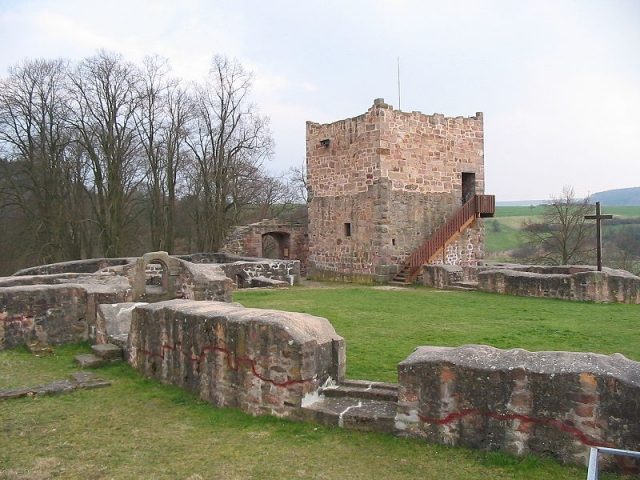
Wartenberg Castle (historical names: Wartinberg (1232); Warthenberg (1293); also popularly known as Wartebach) is the ruin of a hilltop castle about one kilometer east of Angersbach, a district of the municipality of Wartenberg (Hesse), at an altitude of about 270 meters on a flat rock spur above the small river Lauter. The ruin gave Angersbach and Landenhausen their name after their merger in 1972 and their coat of arms in 1978. Furthermore, the castle ruin is considered the landmark of the municipality and is also a protected monument.
Prehistory
During the prospecting of the archaeological site and in the course of excavations by Karl Maurer from 1938 to 1940, two storage pits from the Roman Imperial period (approx. 200 AD) and remains of 8 Carolingian fortified farmsteads (approx. 700 AD) were discovered under the castle's rubble. Skew-angled foundation walls, processed with clay, were found. These foundations could have been part of the settlement "Ungefures" according to the "Lauterbach-Schlitzer border description" from 812. The document states in Latin. At least four houses are assumed to have been on the core hill. Around 1000 AD, before the construction of Wartenberg Castle, the ancestral castle of the Lords of Angersbach was located near the present-day Protestant church in Angersbach.
Construction of the Castle
Around 1220, Friedrich von Angersbach (called Friedrich von Wartenberg from 1232) had a castle built on the "Wartenbachhügel", to which the keep was initially assigned, followed by the inner ring wall and the other buildings. The sons Heinrich and Dietrich von Wartenberg are considered the owners of Wartenberg Castle after Friedrich's death.
Destruction of the Castle
The castle was destroyed in 1265 by troops of Bertho II von Leibolz, Abbot of Fulda, during a feud with the monastic Vogt, Count Gottfried V von Ziegenhain. The Count sought to enlarge his territory at the expense of the abbey's lands and, together with his sub-Vogts, including those of Wartenberg, rose against the Abbot. Bertho succeeded in defeating the rebellious nobles and conquering or destroying 15 castles of his opponents between the Rhön and Vogelsberg, including Wartenberg Castle and Eisenbach Castle near Lauterbach (Hesse).
Lords of Wartenberg+
The Angersbach nobles originally inhabited a small valley castle in the village. With the construction of the castle on the Wartenberg, the family was henceforth called the Wartenbergers, from 1232. The year 1232 thus reveals for the first time in a document the existence of a Wartenberg family. The landed gentry family of Wartenberg belonged to the service nobility of the Benedictine Abbey of Fulda and, as ministerials (officials), was subordinate to the abbot as the supreme liege lord and, as vassals, to the Count of Ziegenhain as the collegiate Vogt. (Vogts were active in purely secular matters for the spiritual territorial lords.) The Wartenbergers had a small but orderly dominion. Their territory included the localities of Lauterbach, Maar, Angersbach, Salzschlirf, Müs, Landenhausen and other estates. Furthermore, the local nobility had the right to exercise administrative, judicial and executive power. Lauterbach was considered Wartenbergian due to its court location - Wartenberg Castle - and its church affiliation.
The heirs of the castle after Friedrich's death, who was the first mentioned of Wartenberg, were his sons Heinrich and Dietrich, who continued to manage the family property. Gisela von Wartenberg, daughter of Friedrich von Wartenberg, married Guntram von Schweinsberg. Of Friedrich's sons, one son, also named Friedrich, became a clergyman in Amöneburg in 1249. In 1252, Heinrich von Wartenberg allied himself with the Vogt of Fulda Abbey, Count Berthold I von Ziegenhain, to whom Heinrich promised to make his castle available as a base in the event of war. The increasingly strong conflicts of interest in the course of the 13th century between the abbot on the one hand and the Vogt, his sub-Vogts and their followers on the other, led to a conflict that involved the Lords of Wartenberg in a feud between Count Gottfried V von Ziegenhain and Prince-Abbot Bertho II von Leibolz. In the course of this, Wartenberg Castle was destroyed by the abbot's troops in 1265.
The subsequent imposed peace brought considerable sanctions for the Wartenbergers, whereby their claim to rule over the Wartenbergian territory was declared null and void. Furthermore, they were denied the reconstruction of the castle. Abbot Bertho II endowed Lauterbach with the rights of a city and built a castle there, to the construction of which the Wartenbergers had to contribute. The resulting Vogtship of Lauterbach was divided into two halves by the Prince-Abbot. He left one to the Wartenbergers and took the other for himself. Dietrich von Wartenberg's daughter, Mechthild, was married to Trabodo von Eisenbach, so that the Eisenbachers came into co-ownership of the Lauterbach Vogtship. Heinrich von Wartenberg and his son Friedrich sold their half of the Lauterbach Vogtship to the Prince-Bishopric of Fulda. However, they met with resistance from their Eisenbach relatives, as a Fulda court document from 1336 reveals. In 1369, Friedrich von Wartenberg died, and around 1375, his wife Else followed him. The Wartenberger family died out with them; it merged in 1350 into the noble family of Eisenbach and thus finally in 1428 into that of the Barons Riedesel zu Eisenbach.
Excavations and Restoration+
After the castle ruin had served as a quarry for the surrounding villages for centuries, the first excavations at the ruin began in 1828. Some entrances and walls were partially uncovered. Between 1850 and 1914, repeated attempts at excavation were made, but they did not reveal any special findings. It was not until Karl Maurer, the then director of the Hohhaus Museum in Lauterbach, that the ruin was excavated from 1938 to 1940 and recognized as an important cultural monument. A permanent exhibition of numerous finds is shown at the Hohhaus Museum in Lauterbach. Individual finds received international attention at the Staufer Exhibition in Stuttgart in 1977 and in the exhibition Phoenix from Sand and Ash: Medieval Glass in Bonn in 1988.
Karl Maurer, who led excavations in the years 1938–40 and published his results in 1961, is instrumental in Wartenberg research. In 2005, Maurer's research was re-evaluated as part of a master's thesis by Susanne Sehrt, focusing on prehistory and early history at Philipps University in Marburg. Sehrt's analysis was limited to the metal finds at Wartenberg Castle, including coins, window, door and lock iron, horseshoes, spurs, and arrowheads. Based on comparative finds from other archaeological excavations and medieval, contemporary pictorial sources, Sehrt was able to determine the age and function of the artifacts. One result, for example, was that knives with spiral tips were used as writing implements and not, as assumed, as cutlery. Furthermore, the more than one hundred projectile points found on the castle hill suggest a military defeat of Wartenberg Castle. Based on this scientific work, Sehrt believes that the construction took place several decades earlier and that the destruction of the castle in the last quarter of the 13th century can be confirmed.
Selected Finds
- Coins: 6 silver bracteates, 8 halved silver bracteates, 6 double-sided silver pennies.
- The Wartenberg coat of arms: 7 cm high gilded bronze coat of arms appliqué; on a blue (or green) background a white bend sinister from top left to bottom right, surmounted in the right field by a golden star. Model for the current coat of arms of the municipality of Wartenberg.
- Blue glass bowl, Saracen arrowheads, rose oil ampoule, clay field or pilgrim flasks - in connection with the Crusades
- The "Wartebachmännchen": presumably a so-called "pocket god", or a toy?
- various building sacrifices
- A chest key
- Silver bell
- Jewelry: amulet, wryneck ring, neck collar and double spiral needle
- The "Stone Eagle" - Eagle figure from Wartenberg Castle - The Wartenberg family held a special position in the region, as they exercised jurisdiction. This is evidenced by the discovery of an eagle, which is interpreted as a symbol of a court seat at Wartenberg Castle.
Restoration
The aim of the restoration work, according to Edmund Lorenz, chairman of the support association for the rescue of Wartenberg Castle ruins, is "not to rebuild the castle", but to preserve the Staufer-era monument as a ruin for posterity.
The restored components of Wartenberg Castle include:
- Archway - From 1993 to 1994, the archway at the entrance to the core castle was rebuilt by the Lauterbach stonemason's guild.
- Tower stump - This was erected in 1984 as part of a job creation measure, then with a height of five meters. Since 2002, the tower has risen nine and a half meters. The extension has created an accessible interior. The tower room now allows for wedding ceremonies.
- Castle well - Since 2006, a reconstructed well replica, which significantly shapes the image of the castle, has been located in the core castle, at the site of the former water source.
- Outer wall - The outer wall was rebuilt from 2001 to 2004.
Further construction measures were carried out in the core castle: these included the oven, cellar 2 in the front palace, and the inner ring wall. Furthermore, the outer gate system was reconstructed.
Take Mobile History with you
You are reading this text for free. Premium adds what matters on the road: descriptions read aloud, sites found through your camera, whole regions taken offline.
- Every description, including the ~17,700 Premium sites
- Audio guide: have descriptions read to you on location
- AR finder: see sites through your camera, with distance and bearing
- Unlimited saved sites
14 days free, then from €2.99 a month. Cancel anytime.
Source: Wikipedia · Licence: CC BY-SA 4.0
This description draws on the facts documented in the linked Wikipedia article; Wikipedia content is licensed under CC BY-SA 4.0. Wording and editing: Mobile History.
Location: 50.6315, 9.4628