Cultural Events
RuinStörmede
Störmede Castle (Ruin)
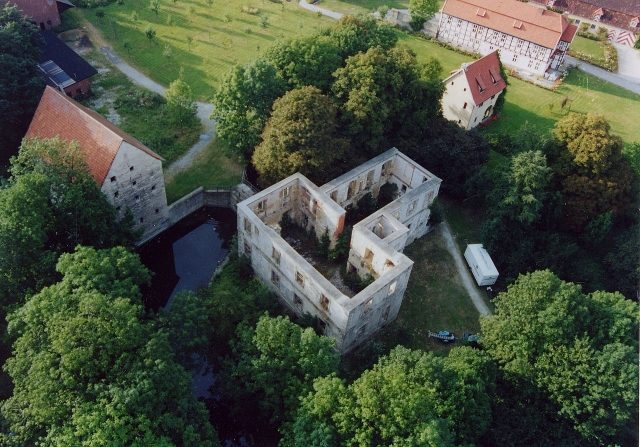
Störmede Castle, also known as Störmede Palace, in Störmede (today part of the city of Geseke) dates back to a possibly early medieval complex. In the High Middle Ages, the castle was the seat of the noble lords of Störmede. Destroyed several times, it was rebuilt at a slightly different location. After the extinction of the Störmede family, the property passed to the von Hörde family, whose Störmede line split into various branches. Through other owners, it came to the von Ketteler family and in 1970 to the city of Geseke.
Störmede was already mentioned in 826 in the register of donations of Corvey Monastery. There may also have been precursors of a castle. Störmede was later the seat of the noble lords of Störmede. A Wernor von Störmede is documented for 1155. The original castle dated back to the 12th century and formed the center of an extensive lordship. The castle on the Hellweg was considered so strategically important by the Archbishops of Cologne, who had a focus of power in Westphalia, particularly around Soest, that Philipp von Heinsberg acquired at least parts of it and returned it as a Cologne fief to Radobus and Reinerus.
However, there was apparently a dispute between the bishops and the lords of Störmede, as the castle was destroyed by the Cologners in 1233. It was then rebuilt. Under Albert von Störmede (1217–1255), the power of the noble lords expanded through the transfer of county rights by the Counts of Arnsberg. Around the middle of the 13th century, the lords of Störmede founded a town in the immediate vicinity of the castle. Castle and town were destroyed in 1277 during the conflicts between the Archbishops of Cologne and the Bishops of Paderborn, but rebuilt in a different location after 1292. The town, however, did not flourish, and today only a few remnants of the ramparts remain.
The noble family died out around 1300. Through inheritance, the castle and property passed to the Lords of Hörde. This led to a strong social ascent for the ministerial family von Hörde. After the division of the family, one line called itself Hörde zu Störmede. This in turn split in the 14th century into the Old House line and the High House line. The property of the Old House line fell to the Korff zu Harkotten family in 1652. The High House came to the von Bocholtz family in the 16th century, forming the Bocholtz zu Störmede line.
In addition, the middle house of the von Hörde family existed temporarily since 1529. Alhard von Hörde tried to achieve an immediate imperial status and enfeoffed the property to Emperor Charles V along with his relatives from the High House. The Archbishops of Cologne objected to this. When Alhard had fortifications built, Salentin von Isenburg intervened. In the so-called Salentin Recess, the lines of Hörde zu Störmede had to renounce all sovereign claims.
The von Bocholtz family sold Haus Störmede in 1879 to the merchant Dietrich Modersohn from Lippstadt. In 1881, the Ketteler-Harkotten zu Schwarzenraben bought the property. They lived there until 1964. The heirs sold the house to the city of Geseke in 1970.
Buildings+
The actual castle, initially in the form of a motte, was located in the Middle Ages approximately on the area of today's church square of Störmede and its immediate surroundings. The complex was about two hectares in size. It was enclosed by a double ring wall, partly two meters thick. Inside the castle were a hunter's house, the houses of the burgmannen, a palas, and a castle chapel. This was built in the 12th century on possibly Carolingian remains.
Later, the castle was moved to its current location. The later complex was secured by a moat and a rampart. The High House, made of half-timbered construction, as well as stables, some wall remnants, gatehouses from the 17th century, and agricultural buildings, are preserved. The Old House, probably also from the 17th century, received late-classical plaster decorations in the 19th century and was located on the southern part of the castle grounds. After passing to the city of Geseke, the building increasingly fell into disrepair and for a long time existed only as a roofless ruin.
In the winter half-year of 2011/2012, the reconstruction of Störmede Castle began. From summer 2013 at the earliest, it is intended to serve as an event venue for weddings, concerts, exhibitions, or conferences, together with an ancillary building yet to be constructed, under the designation "Rittergut Störmede" (Störmede Manor).
Take Mobile History with you
You are reading this text for free. Premium adds what matters on the road: descriptions read aloud, sites found through your camera, whole regions taken offline.
- Every description, including the ~17,700 Premium sites
- Audio guide: have descriptions read to you on location
- AR finder: see sites through your camera, with distance and bearing
- Unlimited saved sites
14 days free, then from €2.99 a month. Cancel anytime.
Source: Wikipedia · Licence: CC BY-SA 4.0
This description draws on the facts documented in the linked Wikipedia article; Wikipedia content is licensed under CC BY-SA 4.0. Wording and editing: Mobile History.
Location: 51.6375, 8.4669