The remains of the Castle can be visited
RuinFischbach
Stockenfels Castle (Ruin)
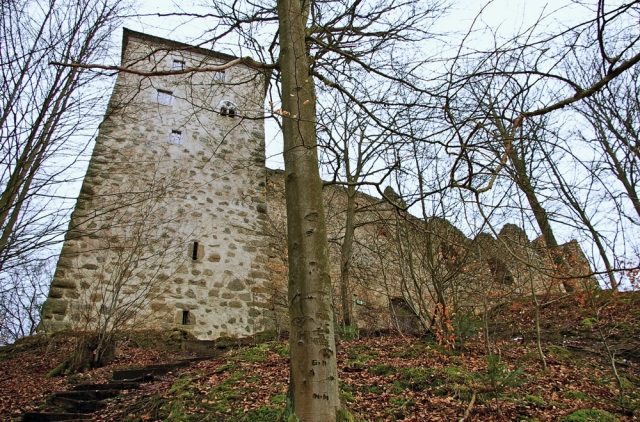
The castle ruin Stockenfels stands at a strategically favorable location on a 120-meter high granite hill in the Regen valley near the district of Fischbach, part of the town of Nittenau in the district of Schwandorf, Bavaria.
The castle was once the center of the lordship of Stockenfels, whose later name was Stockenfels/Fischbach, as the complex was destroyed during the Thirty Years' War and the administrative center shifted from Stockenfels Castle to Fischbach.
The construction style of the still preserved buildings points to the mid-14th century as the date of origin or to the two builders of that time, Duke Ludwig the Strict and his successor Duke Ludwig IV, later Emperor Ludwig the Bavarian. The latter equipped Stockenfels Castle with its own chapel. After the death of Emperor Ludwig, Stockenfels frequently changed owners, among whom were even predatory lords. In 1351, the property came into the possession of the patrician family Auer, who originally came from Regensburg but had to leave their hometown in 1334. In 1372, after some war turmoil, Stockenfels was taken over by the Wittelsbachs. In 1430, the knight Georg Heuras von Satzdorf took over the castle.
In 1510, the Heuras family sold the lordship to Albrecht von Wirsberg, who was a regional judge and administrator in Neunburg v. Wald. A period followed during which the owners constantly changed.
At the beginning of the 19th century, Baron Karl von Eckart acquired the ruin, which is still owned by his descendants, the Counts von der Mühle-Eckart. The current owner is Countess von Drechsel, who also ensures the maintenance and preservation of the castle.
The Legend of the Beer Adulterers+
At Stockenfels Castle, situated high on a ridge above the Regen valley, those who have committed the third worst crime in Bavaria atone for their sins every night. After murder and arson, this is "pouring water into beer," or so at least popular belief and the relevant legends and stories surrounding the notorious ghost castle Stockenfels, sometimes also called the Beer Adulterers' Valhalla, say. The adulterers are joined by unfaithful waitresses, bartenders, innkeepers, and landladies who have adulterated, poorly poured, or otherwise cheated their trusting guests.
Punctually at midnight, the otherwise buried bottomless castle well opens, and a seemingly endless ladder reaches from the bottom of the well up to the top of the massive keep. The Stockenfels devils now drive the poor and wailing souls of the malefactors onto the ladder, until rung by rung is occupied, from the very bottom to the very top. Below, a devil pours bucket after bucket full of water, and the chain of exiles must pass them up to the very top, where the chief devil pours the drawn water over the castle wall again.
This goes on night after night during the witching hour, and the penance lasts for all eternity, because brewing malefactors never find peace. They must draw as much water as they poured into beer during their earthly life and thus cheated their guests. Several are also known by name, such as the Schwodlbräu from Zangenstein, the waitress from Stadtamhof, three waitresses from the Hofbräuhaus, some brewers from Munich, the Podagrawirt from Haag, the administrator from Aufhausen, the brewer from Regensburg, and many others from Bavarian lands.
And several have been up there for 300 years, and every day there are more. That's why the deep ponds at the foot of the castle never dry out, even in the hottest summer, no wonder given the watercourses that pour into them from the castle every night. And many stories circulate about curious, nocturnal hikers who involuntarily witnessed the adulterers' penance at Stockenfels Castle. However, they all paid for their curiosity with their lives and now themselves watch the ghostly feast at Stockenfels every night and forever.
The Nittenau Festival Association performs the legend three times a year at the castles Hof am Regen, Stefling, and Stockenfels in the form of a ghost walk. This is attended by both tourists and locals, which is why the limited tickets for these performances are highly sought after.
Take Mobile History with you
You are reading this text for free. Premium adds what matters on the road: descriptions read aloud, sites found through your camera, whole regions taken offline.
- Every description, including the ~17,700 Premium sites
- Audio guide: have descriptions read to you on location
- AR finder: see sites through your camera, with distance and bearing
- Unlimited saved sites
14 days free, then from €2.99 a month. Cancel anytime.
Source: Wikipedia · Licence: CC BY-SA 4.0
This description draws on the facts documented in the linked Wikipedia article; Wikipedia content is licensed under CC BY-SA 4.0. Wording and editing: Mobile History.
Location: 49.2267, 12.1725