The remains of the Castle can be visited
CastleSur
Spliatsch Castle (Ruin)
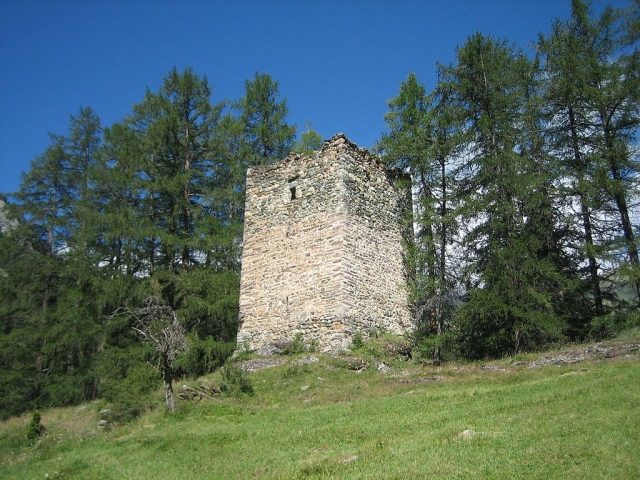
The ruin of the high medieval castle Spliatsch is located in the municipality of Sur in the Swiss canton of Graubünden. The ruin of the tower stands on a small hill not far from the Julier Pass road between Marmorera and Mulegns. The interior of the tower is not accessible.
Layout+
What remains is a well-preserved tower with three stories and a square footprint of 8 by 8 meters. The wall thickness is about 1.4 meters. The well-preserved upper wall termination could indicate a vanished fourth wooden story. The masonry consists of stones of unequal size, which are layered somewhat horizontally. In the lower part, there are traces of a Rasa-Pietra exterior plaster. On the third floor, there was a window with two seats, as well as a latrine bay and a smoke vent for the oven.
The elevated entrance was on the second floor on the west side. The jamb stones are well preserved. Remains of beams show the location of the stairs and the balustrade in front of the entrance. Above the door, there are remains of a sloping canopy.
On the inside, in two inhabited upper floors, there are remains of a smooth plaster. Remains of beams indicate the location of the floors. On the ground floor, remains of a fireplace with a sloping smoke vent are preserved.
Southeast of the tower, on a terrace, was a supply yard built of dry stone walls and wood; a rectangular footprint of a small house is still clearly recognizable. The yard was enclosed by a curtain wall, which is still partially visible in the south.
Written documents about the origin of the complex are missing, nor was there ever a family of Spliatsch. Presumably, the tower was built at the beginning of the 13th century by the Lords of Marmels.
In 1486, the tower was owned by the brothers Anton and Augustin von Beccaria, who had inherited it from their mother, Anna von Marmels. At the end of the 15th century, the court was granted as a hereditary fief, with the enfeoffed parties having to ensure good maintenance. They had to keep the properties in good condition and especially "cover the tower as needed".
Whether the complex was still inhabited at that time cannot be clarified without archaeological investigations.
Take Mobile History with you
You are reading this text for free. Premium adds what matters on the road: descriptions read aloud, sites found through your camera, whole regions taken offline.
- Every description, including the ~17,700 Premium sites
- Audio guide: have descriptions read to you on location
- AR finder: see sites through your camera, with distance and bearing
- Unlimited saved sites
14 days free, then from €2.99 a month. Cancel anytime.
Source: Wikipedia · Licence: CC BY-SA 4.0
This description draws on the facts documented in the linked Wikipedia article; Wikipedia content is licensed under CC BY-SA 4.0. Wording and editing: Mobile History.
Location: 46.5170, 9.6269