The remains of the Castle can be visited
CastleSeewis im Prättigau
Solavers Castle (Ruin) (Seewis)
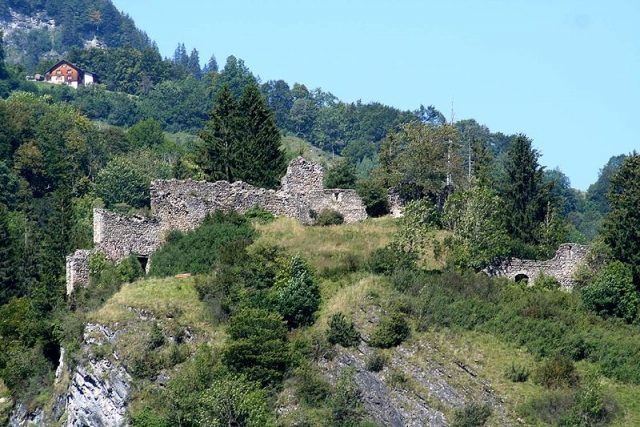
The ruins of Solavers Castle are located in the municipality of Seewis at the beginning of the Prättigau valley in the Swiss canton of Graubünden. The ruins of the former church castle of Solavers lie just above Seewis-Schmitten and Grüsch on a rocky outcrop.
The most impressive remnant of the defensive complex is the 57-meter-long wall, which stretched across the entire hilltop and secured the castle to the north. Near the gate, where an attack would have been particularly fierce, the wall has a thickness of 1.6 meters; at its highest point, it is only 60 centimeters thick. Mortar joints show that the wall was extended and raised several times. Two walled-up openings several meters high presumably led to wooden oriels that served for defense.
From the bottom of the northern cut, the path leads up to the current wide gate, whose jamb stones have been removed. The gate was added later, presumably to allow for a more convenient connection to the feudal residential wing. The original and now walled-up entrance was about 15 meters further east in a less accessible location. The wall was equipped with a wooden battlement that sloped down in steps to the west.
Immediately behind the wall, at the highest point of the hill, stood a church dedicated to the Virgin Mary, whose oldest part, the nave, dates back to the Romanesque period. The angular choir with its Gothic windows dates from the 15th century.
The feudal buildings stood in the lower-lying south of the complex. Barely visible are faint traces of a square tower with sides of almost 12 meters, parts of a residential wing with pointed arch windows, and a 21-meter-long remnant of the south wall. Only sparse remains of a curtain wall that surrounded the entire plateau are still present.
Written records about the origin of Solavers Castle only begin in the 14th century. The church's Marian patronage and its function as the mother church of Seewis and Fanas suggest an early medieval construction period for the church.
When and by whom the church castle was converted into a feudal castle cannot be said with certainty. In the 13th century, the castle came into the possession of Ulrich von Aspermont, under whom it became a center of power in the lower Prättigau. The Prättigau inheritance and thus the Solavers complex of the Aspermont family passed to the Counts of Toggenburg in 1344 during a division of property; they also occasionally resided in the castle. The last Toggenburg, Friedrich VII, is even said to have been born in the castle around 1370. In the same year, the Marienkirche of Solavers is mentioned for the first time.
After the death of the last Toggenburg, Friedrich VII, in 1436, Solavers passed, after various inheritance disputes, first to Wilhelm von Montfort-Tettnang and Heinrich von Sax-Misox. After several changes of ownership, Count Hugo von Werdenberg sold Solavers to Sigmund of Austria: "...together with the enclosed Pellfort, Strassberg and other castles..."
After the Prättigau converted to the Reformed faith, the Church of Our Lady of Solavers was probably abandoned.
The church, however, remained in operation until the late Middle Ages and appears again in documents in 1487. However, it only appears as a filial church of the new church of Seewis, which was easier to reach.
Take Mobile History with you
You are reading this text for free. Premium adds what matters on the road: descriptions read aloud, sites found through your camera, whole regions taken offline.
- Every description, including the ~17,700 Premium sites
- Audio guide: have descriptions read to you on location
- AR finder: see sites through your camera, with distance and bearing
- Unlimited saved sites
14 days free, then from €2.99 a month. Cancel anytime.
Source: Wikipedia · Licence: CC BY-SA 4.0
This description draws on the facts documented in the linked Wikipedia article; Wikipedia content is licensed under CC BY-SA 4.0. Wording and editing: Mobile History.
Location: 46.9833, 9.6444