The remains of the Castle can be visited
RuinSiegenstein
Siegenstein Castle (Ruin)
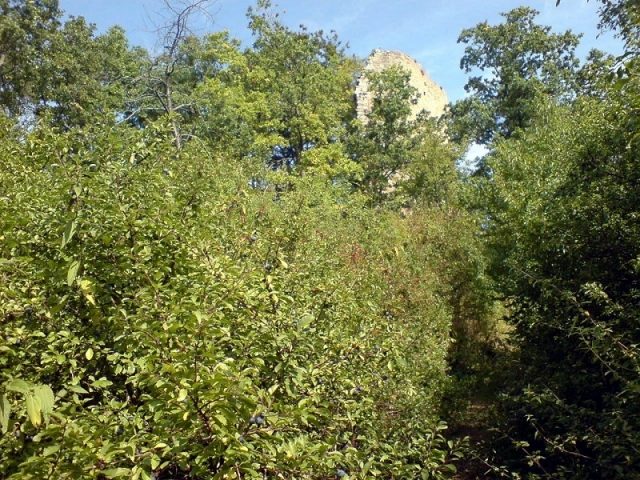
The castle ruin of Siegenstein is located on the edge of the village of the same name, which today belongs to the municipality of Wald in the district of Cham in Bavaria.
It is a trapezoidal castle complex from the 13th century, situated on a 546-meter high granite hill in the Bavarian Forest, steeply sloping to the north.
Preserved from the former hilltop castle are towering wall remains on the densely wooded castle hill in the south and in the northeast corner of the castle, faced with granite ashlar, in places also with bossed ashlar and rubble masonry. Also recognizable are the former rampart-ditch system and the remains of a curtain wall, as well as the transition between the castle and the former outer bailey.
From the 14th century, the Siegenstein estate also included the two-kilometer distant district of Schönfeld with a farm and the Romanesque church of St. Aegidius from the 12th century.
According to tradition, the origins of Siegenstein date back approximately 900 years. When Bavaria was divided in 1255, Siegenstein, with the then Burgraviate of Regensburg, fell to Duke Ludwig II of Bavaria. He, as documented, gifted it with all rights in 1282 to the episcopal prince-bishopric of Regensburg under Bishop Heinrich II of Regensburg. Bishop Heinrich, in turn, enfeoffed Konrad von Erenfels with Siegenstein Castle. In 1320, Dietrich von der Au came into possession of the fortress, followed in 1329 by Friedrich Hauzendorfer as administrator. Friedrich der Auer von Brennberg returned the Siegenstein property to the Regensburg Cathedral Chapter in 1353 with all goods and the tithe. The bishops later pledged Siegenstein to the Dukes of Bavaria, from where it subsequently fell to the Prackendorfer and Teuffel families, but remained in the pledged possession of the Prackendorfer until 1606. Bishop Wolfgang II then redeemed the lordship again. Already at the beginning of the 16th century, the castle had become so dilapidated that the Prackenbacher moved to their seat in Wulkersdorf; by 1606, the complex was already in ruins.
Castle Chapel+
The castle chapel was built in the 13th century east of the castle hill in the area of the so-called outer bailey, whose rampart-ditch system is still recognizable today, and dedicated to Saints Lawrence and George. In 1353, it was assigned to the Frauenzell monastery, and the last exterior renovation took place in 1974.
It is a plastered rubble stone building with Romanesque and Gothic elements, e.g., hewn corner ashlar and narrow pointed arch windows. Inside, there is a semicircular apse with a chamfered chancel arch, and the nave has a plank ceiling. The 17th-century altar structure features fluted columns and figures of Saints Hedwig and Lawrence. A shingle-covered roof turret from the 17th century sits on the roof.
Take Mobile History with you
You are reading this text for free. Premium adds what matters on the road: descriptions read aloud, sites found through your camera, whole regions taken offline.
- Every description, including the ~17,700 Premium sites
- Audio guide: have descriptions read to you on location
- AR finder: see sites through your camera, with distance and bearing
- Unlimited saved sites
14 days free, then from €2.99 a month. Cancel anytime.
Source: Wikipedia · Licence: CC BY-SA 4.0
This description draws on the facts documented in the linked Wikipedia article; Wikipedia content is licensed under CC BY-SA 4.0. Wording and editing: Mobile History.
Location: 49.0935, 12.3563