The remains of the Castle can be visited
RuinSchiltach
Schiltach Castle (Ruin)
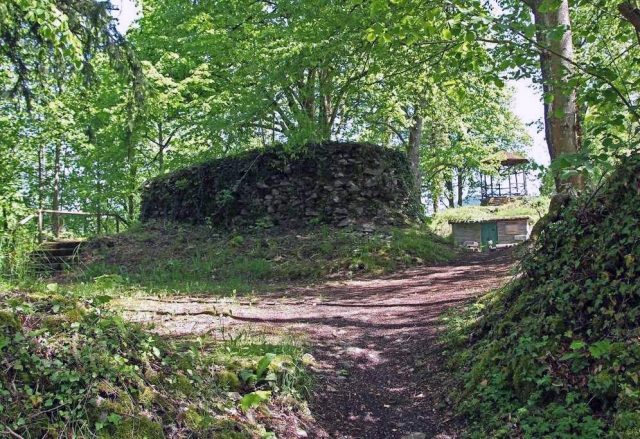
Schiltach Castle, also known as Landsehr or Hohe Landesehr, is a castle ruin above the town of Schiltach in the Black Forest in the district of Rottweil in Baden-Württemberg, Germany.
The exact origin of the hilltop castle is unclear; it was probably built together with the town of Schiltach below it before 1250 by the Dukes of Teck. The aim was to create a supply center with the town, which was defended, administered, and also ruled from the castle.
Schiltach Castle was presumably also part of a defensive line of the Dukes of Teck for monitoring and securing the Schiltach valley, together with Klingenburg Castle and Schilteck Castle.
Through inheritance, the castle and town came to the nephew of the deceased Hermann von Teck, Konrad von Urslingen, in 1371.
In 1381, the Urslingers sold the castle to the Counts of Württemberg.
Since Schiltach was an outpost of Württemberg, the castle had to serve for national defense and constantly housed troops. After 1700, the castle, sometimes also called Schloss or Feste Hohe Landesehr, became increasingly dilapidated due to constant troop quartering. In 1733, it was repaired by the Swabian Circle.
However, in 1747, urgent repairs were again reported to the office in Hornberg. Since peace had now returned and the castle was no longer needed, the Duke ultimately agreed to the demolition of all usable building materials from the castle and their sale.
From 1749, wood, windows, ovens, and doors were removed and auctioned off. In 1760, further auctions of bricks and woodwork took place. However, nothing was allowed to be changed on the masonry. The proceeds from the 1760 auction were used to repair the castle tower and the customs house.
The town fire of 1791 led citizens to break stones from the castle walls to rebuild their houses. Due to accidents during stone breaking, the castle walls were removed down to the window openings in 1805.
Having come to the state of Baden in 1810, the Water and Road Construction Inspectorate Offenburg opposed further demolition of the castle. However, when another section of the wall collapsed in 1826, the domain administration in St. Georgen decided to report to the Grand Duke that demolition was urgently needed.
The Grand Duke agreed, and the castle ruin was demolished from 1829 to 1830, leaving only the foundations and a few wall remnants, especially on the south side.
Layout+
Worth seeing is the wooden bridge over the neck ditch to the castle, where the drawbridge once stood, with a beautiful view over the old town of Schiltach. On the castle grounds, benches within the wall remnants invite visitors to rest.
A reconstruction of the castle is on display in the museum at the market square.
Take Mobile History with you
You are reading this text for free. Premium adds what matters on the road: descriptions read aloud, sites found through your camera, whole regions taken offline.
- Every description, including the ~17,700 Premium sites
- Audio guide: have descriptions read to you on location
- AR finder: see sites through your camera, with distance and bearing
- Unlimited saved sites
14 days free, then from €2.99 a month. Cancel anytime.
Source: Wikipedia · Licence: CC BY-SA 4.0
This description draws on the facts documented in the linked Wikipedia article; Wikipedia content is licensed under CC BY-SA 4.0. Wording and editing: Mobile History.
Location: 48.2880, 8.3441