The remains of the Castle can be visited
CastleSagogn
Schiedberg Castle (Ruin) (Sagogn)
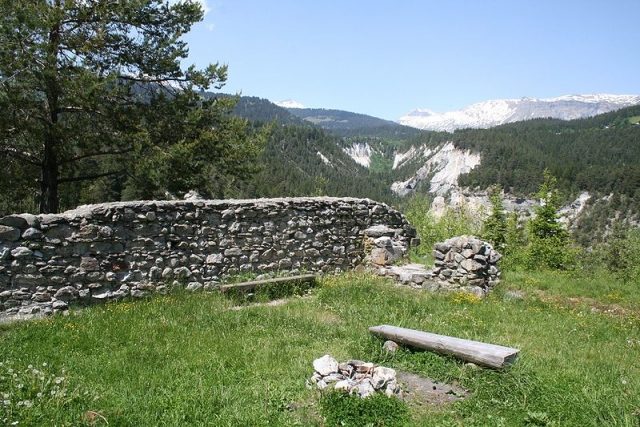
Schiedberg Castle is a ruin southeast of the village part Vitg Dado of the municipality of Sagogn in the Swiss canton of Graubünden.
Location+
The ruin is located on the Schiedberg, a gravel hill. The name Schiedberg only appeared around 1570. Locally, the hill was always called casti, and in Roman and early medieval times, castrum.
Layout+
The center of the elongated castle complex was a tower; various residential buildings stood along the southern curtain wall.
An emergency excavation in 1964 and further investigations in 1968 prove that the site was already settled in prehistoric and Roman times as well as in the early Middle Ages. The excavation findings (iron tools, kiln ceramics, non-ferrous metal, glass, bones) suggest that Schiedberg is identical to the castrum of Sagogn mentioned in Bishop Tello's will, where the family owned a stately stone house. West of Schiedberg, in Sagogn, was the center of power of the Victorids, to whom Tello belonged, in the 8th century. In his will, Tello bequeathed a manor house with appurtenances, farms, fields, meadows, vineyards, and alpine pastures to Disentis Monastery in 765. The estates were located in the inner village, in the farms around Sagogn, on Bregl da Heida, where a manor house and a Carolingian hall church dedicated to Saint Columban stood.
The construction of the noble castle took place around 1000; the complex was last expanded around 1250. The castle was the seat of the noble free lords of Sagogn; in 1137, Chuno de Sagannio, one of the first nobles of Churwalden, is mentioned.
After the extinction of the House of Sagogn-Wildenberg, the castle passed to the Counts of Werdenberg-Heiligenberg in 1320 through an inheritance.
The castle and lordship probably fell around 1352 in the war between the Lords of Belmont and those of Werdenberg (Belmont Feud). Other landowners were the monasteries of Disentis, St. Luzius and Churwalden, the Diocese of Chur, the Lords of Belmont and Montalt, as well as free farmers. After a fire in the second half of the 14th century, the castle was not rebuilt and began to decay. Today, the ruin is owned by the municipality of Sagogn.
Take Mobile History with you
You are reading this text for free. Premium adds what matters on the road: descriptions read aloud, sites found through your camera, whole regions taken offline.
- Every description, including the ~17,700 Premium sites
- Audio guide: have descriptions read to you on location
- AR finder: see sites through your camera, with distance and bearing
- Unlimited saved sites
14 days free, then from €2.99 a month. Cancel anytime.
Source: Wikipedia · Licence: CC BY-SA 4.0
This description draws on the facts documented in the linked Wikipedia article; Wikipedia content is licensed under CC BY-SA 4.0. Wording and editing: Mobile History.
Location: 46.7917, 9.2665