The remains of the Castle can be visited
RuinZierenberg
Schartenberg Castle (Ruin) (Zierenberg)
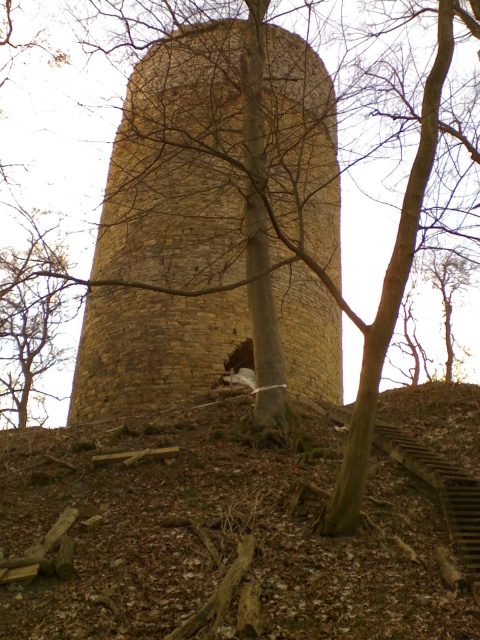
The castle ruin Schartenberg is located near Zierenberg in the district of Kassel in North Hesse. First mentioned in a document in 1124, Schartenberg Castle was described as abandoned and dilapidated in 1518. Parts of the keep and remnants of the neck ditch and walls are preserved. Access to the castle is currently prohibited due to the risk of collapse. The Groppeschloss once stood directly next to Schartenberg Castle.
The castle ruin is located in the northern part of the Habichtswald Nature Park, about 2.4 km north of Zierenberg, on a western mountain spur of the Schartenberg, between the valleys of the Nebelbeeke to the east and the Warme to the west.
A Saxon nobleman, probably at the beginning of the 11th century, after the rule of the Conradines in the Hessengau had ended, built a castle on the Schartenberg, which was first mentioned in 1020 as being in the possession of a certain Anna. Around 1089, Volkold von Malsburg inherited the castle; he was first documented in 1062 and named himself after his ancestral seat, the neighboring Malsburg Castle. Volkold's sons Volkold II and Udalrich pledged the castles of Malsburg and Schartenberg, inherited from their father, to Archbishop Adalbert I of Mainz as a fief in 1124. Volkold II had already moved to Nidda before 1100, where he succeeded his father as Fulda Vogt of the Fulda Mark and founded the family of the Counts of Nidda from the House of Malsburg.
Mainz enfeoffed the Counts of Dassel with Schartenberg Castle, where, however, a castellan named Stephan (Stefan), a scion of a lower noble family and obviously a relative of the Mainz castellans simultaneously stationed at Malsburg, was also in office. Stefan's descendants († around 1180?) were in actual possession of the castle until the end of the 14th century and therefore called themselves "von Schartenberg". The relatives at Malsburg accordingly called themselves von der Malsburg at least since 1143. A smaller castle located on the Schartenberg was given as a fief to the Lords Groppe von Gudenberg.
At the beginning of the 13th century, a bloody and years-long feud, probably triggered by inheritance disputes, broke out within the Schartenberg family, in which the other noble families of the region were also involved. It was not until 1213 that the liege lord, Archbishop Siegfried II of Mainz, managed to end the feud at a day of atonement in Fritzlar.
Albert von Schartenberg became known in the service of Bishop Simon of Paderborn, who bought the castle from Count Ludolf V of Dassel in 1267 or 1268. However, the Archbishop of Mainz, Werner von Eppstein, opposed this transfer of ownership of the Mainz fief castle. An agreement was reached only in 1279: Archbishop Werner transferred one half of the castle as a fief to Simon's successor on the Paderborn episcopal see, Otto von Rietberg, but kept the other half in Mainz possession.
One of his successors, Archbishop Gerhard II von Eppstein, gave the Mainz half in 1294 as a fief and wedding gift to Elisabeth ("the Middle") (1276–1306), a daughter of Landgrave Heinrich I of Hesse, on the occasion of her marriage to Count Gerhard V von Eppstein. The marriage remained childless, and this half fell back to Landgrave Johann of Hesse, Elisabeth's brother, in 1307 as per contract. Johann died in 1311, and Archbishop Matthias von Buchegg demanded in 1325 from Johann's half-brother and heir Otto I of Hesse, among other things, Schartenberg Castle as an escheated fief. This demand proved meaningless, as Matthias suffered a devastating defeat in his long feud with Otto in 1328 near Wetzlar after initial military successes and had to give in through the mediation of King John of Bohemia.
After 1307, the castle was pledged for a longer period to a castellan family von Hertingshausen, who then called themselves von Schartenberg. Stefan von Schartenberg, who was involved as a vassal of Landgrave Heinrich the Iron in the breaking of the formerly Mainz castle Haldessen near Grebenstein, was known from this family. He died childless around 1375. The last of this family, Hermann, a close relative of the von Malsburg and von Dalwigk families at Schauenburg, sold his share of the castle to Landgrave Hermann II of Hesse and died in 1382 or 1383. Hesse then held both halves of the double castle as fiefs, one half from Kurmainz, the other from Paderborn, but the Mainz archdiocese was no longer able to enforce its feudal sovereignty. The Landgraves assigned the castle to their officials as a residence or pledged it with the court of the same name, including to Reinhard IV von Dalwigk, Johann Spiegel, Dietrich von Schachten, and Hermann von der Malsburg.
In the final phase of the struggles between the Archbishopric of Mainz and the Landgraviate of Hesse for supremacy in Lower and Upper Hesse, fighting took place in front of the castle. Led by Johann Spiegel, the then Mainz bailiff at Schöneberg Castle near Hofgeismar, a group of Mainz vassals and armed men from the Mainz city of Hofgeismar plundered the area around Grebenstein and the Diemel valley for several days in November 1424. Afterwards, the group appeared at night in front of Schartenberg Castle, whose garrison, however, repelled them. Instead of the castle, the economic facilities in the foreground and probably also the nearby village of Rangen were destroyed, and the village of Fürstenwald was set on fire. This prompted Landgrave Ludwig I to act, who soon after appeared before Hofgeismar, shelled the city, and in turn devastated the surrounding area.
Only three years later, in 1427, after Ludwig's decisive victories in the Mainz-Hessian War in July near Fritzlar and in August near Fulda against Archbishop Konrad of Mainz, Schartenberg Castle became Hessian.
The castle played a warlike role for the last time when the then bailiff Heinrich von Boineburg contributed twelve wagons for the transport of supplies in 1476 during the Landgrave's campaign against the Electorate of Cologne city of Volkmarsen.
The condition of the castle was no longer good, and in 1490 Landgrave Wilhelm I instructed the then pledge holder Dietrich von Schachten to have repairs carried out for 200 guilders. Whether this still happened is not known, but already in 1518 the castle was described as abandoned and dilapidated. It was in the possession of the Lords von der Malsburg in 1519/1521, but was left to decay. The ruin was not suitable for use as a quarry, because the limestone ashlar quickly broke into rubble when attempts were made to dismantle it. The destruction occurred through natural decay.
Description of the Castle Ruin+
Of the Schartenberg castle ruin, which stands on one of the steepest parts of the western slope of the Schartenberg, the keep is the only clearly visible relic preserved. In summer it cannot be seen; only in winter, when the surrounding trees have no leaves, can its position be guessed. Access to the complex is currently prohibited due to the risk of collapse.
The keep itself is round and relatively high, with a diameter of up to 8.5 m. On the western edge, it has collapsed by about half on the weather side. No loose rubble material is visible. The walls, up to 3 m wide at the base, taper significantly upwards floor by floor. At the end of the 19th century, a tunnel was broken into the base of the tower. This tunnel is narrow and also at risk of collapse. Inside the tunnel, supports and holes for beams and intermediate floors can be seen as remnants of the installations. The broken parts of the tower were overgrown for a long time. In the summer of 2006, extensive restoration work began on the main tower to secure the walls. The walls are built from locally available limestone, the color of which varies from fiery red to creamy white.
The base of the keep forms the highest point of the complex. To the west is a step, bordered by only faintly recognizable and overgrown limestone wall remnants. It probably formed the – or one (?) – castle courtyard. The original outer wall is only recognizable in its beginnings, which cannot be seen from the inside. From the outside, that is, from below, as the mountain slopes very steeply, they appear about one to in places two meters high.
To the north, a deep ditch separates the keep part of the castle from the northern part, the so-called Groppeschloss. To the northwest, two terraces adjoin, which are to be interpreted as parts of this castle. At their edge, the mountain slopes steeply down to the Warmetal. In this northern part of the castle, only minor wall remnants are preserved, while the shape of the mountain shows clear traces of human shaping.
Take Mobile History with you
You are reading this text for free. Premium adds what matters on the road: descriptions read aloud, sites found through your camera, whole regions taken offline.
- Every description, including the ~17,700 Premium sites
- Audio guide: have descriptions read to you on location
- AR finder: see sites through your camera, with distance and bearing
- Unlimited saved sites
14 days free, then from €2.99 a month. Cancel anytime.
Source: Wikipedia · Licence: CC BY-SA 4.0
This description draws on the facts documented in the linked Wikipedia article; Wikipedia content is licensed under CC BY-SA 4.0. Wording and editing: Mobile History.
Location: 51.3909, 9.3081