The remains of the Castle can be visited
RuinLaufen
Schalksburg Castle (Ruin)
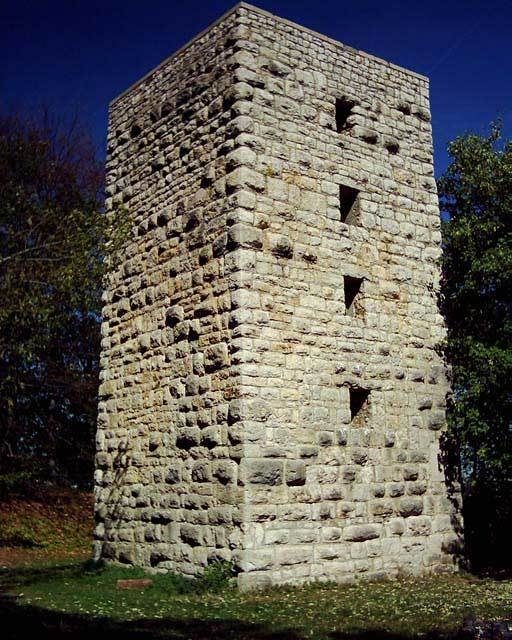
The Schalksburg (formerly also Schaltzburg or Schalksberg) is a former hilltop castle, the ruins of which are located about six kilometers southeast of Balingen between the Albstadt districts of Burgfelden and Laufen an der Eyach.
The castle is situated on the outermost tip of the Steinberg and a 20-minute walk southwest of Burgfelden, which is one of the highest-lying communities in the Swabian Alb. Burgfelden derives its name from the Schalksburg. The village's coat of arms shows the symbolized castle as a dividing line, and the shield colors show the black and white of the Zollern lords of the castle.
The Schalksburg was a castle of the Zollern family and was temporarily the seat of the Zollern-Schalksburg branch of the noble family.
The first traces of settlement date back to the Bronze and La Tène periods. Pottery finds from the Middle Bronze Age, with finds also from the Urnfield period (Late Bronze Age), from the Hallstatt and La Tène periods (Iron Age) and the Roman period were made at the Schalksburg.
In the St. Michael's Church in Burgfelden, there are Romanesque frescoes from the 11th century. Burgfelden was first mentioned in a document in 1064 as Burchveld. The first foundations and grave finds of St. Michael date from the late Merovingian period at the beginning of the 8th century.
The village probably emerged from an ancient noble seat from the 7th century. Although the castle complex dates from the year 1100 and the first documented mentions of the Schalksburg are only found by Count Friedrich V in 1266, it is presumed that fortifications were already present at the site of the castle complex before the year 900.
After the division of the Hohenzollern line in 1288, Friedrich I, known as the Younger († 1308), took up residence in the castle. In the 14th century, the Schalksburg was referred to as a palace and, with an area of three hectares, represented a mighty complex.
In 1403, the lordship of Schalksburg, with the city of Balingen and 17 other localities, including Onstmettingen, was sold by Count Friedrich V of Zollern-Schalksburg after the death of his only son for 28,000 guilders to Count Eberhard III († 1417) of Württemberg. The line of the Counts of Zollern-Schalksburg died out with the death of Friedrich V of Zollern-Schalksburg in 1408.
This transfer of power to the Württembergers is recounted in the legend of the Hirschgulden, which was recorded by Gustav Schwab and Wilhelm Hauff – according to the legend, however, only a single gulden was paid.
In 1464, the Schalksburg was destroyed by Count Jos Niklas I of Zollern during a feud with Hans von Rechberg on behalf of Württemberg. In 1465, it was rebuilt.
During the German Peasants' War (1524–1526), farmers from Pfeffingen and Dürrwangen besieged and captured the Schalksburg. In 1557, the castle was demolished due to dilapidation; in 1624, the castle was only referred to as a castle site.
From 1957–1960, an observation tower was erected on the remains of the medieval keep with the help of helicopters from the American army.
From the edge of the Albtrauf, there is a magnificent view over the Alb foreland, the Eyach valley, and the Balingen mountains.
Take Mobile History with you
You are reading this text for free. Premium adds what matters on the road: descriptions read aloud, sites found through your camera, whole regions taken offline.
- Every description, including the ~17,700 Premium sites
- Audio guide: have descriptions read to you on location
- AR finder: see sites through your camera, with distance and bearing
- Unlimited saved sites
14 days free, then from €2.99 a month. Cancel anytime.
Source: Wikipedia · Licence: CC BY-SA 4.0
This description draws on the facts documented in the linked Wikipedia article; Wikipedia content is licensed under CC BY-SA 4.0. Wording and editing: Mobile History.
Location: 48.2344, 8.9200